
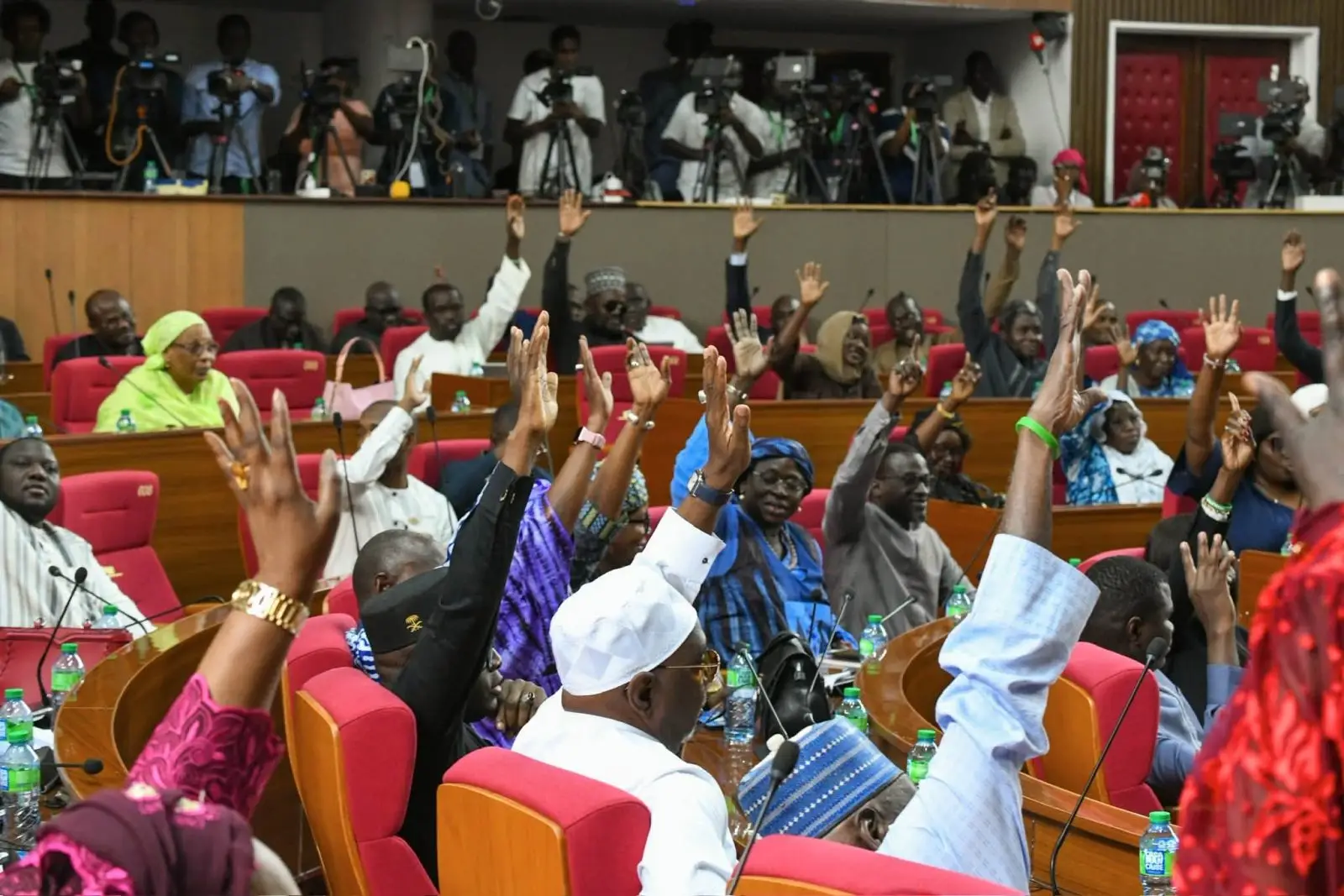
Decree implementing the LFR: the National Assembly adopts a resolution to defend the authority of its vote
The National Assembly adopted, on Wednesday, November 25, 2026, a proposed resolution relating to the presidential decree having brought into force the draft amending finance law (LFR) 2026, although rejected by the deputies on November 3. Through this text, parliamentarians intend to raise questions about the institutional and legal consequences of this decision and the responsibilities linked to its execution.
The rejection of the 2026 amended finance bill (LFR) by the National Assembly has not closed the debate on its application. Meeting in plenary session on Wednesday, the deputies adopted a proposed resolution relating to decree no. 2026-2416 of November 19, 2026 bringing this bill into force.
Presenting the text on behalf of the PASTEF Les Patriotes parliamentary group, its author, MP Mohamed Ayib Salim Daffé, highlighted a central question: that of the authority of the parliamentary vote in the face of the decision to put into force a bill explicitly rejected by the national representation.
The meaning of the parliamentary vote at the heart of the debate
For Mohamed Ayib Salim Daffé, this implementation raises questions about respect for the constitutional prerogatives of the National Assembly. The deputy notably contested the interpretation of articles 68, paragraphs 3 and 5, of the Constitution, as well as article 57, paragraph 2, of the organic law relating to finance laws, invoked to justify the presidential decree.
According to his argument, the subsidiary procedure provided for to ensure the budgetary continuity of the State cannot be used to bring back into force a text which has already been the subject of an explicit rejection by the deputies. The issue thus goes beyond the sole question of the execution of the amending budget: it concerns the scope of the parliamentary vote and the balance between the institutions.
Responsibilities linked to budget execution
The plenary debates also addressed the practical consequences of this situation. The discussions focused in particular on the responsibilities likely to fall on government authorities, expenditure authorizers and public accountants responsible for budget execution.
The question also concerns Senegal’s technical and financial partners, in particular the International Monetary Fund (IMF). The adopted text thus intends to draw attention to the implications that this situation could have for the various actors involved in the management of public finances.
Through this resolution, the National Assembly intends to reaffirm the authority of its decisions, the principle of separation of powers and its constitutional prerogatives in budgetary matters. The debate around the LFR 2026 thus takes on an institutional dimension, beyond its financial content.
