
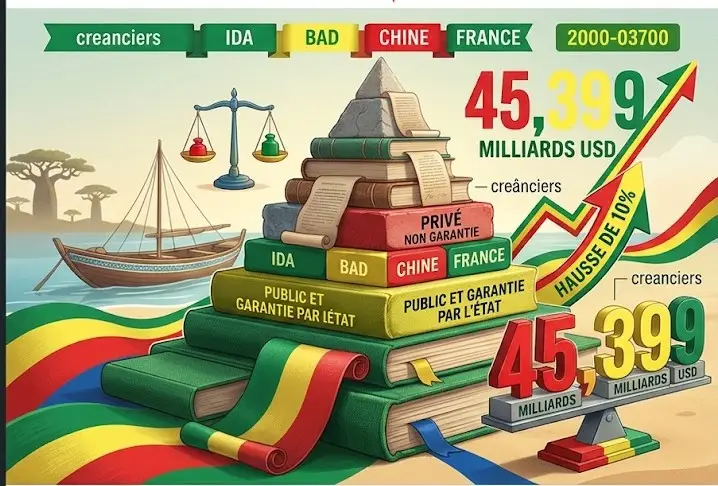
Senegal external debt: $45.399 billion recorded in 2025
In Senegal, the total outstanding external debt reached $45.399 billion in 2025, or more than 26,531 billion CFA francs. This represents an increase of 10% compared to 2024. This is what reveals the World Bank Group’s 2026 International Debt Report released on Thursday, November 5, 2026.
Senegal’s total outstanding external debt is estimated at $45.399 billion in 2025, or more than 26,531 billion CFA francs, an increase of 10% compared to 2024. According to the World Bank Group’s 2026 International Debt Report published on November 5, 2026, it has more than quadrupled since 2015, when it stood to 10,470 million.
Analysis of the tables of this debt shows that the curve progresses almost continuously, with a slight decline around 2023-2024 before the recovery in 2025. Thus, concerning the structure by debtor, the document underlines that the debt is divided into three main categories.
Also read: External debt of developing countries: a record amount of $9.4 trillion in 2025
It should be noted that the weight of unsecured private debt is notable. It does not benefit from the State guarantee, but weighs on the country’s overall external position.
It is also urgent to note that, from World Bank data, the structure by type of creditor on public and guaranteed debt emerges in three categories. For multilateral creditors, the amount is approximately $13.287 billion, or 45%. Regarding private and bilateral creditors, Senegal owes them $11.108 billion and $5.193 billion respectively.
On the list of multilateral creditors, the World Bank through IDA is the first creditor with 5.186 billion dollars, followed by the African Development Bank (AfDB) with 2.135 billion dollars and other multilateral institutions which accumulate 5.967 billion dollars of these claims.
Compared to bilaterals, the report indicates that China comes first with 2.086 billion dollars, ahead of France to whom Senegal owes 1.611 billion dollars and the other bilateral creditors who lent 1.497 billion to the Senegalese state.
Nearly 38% of public debt owed to private creditors
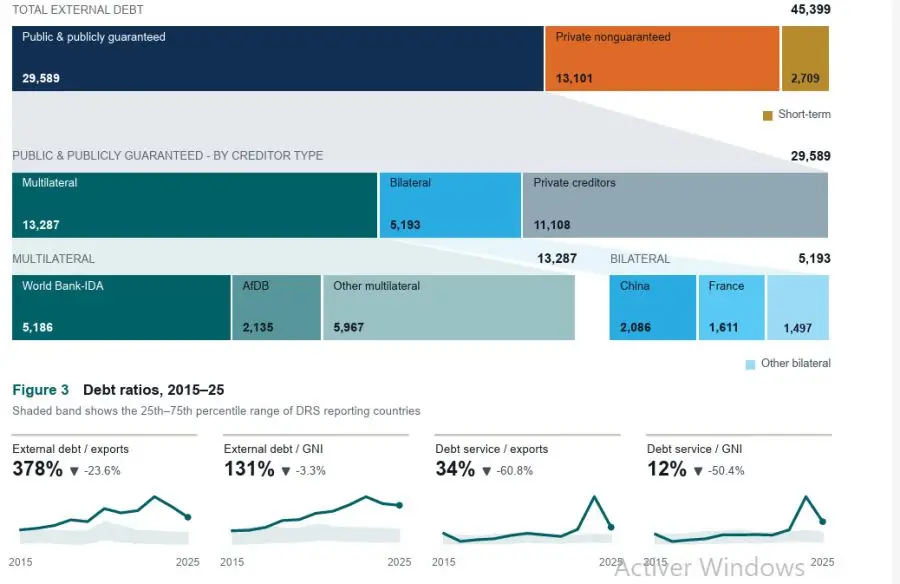
The graphs also show that these ratios have increased over the decade, with a marked peak in debt service before a sharp decline in 2025. The level, however, remains well above the interquartile range which lies between 25 and 75% of reporting countries, represented by the gray band. Senegal is therefore among the most indebted countries in the sample.
On the conditions of new commitments in 2025, the World Bank informs that for official creditors, new commitments have an average maturity of 13 years; a grace period of 4 years and an interest rate of 3.0%.
Mariama DIEME
