
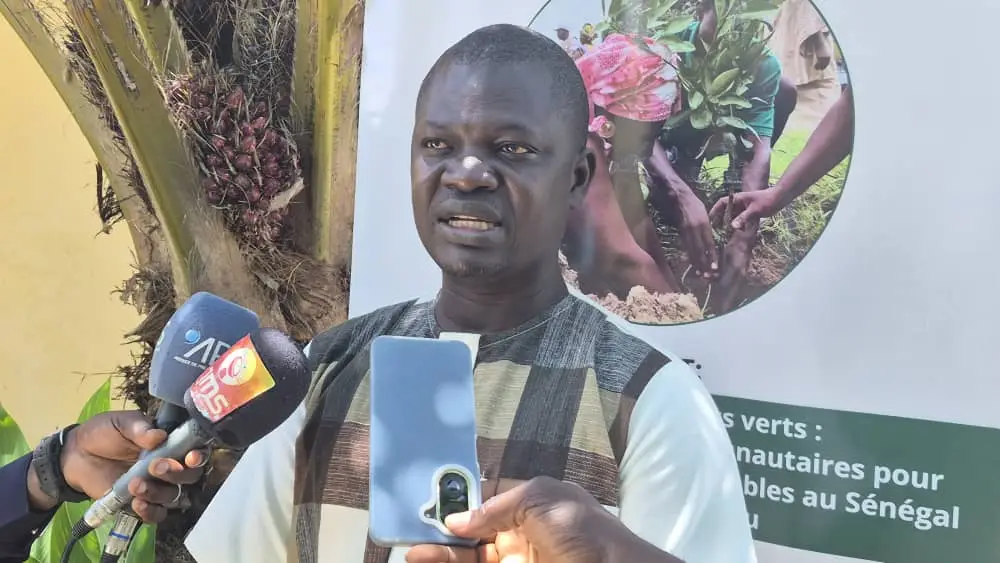
Protection of natural resources: the “Building Green Bridges” project launched to save land
Faced with the accelerated degradation of natural resources, a new project wants to make agroecology a lever of resilience between Senegal and Guinea-Bissau. Launched this Tuesday, September 8, the “Building Green Bridges” initiative aims to restore ecosystems, strengthen communities and stimulate economic exchanges on both sides of the border.
ZIGUINCHOR – The earth is depleting, biodiversity is declining and salt is gradually gaining ground. In Casamance as in Guinea-Bissau, it is said, the increasing pressure exerted on natural resources is weakening agricultural activities and threatening the balances that support rural communities.
It is in this context that the “Building Green Bridges” project was born. It intends to open a new path, based on the restoration of resources and the promotion of more sustainable agriculture. Supported by a consortium bringing together Enda Tiers Monde, “Usoforal” in Ziguinchor and Kafo in Guinea-Bissau, the initiative will take place in Senegal, particularly in the municipalities of Kataba 1, Kafountine, Niamone and Oulampane, as well as in Oyo and other Guinea-Bissau municipalities.
For Jean-Michel Wally Sène, executive secretary of Enda Tiers Monde and member of the consortium, the project is based on a straightforward observation. “Our natural resources are under strong pressure which is leading to the salinization of the land, the decline in its fertility and a worrying decline in biodiversity. Added to this is the weakness of governance mechanisms at the village level and between communities, which accentuates the fragility of our agriculture,” he analyzed.
The ambition is now to bring together existing initiatives and act as close as possible to the territories. “Building green bridges is a new dynamic that we want to bring into synergy and complementarity with the projects already present in Casamance and Guinea-Bissau. Through this cooperation, we also want to contribute to strengthening economic ties between the two States,” explained Mr. Sène.
At the heart of the system, agroecology must make it possible to reconnect with more responsible management of resources. “We must change the way we manage natural resources and promote effective agroecological practices, capable of sustainably improving the living conditions of populations,” he insisted.
From farmer seed to processing, the project also wants to act across the entire chain. “We must strengthen local governance bodies and support grassroots communities. In the departments of Oussouye, Bignona and Ziguinchor, the degradation of biodiversity is already very advanced. We therefore want to promote agroecological agriculture, from the production of peasant seeds to the valorization of products, with the modernization of agricultural equipment,” he continued.
In the targeted communities, the initiative is seen as an opportunity. Mayor of Oulampane, Sagar Coly believes that the project can provide a concrete response to the needs of our communities in terms of sustainable management of natural resources. “Above all, we need awareness and support to preserve this heritage,” said the elected official.
Women and young people also occupy a central place in this new dynamic. President of the women’s federation of the commune of Niamone, Yaye Ami Konté indicates that this initiative is a real opportunity to strengthen the capacities of women, improve their income and better equip them. “Young people and women, who are among the main beneficiaries, will thus be able to further promote their activities,” she said.
Beyond borders, “Building Green Bridges” therefore aims to build a space of cooperation where land protection, community empowerment and economic development advance together. In Casamance as in Guinea-Bissau, the challenge is clear: restore resources today to preserve means of subsistence tomorrow.
