
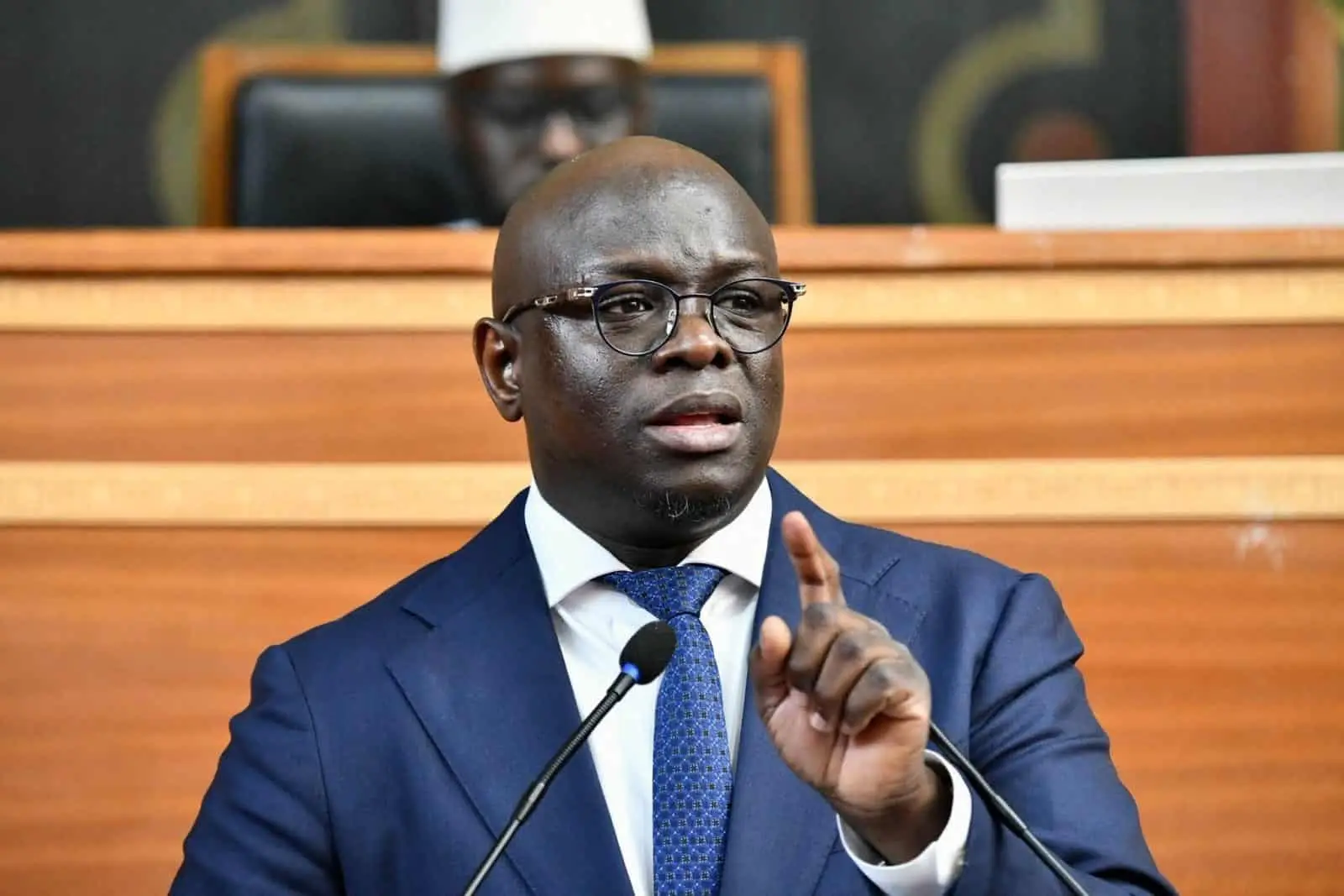
PLFI 2027 exam: Cheikh Diba: “A budget cannot be judged by its intentions”
A budget is not judged by its intentions but rather by what it changes in the lives of people and the confidence it inspires. This was underlined on Saturday by the Minister of Economy, Finance and Planning, Cheikh Diba, during the parliamentary session devoted to the draft Initial Finance Law (PLFI) 2027, presented in committee to the National Assembly.
Financing Senegal’s socio-economic priorities, without increasing the debt, requires, according to the Minister of Economy, Finance and Planning, Cheikh Diba, to mobilize more own resources and spend differently.
“Our domestic revenues excluding hydrocarbons will increase by 5.8% in 2027. This projection is deliberately conservative, the tax potential being higher in reality. But we have learned the lessons of 2026. We refuse to include revenue in the budget that we are not sure we will be able to recover,” he noted.
Thus, for the year 2027, the government’s ambition is clear: “to broaden the tax base, ensure a fairer contribution from everyone and better fight fraud, without placing a burden on taxpayers who already respect their obligations”.
The year 2027 will also be marked, according to the minister, by the planned entry into force of the new General Tax Code and the new Customs Code. These two major reforms will modernize the Senegalese tax and customs system, simplify taxpayers’ obligations and strengthen the efficiency of collection.
“A budget cannot be judged by its intentions. It is judged by what changes it makes in the lives of populations and the confidence it inspires,” he argued in committee during the presentation of the Initial Finance Bill 2027 to the National Assembly.
480 billion to revive the economy
When discussing priorities, Minister Cheikh Diba highlighted a measure that businesses have been waiting for for a long time. In this regard, he noted that the 2027 budget devotes 480 billion FCFA to settling arrears owed to the private sector. In total, between 2025 and 2027, the State will have cleared the debt owed to the private sector to the tune of 1,280 billion.
“With the accumulation of arrears, there are SMEs that have delivered to the State and are waiting to be paid. There are employees whose jobs are threatened. There are banks that are reluctant to lend. Paying what the State owes means putting cash back into the real economy. It’s reviving private investment. It’s about preserving jobs. These payments will be made according to objective criteria and in complete transparency. And we are committed to no longer accumulating new arrears,” he said.
Also read: Budget 2027: Expenditure projected at 7,363 billion FCFA
Thus, with the reform of the parapublic sector, believes the Minister in charge of Planning, the government is changing the strategy of the State shareholder, generalized performance contracts, with reliable financial information and the restructuring of companies in difficulty.
“SONACOS, SODEFITEX, SAED, SODAGRI and Air Sénégal will be restructured to reduce their dependence on subsidies. Public money must produce results, not compensate for losses. As such, a recovery fund was specifically created in the form of a CST to sustainably address the problem of companies in difficulty. It was allocated 22 billion,” he said.
Moreover, Cheikh Diba reported that the government has initiated a major reform of debt management with the creation of the General Directorate of Financing and Debt and the programming and execution of all expenditure financed with external resources through the public expenditure management application, “SYSBUDGEP”.
“Each franc borrowed will be recorded, monitored and justified”
“Concretely, no loans and no donations can no longer be executed outside the budgetary circuit. Each franc borrowed will be recorded, monitored and justified. This is the guarantee of real control of debt. It is a guarantee of the traceability of each franc and the credibility of our public finances,” he said.
In the same wake, he notes, all transfers for the benefit of non-personalized state services are eliminated. None of its services can no longer execute its expenses through a deposit account. Annex XIII of this law concerns transfers for the benefit of third parties whose administrative phase of the expenditure is carried out by the SNPEs listed therein.
General budget revenue reaches 5,653.9 billion FCFA
“I conclude with the key figures of this project, because they are the ones which commit: general budget revenue reaches 5,653.9 billion FCFA; expenditure amounts to 7,005.6 billion FCFA; the deficit is reduced to 1,351.7 billion FCFA, or 4.7% of GDP; the primary deficit is reduced to 0.2% of GDP,” he told the Finance and Budgetary Control Committee of the National Assembly.
Having presented the figures and ambitions of the PLFI 2027, the minister indicated that the 2027 budget fully meets the requirement for rigor, sincerity and transparency. He thus invites the deputies to examine it, and to place their trust in it, in the service of Senegal and the Senegalese.
“By voting this budget, you are not simply validating an accounting balance, but above all you are validating a national commitment, that of restoring confidence, releasing productive energies and building a common, just and united future,” he concluded.
Mariama DIEME
