
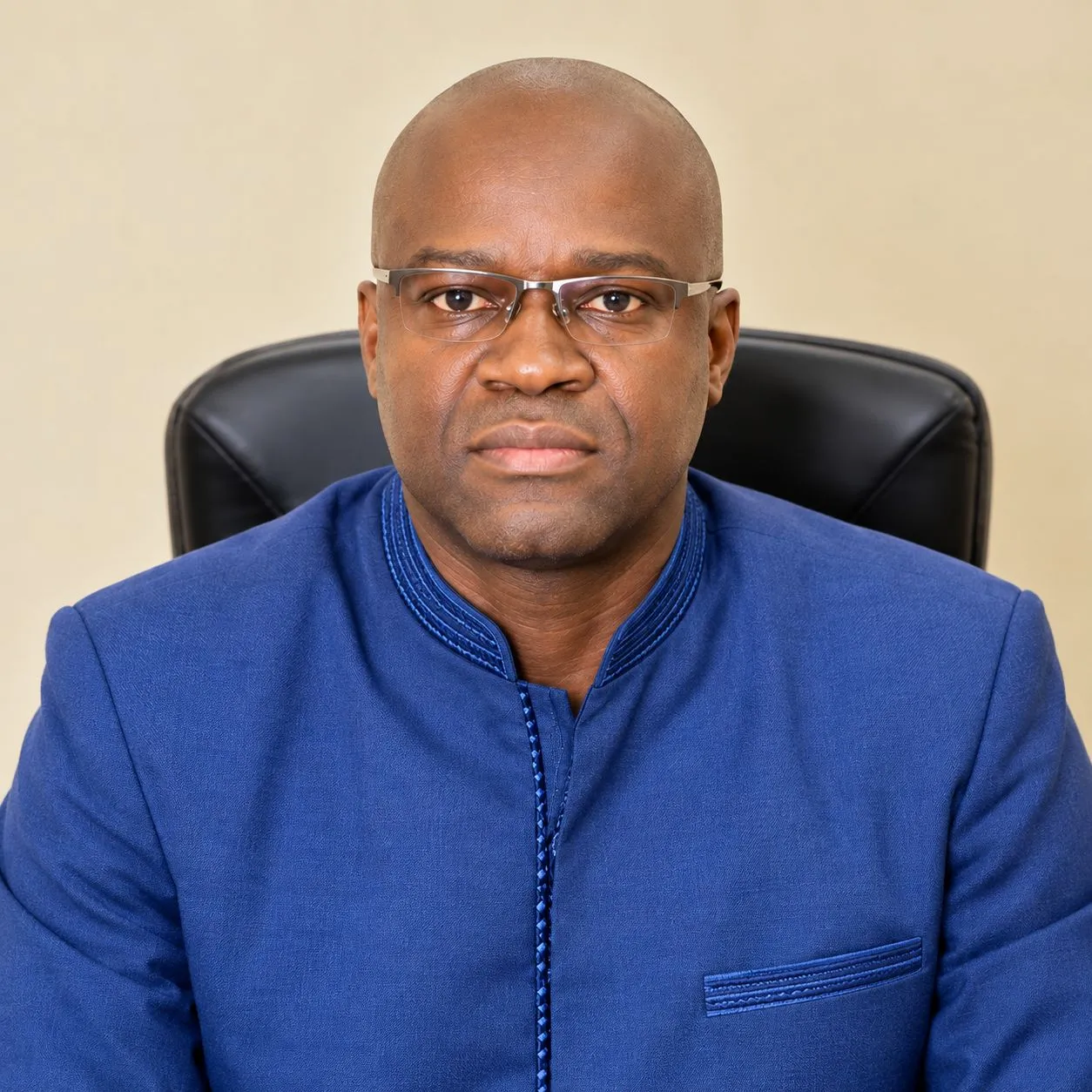
Professor François Joseph Cabral, Rector of the University of Eastern Senegal: “On an educational level, we are ready”
At the University of Eastern Senegal (Uso), officials are ready to welcome its first students. The assurance is from the Rector, Professor François Joseph Cabral. He affirmed that the teaching and research staff (Per) are eager to start educational activities.
Mr. Rector, can you give us a brief presentation of the University of Eastern Senegal (Uso)?
To have a brief idea of the University of Eastern Senegal (Uso), we must first refer to the decree establishing its creation. It was signed on December 22, 2022 and published in the Official Journal. It is specified that the University of Eastern Senegal (Uso), whose establishment is planned in the Tambacounda region, will contribute to translating the State’s desire to territorialize public policies and to place the university map of our country in a logic of professionalization of curricula.
Thus, Uso will be a university with a technological and career training vocation. It will support the development of Senegalese and African extractive industries through the training of technicians, engineers and executives in different fields linked to the development potential of the natural region of eastern Senegal. Furthermore, it will have to make its contribution to the development of endogenous arts and cultures, while promoting the development of skills in the field of digital arts.
In addition to the decree, the change in policy framework, dictated by the National Transformation Agenda “Senegal 2050”, naturally led to taking into account the new economic policy options of decision-makers as reflected in the bet made on priority sectors. Consequently, Uso has also set itself the ambition of meeting the qualification needs of priority sectors of the Senegalese economy and training its future learners in the culture of entrepreneurship.
What about the Uso training courses?
The University of Eastern Senegal will start with four Training and Research Units (Ufr) and four Higher Schools whose entrance exams were organized last June across the national territory. To remain in line with the decree and the “Senegal 2050” policy framework, and depending on the number of teacher-researchers made available to us by the Ministry of Higher Education, Research and Innovation (Mesri), Uso will start with four Ufrs: Mines and geology, Health sciences, Advanced sciences and technologies and finally Arts, culture and professions.
Also read: University of Eastern Senegal of Tambacounda: Delivery planned before October 2026
As for the grandes écoles, also four in number, 200 students will have access from this first year. They all succeeded in the entrance exams organized on June 20. There will thus be the Tambacounda Polytechnic Higher School (Espt), the Higher School of Mining Law, Intellectual Property and Digital Technology (Esd), the Higher School of Entrepreneurship and Innovation (Esei) and the Higher School of Economics and Management (Esem). Other training offers are in development within Espt and will emerge with the increase in our teaching and research staff (Per) and the scaling up of Uso.
What can a student expect when joining Uso?
The student who joins Uso will join a dynamic training center focused on the professions of the future. He must be aware that the ambition of the teaching team is to reinvent the Senegalese university and ultimately succeed in making Uso one of the most popular universities in Africa. The guiding idea of the educational model deployed at Uso is no longer just to transmit knowledge. It means training critical, agile and creative minds, capable of anticipating the upheavals in their society and providing innovative responses.
Uso wants to be this place where training “lights the fire” of audacity, an audacity which will only be valid if it remains anchored in knowledge, method and rigor, because there is no intellectual freedom without scientific requirements. Consequently, everything will be done so that the student considers himself as an actor of development with the capacity to anticipate future changes and to change his environment thanks to the learning approach favored by the Uso educational model.
It is planned to welcome the first students from the next school year in October. Are you ready?
Educationally, we are ready. The teaching and research staff (Per) are eager to start educational activities. Already, for more than a month, the various higher education officials have begun to communicate with students admitted to their school’s competitive examination, as well as with the parents of these students. This confirms that we are ready. As for the point on the construction sites, it must be said that in my capacity as a teacher and educational manager of the University of Eastern Senegal, I would have liked to have had the infrastructure much earlier.
Having the infrastructure at least at the end of August 2026 would have allowed the teaching-researcher staff and the administrative, technical and service staff (Pats) to deploy throughout the month of September and to welcome our first students in acceptable conditions at the start of the academic year in October 2026, as announced by the President of the Republic, Bassirou Diomaye Faye, during his visit to the construction sites at the beginning of February 2026.
Unfortunately, this was not possible. The Ministry of Infrastructure is currently making all necessary efforts to ensure that the delivery of infrastructure takes place as quickly as possible, that the year can start in the best conditions and that Uso does not enter, from its birth, into the cycle of universities which see their academic years overlap.
Collected by Aliou KANDÉ
