
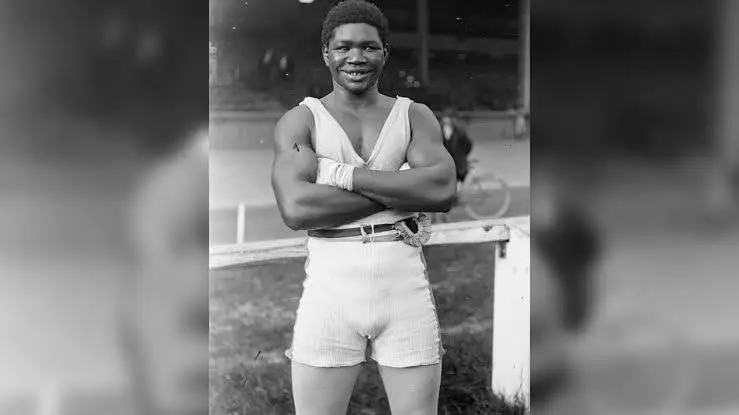
On September 16, 1897, Mbarrick Fall alias Battling Siki was born, the first African world boxing champion.
Born on September 16, 1897 in Saint-Louis, in the fishing district of Guet Ndar, Amadou Louis Mbarrick Fall grew up in a large family before joining Europe while still a teenager, in circumstances that remain unclear according to sources. Doing odd jobs (diver, door opener, dockworker), it was in this context of survival that he discovered boxing and chose a ring name that would become legendary: Battling Siki.
Spotted around 14 or 15 years old by a former boxer, he fought his first professional fights on the Mediterranean coast, from Narbonne to Nice. Between 1912 and 1914, he fought around sixteen fights for a few francs, before the First World War abruptly interrupted his budding career. Engaged in the colonial troops, he crossed the battlefields of northern France to the Gulf of Thessalonica in Greece, and emerged decorated with the war cross and the military medal.
A meteoric rise after the war
Demobilized, Battling Siki took up the gloves in 1919 and won victories with impressive regularity (up to 46 fights in four years for a single defeat, according to some sources). This exceptional series raised him to the rank of credible contender for the world light heavyweight title, then held by French idol Georges Carpentier.
The clash took place on September 24, 1922 at the Buffalo stadium in Montrouge, in Paris, in front of around 40,000 spectators. Waiting for a long time in the face of Carpentier’s attacks, Siki radically transformed in the final rounds and managed to make his opponent abandon in the sixth round. The referee, first invoking an imaginary technical fault, tried to give victory to Carpentier, before changing his mind under pressure from the crowd and designating Battling Siki world champion. An appeal from the Carpentier camp was rejected a few days later.
The fall after glory
Battling Siki’s reign at the top would unfortunately be short-lived. He lost his title to the Irishman Mike McTigue, on St. Patrick’s Day, after a fight fought in Ireland and judged by some to be tainted by unfavorable local refereeing. He subsequently lost his French and European champion titles by disqualification, against Émile Morelle.
His flamboyant personality and his way of life (he was fond of, according to accounts from the time, white women, white cars and jazz) earned him a sulphurous notoriety but also growing hostility in a colonial France little prepared to sustainably celebrate a black champion. He tried his luck in the United States with the ambition of facing Jack Dempsey, but lost in his first official fight in New York, on November 20, 1923, against Kid Norfolk. He continued to lead a turbulent career there, alternating victories and defeats, until he had a total of 71 professional fights. Battling Siki was shot twice in the back on December 15, 1925, in New York, at the age of 28.
A conference to transform memory into an object of research
More than a century after his coronation, this extraordinary trajectory is now the subject of a scientific approach. An international conference will be held in Saint-Louis on December 14 and 15, 2026, with the ambition of making Battling Siki not only a great figure in the history of boxing, but also a real object of historical, memorial and pan-African research. The event, led by Marième Fall known as Soda Dia, granddaughter of the boxer and president of the Association for the Memory of Amadou Louis Mbarrick Fall (AMALF), is part of a broader approach to reappropriation of colonial history and memory.
Initially scheduled for December 2025 to coincide with the centenary of his assassination, the meeting was postponed to December 2026 after the death of Idrissa Seydou Dia, journalist at Voice of America and husband of Marième Soda Fall. The expected contributions will explore six axes: the family and Saint-Louis origins of the boxer, his career and boxing networks, his military experience, the available media and oral sources, the circumstances of his assassination, as well as the political and memorial dimensions of his commemoration, with the stated ambition of making it a resource for culture, sport, tourism and education, and a reference for youth.
The organizing committee is chaired by the philosopher and writer Alpha Amadou Sy, the scientific committee by Boubacar Diop, known as Buuba, professor of history at Cheikh Anta Diop University (UCAD). Communication proposals, limited to five pages, must be sent no later than October 10, 2026, with the selected authors informed before October 25.
OBN
