
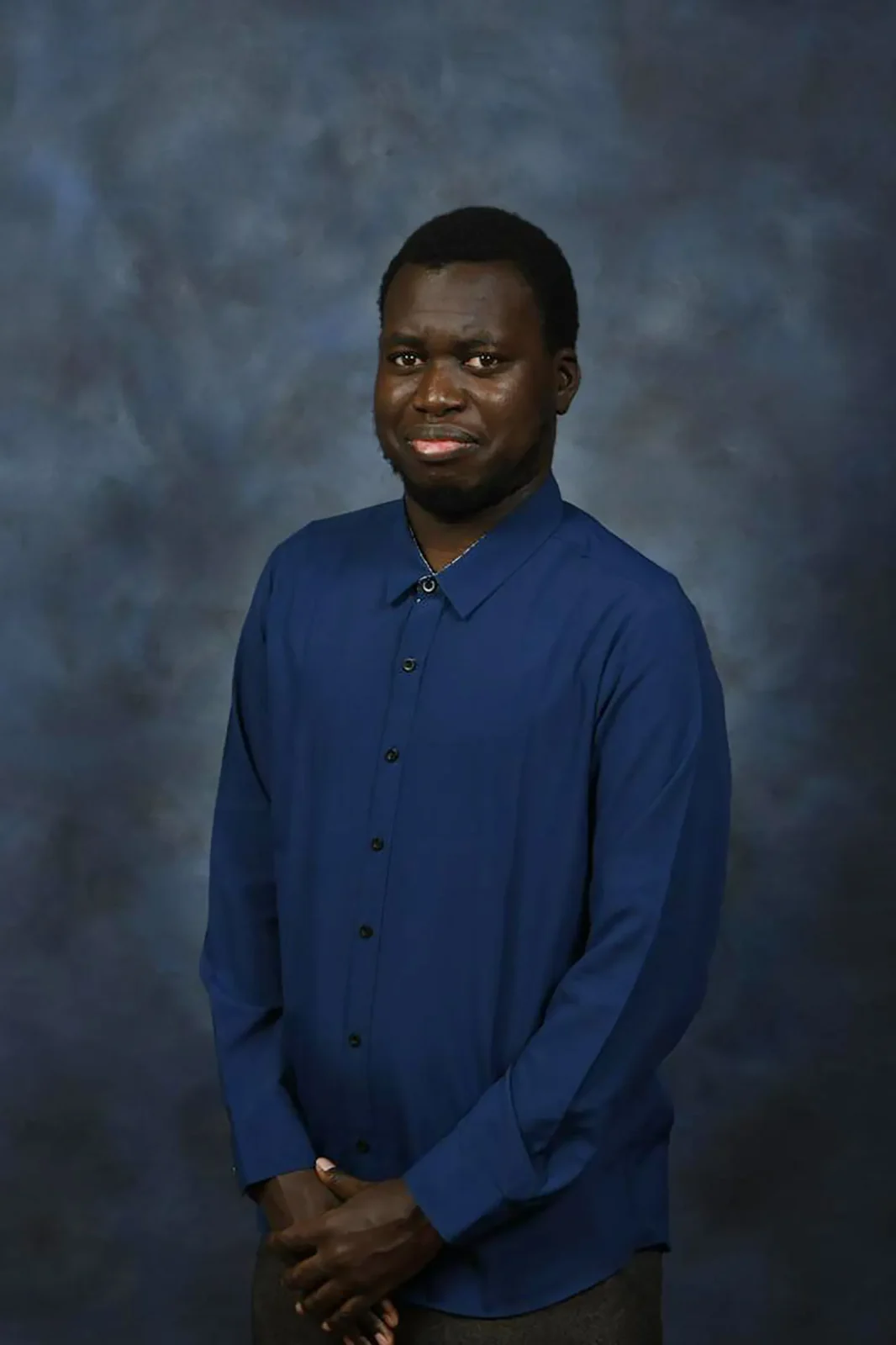
Khadim Mboup, the “Budding Genius” has become big
In 2014, in front of the presenter of the show Oumy Ndour, he gave an answer even before the question was finished. Valdiodio Ndiaye. Twenty points. A brilliance which made Khadim Mboup one of the most familiar faces of the national “Budding Geniuses” tournament. Twelve years have passed. The young prodigy from Louga grew up, studied in Lyon, Lausanne and Quebec. Mathematics meets economics. And behind the diplomas, a conviction has become clear: Senegal does not lack brains, it still lacks the means to nurture them, to retain them, to put them at the service of its own destiny.
In 2014, on the stage of the national final of “Génies en herbe”, Khadim Mboup delivered a general culture recital whose memory has not disappeared. But behind the champion that the small screen had revealed, there was a boy that the school had patiently shaped.
In 2026, Khadim no longer responds like the boy from 2014. He looks further. “What immediately sticks out to me is not so much the finale itself as what happened afterward,” he says. Afterwards, several students came to ask him how to become “cultured”, how to work, how to progress. It is this image that has stayed with him. Not the trophy. Not the cameras: “It made me realize that this competition didn’t just have value for me or for my high school. She inspired.”
Born in Geneva, Khadim is deeply shaped by Louga where he grew up. The child attends the Koranic school before joining the Senegalese school. He still talks about this first training. “It’s a set of things that came together: my parents, the family environment, a curiosity that was undoubtedly already there in me, but above all the education that my grandmother gave me and my time at Koranic school,” he explains.
However, Khadim did not follow a perfectly straight educational path. He had to make up three years, skipping classes to get up to speed. In fourth grade, we decided to present him to the Bfem as a free candidate. He finished first in his exam center. “I think that’s when something shifted in me,” he remembers.
Afterwards, everything comes together. The S series. Mathematics. The Senegalese General Competition where he obtained a distinction. Then “Génies en herbe”, won in 2014 with Malick Sall high school. The S1 baccalaureate with honors. Successes that could give the illusion of a smooth trajectory. He himself rejects this overly simplistic reading. “There was not an isolated trigger, separated from the rest. It came naturally, as an extension of everything that had built me up until then,” he explains.
He understands that his studies can take him well beyond the borders of Senegal. So he leaves. Lyon first, at Claude Bernard University, for scientific studies. Then Lausanne, in Switzerland, for mathematics. Finally Quebec, at Laval University, where mathematics rubs shoulders with economics. A university geography which could have distanced the young Lougatois from his first ties. “What I felt above all was the need to remain myself,” he says.
He arrives in demanding university environments without presenting himself as a student from far away who first needs to be reassured. He comes to learn. Discover. To understand. Soak up. “I remained Senegalese, with the same thirst for knowledge that had driven me since Koranic school and Génies en herbe,” he confides.
Patriotism
From abroad, Khadim Mboup better measures the extent of Senegalese potential. He sees the talents. Innovation capabilities. Youth. He also sees the slowness, the inadequacies, the missed opportunities. He talks about scientific training, reforms, the place of science, the way of teaching. He also talks about the decolonization of education, the way in which knowledge is transmitted, the knowledge that we choose to value.
It is no longer the “Budding Geniuses” candidate who is speaking. He is a young scientist who became an economist, a Senegalese who has seen other university systems and who returns in thought to the one who trained him. He doesn’t say that everything has to be redone. He says much remains to be done. Senegal, believes the champion, does not yet offer enough high-level scientific training offers. But the problem goes further. Even graduates from Senegalese schools of excellence, such as the École Polytechnique de Thiès or the National School of Statistics and Economic Analysis (Ensae), end up leaving after their training. Khadim sees a contradiction there: “We invest in the training of these young people, but we do not build the conditions to retain them nor the mechanisms to integrate them directly into the service of the country. »
His question is concrete. Why do graduates of the National School of Administration (ENA) benefit from state support and a professional career in the public service while graduates from scientific and technical fields do not have the same framework? The question is not theoretical. It concerns those who will tomorrow have to build infrastructure, produce statistics, design economic models, and think about public policies. “However, it is these profiles, engineers, statisticians, economists, mathematicians, that Senegal needs most to build its infrastructure, think through its public policies with rigor and accelerate its economic transformation,” he says.
We must therefore, according to him, stop making returning home a simple matter of individual will. The young graduate who goes abroad is not necessarily someone who turns his back on his country. He may be someone who seeks the conditions for his own fulfillment.
There is his commitment, yes. His desire to put his skills in mathematics and economics to the service of the development of Senegal. But there is also the responsibility of the State to create the conditions that will make this choice possible. “As long as this consistency does not exist, we will continue to ask young people to come back and sacrifice opportunities, without offering them in return a framework worthy of their training,” he warns.
In the meantime, mathematics has changed place in his mind. They are no longer just the discipline in which he excelled. They have become a tool. When he turned to economics at Laval University, Khadim did not turn his back on numbers. He takes them with him. “I don’t see this transition as an abandonment of mathematics, but as a natural extension,” he explains.
Thirst to learn and understand
The boy who was looking for answers to general culture questions is now interested in the mechanisms that shape the life of societies. And when he looks at the Khadim of 2014, he denies nothing. “What has never changed is the essential: this thirst for learning and understanding, this rigor inherited from the Koranic school, and this spirituality which accompanies me wherever I go,” he says. He remained Senegalese. Remained talibé. Stayed curious. Remained calm. But something changed in his eyes. As a student, he learned to succeed. To go further in his studies. Today, knowledge carries another burden. This same thirst for knowledge has transformed into a desire to understand the major issues facing Senegal and Africa, and above all into a desire to serve, to put this entire journey to the benefit of his country.
This is the path traveled. The rest is still to be written. Khadim Mboup does not talk about his future in terms of his personal career. He talks about transformation. Of a Senegal capable of relying on its own strengths, of building an endogenous and sovereign economy, of giving its young people the means of their dreams. In his eyes, the country is full of talent and brilliant young people, but there is still a lack of structures to reveal them, train them and retain them. “I want to make a concrete commitment to Senegalese youth, to humbly try to show, through my own imperfect journey, that it is possible to aim for excellence without ever denying one’s roots,” says Khadim.
By Adama NDIAYE
