
Joint companies or the hidden face of the national flag (1/4) October 13, 2026
Under the Senegalese flag, but in hands that are sometimes difficult to identify, ships from Europe and especially Asia raise questions about their real owners. Behind the mixed companies and the opaque arrangements, who really controls these boats? Carried out for three months in Dakar, Mbour and Saint-Louis, this “Soleil” investigation highlights the difficulties in accessing the identity of the actual beneficiaries, in a strategic sector which represents 3.2% of the national GDP and provides 70% of the animal proteins consumed.
“I know this boat. But if you ask me who is really behind it, I have to look at the documents. » This Saturday, August 15, 2026, with a smile, Mbor Ngom looks at a unit moored at Mole 10. The fifty-year-old has grown white under the harness and with 37 years of experience in industrial ships. However, when it comes to tracing the true owner of a fishing tool, his confidence gives way to caution. “The name of the boat and its flag are not enough. We have to look at the company, the capital, the managers and those who really control the activity,” continues the 62-year-old man.
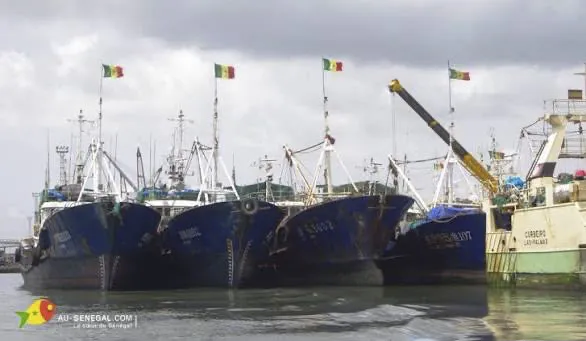
This Assumption Day, men move around on the quay, amid the noise of equipment and port operations. Many of the boats seen here are officially Senegalese owned. But, according to certain actors interviewed, behind certain arrangements there may be nominees making it possible to circumvent the restrictions applicable to foreign ships. “When a country does not have a fishing agreement with Senegal, this is the way around for its boats to come and fish in our waters. This is the naturalization system, commonly called “Senegalization”. This bypass is killing fishing,” underlines Aziz Soumaré, former boat captain from 2006 to 2017.
Read also: The explosion of new registrations (2/4)
In industrial fishing, the flag provides information on the State of registration, the owner on legal ownership, the shipowner on exploitation, the license on access to the resource and the beneficial owner on the person who actually controls or benefits from the business.
It is precisely in this tangle that the question of mixed companies lies. “A company can be Senegalese on a legal level. But this does not automatically mean that Senegalese interests effectively control the activity,” explains Baba Sène, a former navigator.
The register of beneficial owners is precisely a tool intended to identify the natural persons who actually control or benefit from a company. For three months, we sought to have this central register at the General Directorate of Taxes and Domains. In vain. The administration talks about protection of personal data. “The real issue is not the apparent origin of the boat. We need to know who holds the license, who operates the vessel, who makes the decisions and who benefits economically from fishing,” continues Baba Sène. On the hulls, the names are legible. Registration numbers as well. The men working around the ships are clearly visible. But the one who actually controls the activity is rarely on deck.
Flaws in the legal framework
The legal system governs access to the Senegalese pavilion, but weaknesses remain around mixed companies. Marième Diagne Talla and Massal Fall call for strengthening guarantees and transparency.
Creating a mixed company in the fishing sector requires falling within the framework of Ohada law. In the scheme described by Marième Diagne Talla, lawyer and former legal advisor to the Ministry of Fisheries and Maritime Economy, national participation is in the majority, with 51% for nationals and 49% for foreign investors. The company is incorporated in Senegal, with the shareholders’ participations recorded in the statutes.
But it is precisely at this level that the lawyer notes a fragility. According to Ms. Talla, the simplification of business creation procedures would encourage the appearance of “front” companies. She mentions in particular companies with around 100,000 FCfa in capital, while being presented as holding several vessels eligible for access to the resource because they fly the Senegalese flag.
Marième Diagne Talla raises a paradox: how can a structure with, according to her, such low financial resources be associated with several ships? “This situation favors the phenomenon of nominees, when the people appearing legally as partners do not necessarily correspond to the real economic interests behind the company,” she explains. Ms. Talla considers it necessary to strengthen the conditions for setting up mixed companies.
Retracing the life of ships
For Massal Fall, researcher in fisheries sciences and marine biology, the question cannot be dissociated from the legal status of the vessels. The Merchant Shipping Code sets the conditions allowing a vessel to fly the Senegalese flag and provides in particular, for fishing vessels, requirements relating to ownership or control by ECOWAS nationals or nationals.
The researcher calls for the regular publication of a detailed register indicating the successive names of the boats, their former flags, the shipping lines to which they were linked, their registration, their tonnage and their licenses. It also recommends an independent and comprehensive audit of the industrial fleet. The objective is to “have a clear photograph of the vessels operating under the Senegalese flag and their route”.
A survey carried out by Babacar Guèye DIOP
