
In El-Alamein, President Bassirou Diomaye Faye places the economy at the heart of African commitment
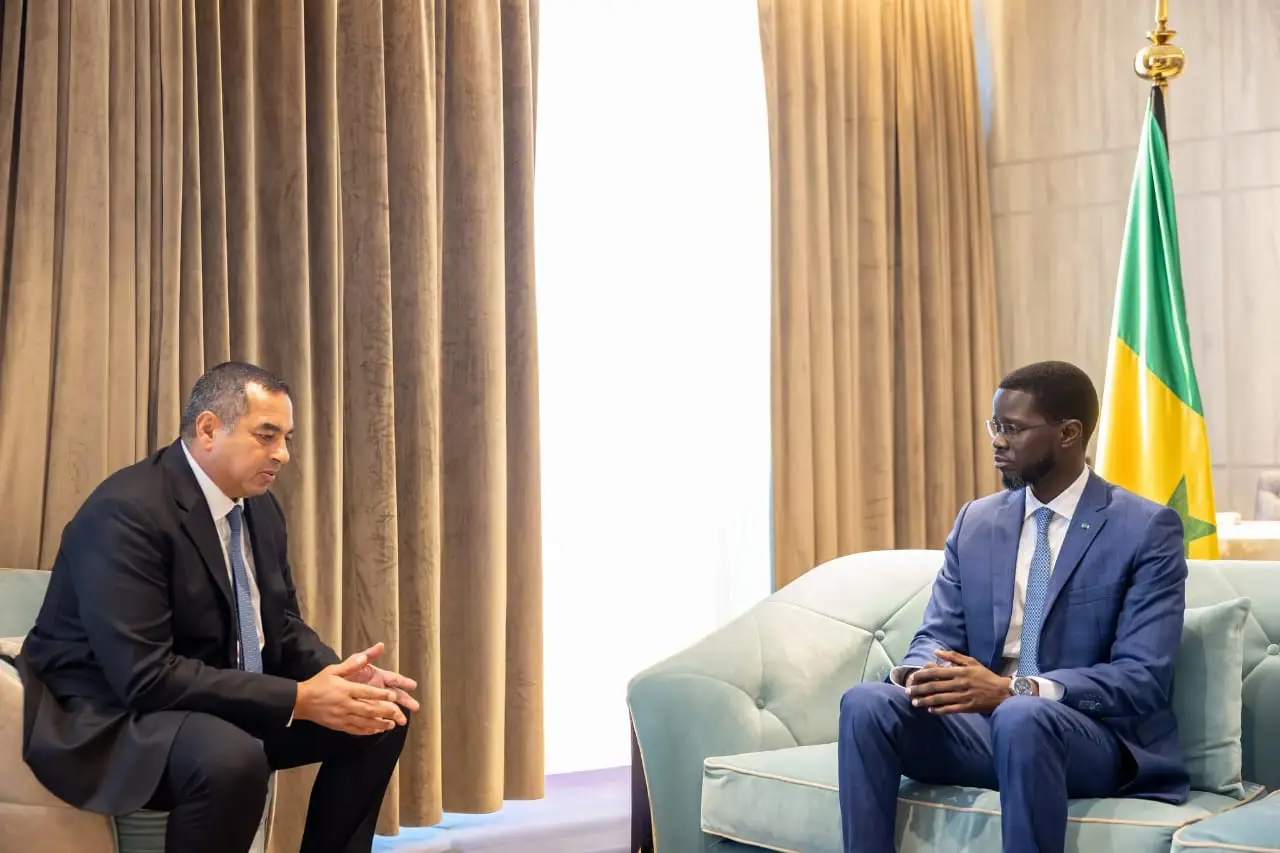
While in Egypt, Senegalese President Bassirou Diomaye Faye received three major players in the Egyptian economy before speaking to the founding countries of NEPAD.
A few days after the United Nations General Assembly, President Bassirou Diomaye Faye continued, this Saturday, October 3, 2026, his diplomatic tour to El-Alamein, Egypt. The city is hosting a meeting of African leaders hosted by Egypt with the African Union and Afreximbank, accompanied by a business forum dedicated to intra-African trade. The Head of State led diplomatic action and the search for partnerships simultaneously, in a diplomacy which, according to the Presidency, “places the Senegalese economy at the heart of each trip”.
Three hearings for the Senegalese economy
His morning was devoted to three interviews with leaders whose activities directly affect the needs of the country. The first, Hussein Sherif Fahmi, heads Air Cairo, Egypt’s second largest airline. It is preparing the resumption of a direct link between Cairo and Dakar. It says it is ready to support Air Senegal in the training of its engineers, mechanics and cabin crew, and to open a cargo line to serve trade between the two countries. Its leader sees Senegal as a natural hub, open to Africa, Europe and the Americas, which is in line with Dakar’s ambition to become a transport and trade platform for the sub-region.
Energy occupied the second audience. Mohamed Ismail Mansour, founder of the Infinity group, is already present in Senegal with the Taïba Ndiaye wind farm, via Infinity Power, his joint venture with the Emirati Masdar. He expressed his group’s desire to go further, with new one-gigawatt wind and solar projects. Such a volume would have a significant impact on national electricity production and would serve the energy sovereignty objective of the Senegal 2050 National Transformation Agenda.
The third meeting focused on finance. Mohamed Mahmoud El Etreby chairs the National Bank of Egypt, the country’s leading banking establishment, as well as the Association of Egyptian Banks. His bank wishes to establish a banking and commercial partnership with Senegal. An establishment in Dakar would offer entrepreneurs from both countries instruments adapted to their transactions and would open up new prospects for bilateral trade.
Senegal among the founders of NEPAD
The afternoon gave this approach a continental dimension. Senegal is, with Algeria, South Africa, Egypt and Nigeria, among the five countries behind the New Partnership for Africa’s Development. Born in 2001 from the meeting of President Abdoulaye Wade’s Omega Plan and the African Renaissance Program supported by Presidents Thabo Mbeki, Olusegun Obasanjo and Abdelaziz Bouteflika, NEPAD brought together its founding members twenty-five years later in El-Alamein.
President Faye paid tribute to the founding fathers, whose vision placed the development of the continent under the responsibility of Africans themselves. He praised the progress made in infrastructure, human capital and intra-African trade, without forgetting the remaining path, from access to water to youth employment, in an international environment riddled with crises.
He defended an Africa which relies first and foremost on its own assets: its youth, its arable land and its natural resources. He called for the acceleration of regional infrastructure, particularly through the Program for Infrastructure Development in Africa, and for financing commensurate with needs, combining concessional resources, domestic savings and commitment from the African private sector. Finally, he hoped that AUDA-NEPAD would become the “operational arm of Agenda 2063” of the African Union, better articulated with States, Regional Economic Communities and African financial institutions. For him, “achieving the development of the continent is within our reach”, provided that African countries commit together around shared priorities.
The Alamein Declaration
The work concluded with the adoption of the Alamein Declaration. The five founding countries pay tribute to the builders of NEPAD and reaffirm their desire to finance and drive the continent’s development agenda using predictable African resources. The text recognizes the private sector as a driving force in the implementation of Agenda 2063 and sets specific deadlines: an investment platform will bring together private capital commitments by February 2027, a continental facility in favor of SMEs and value chains is expected in mid-2027, and an African instrument for risk reduction and blended financing must emerge within eighteen months.
The same line, from Washington to El-Alamein
This position extends that of the morning’s hearings: promoting local resources and involving the private sector in financing development is also the heart of the Senegal 2050 Agenda. After Washington, Abu Dhabi and New York, where he strengthened the confidence of Senegal’s partners, the Head of State is continuing this work in Egypt with African and Arab partners.
On Sunday, he will take part in the 8th Biannual Coordination Meeting of the African Union and Regional Economic Communities, in his capacity as current President of ECOWAS.
