
Heritage at the heart of transmission October 23, 2026
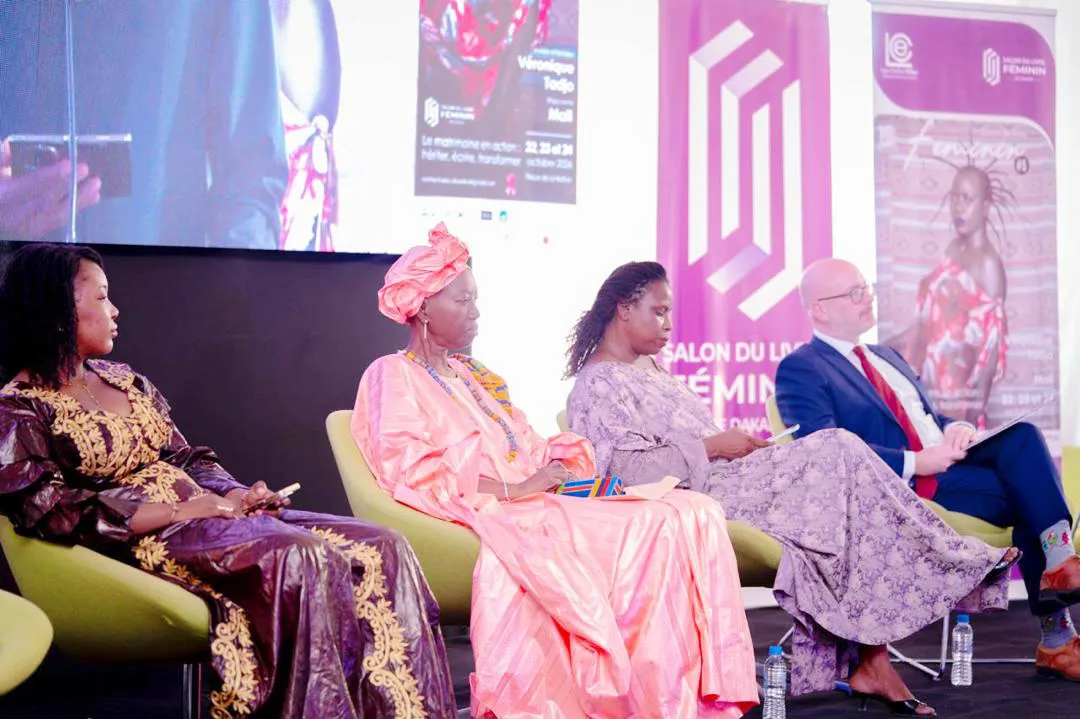
The fifth edition of the Dakar Women’s Book Fair opened on Thursday October 22, 2026, at Place de la Nation. Placed on the theme “Matrimony in action: inherit, write, transform”, this three-day meeting (from October 22 to 24) highlights women of letters, their works and their contribution to collective memory.
The women’s book opens a new chapter in Dakar. Three days after the closing of the 18th edition of the Dakar International Book and Teaching Materials Fair (Fildak), the Place de la Nation (formerly Obelisk) hosts a new meeting devoted to literature.
The fifth edition of the Dakar Women’s Book Fair, which opened on Thursday, October 22, intends to give more visibility to female authors and rehabilitate the cultural heritage transmitted by women.
Initiator of the Salon, the novelist, screenwriter and cultural entrepreneur Amina Seck has defended, since the launch of this initiative, a conviction: women must be recognized not only as characters in books, but also as those who write and transmit stories.
“They must not only be present in books, they must also be recognized as those who write, transmit and transform the world,” she declared during the opening ceremony.
Through this event supported by the structure Les Cultur’Elles, the ambition is to create a meeting space between women of letters, to encourage collaborations and to allow young authors to make their works known. The Salon also intends to give back their place to stories long relegated to the margins of collective heritage.
This year, the reflection revolves around heritage. For Amina Seck, it is not simply a question of adding a few women’s names to a history already written, but of recognizing their works, their knowledge and their creations.
An issue of recognition
Storytellers, language guardians and women who have passed on stories from generation to generation fully participate in this collective memory.
“Recognizing heritage therefore means refusing erasure, it is making memory a living force, transmission a political act and creation a means of transforming the present,” she underlined.
Representing the Minister of Culture, Crafts and Tourism, the Director of Books and Reading Promotion, Ibrahima Lô, welcomed an initiative which extends efforts to promote books in Senegal. He particularly insisted on the scope of the theme chosen for this fifth edition.
“To inherit is to receive. To write is to speak. Transforming means doing useful work for generations to come,” he declared.
According to him, the promotion of heritage is consistent with the orientations of the national book and reading policy, particularly in terms of the transmission and preservation of heritage.
The book also constitutes, he continued, a tool of cultural sovereignty. “There can be no sovereignty without full recognition of the voices of women,” said Mr. Lô.
Beyond the speeches, the Salon intends to offer concrete spaces of expression and visibility to women of letters. The program includes meetings, workshops, conferences, screenings, shows, exhibitions and signing sessions.
This fifth edition welcomes Mali as a guest country and the writer Véronique Tadjo as guest of honor. An opening that highlights the links between African imaginations and the place of literature in dialogue between peoples.
The Dakar Women’s Book Fair thus intends to make heritage a living heritage, to be preserved, questioned and transmitted to future generations.
Prizes to promote women of letters
The fifth edition of the Dakar Women’s Book Fair was also an opportunity to celebrate literary creation through two distinctions: the Ken Bugul Book Prize and the High School Students’ Prize for the first female book.
This year, Fatou Warkha Samb and Nataly Ong are the winners of these prizes which aim to promote female authors and encourage a taste for reading among young girls.
The High School Students Prize for the first female book was awarded to Fatou Warkha Samb for her work “Assignée au silence”. This distinction gives young girls an active place in the discovery and evaluation of works.
“They are not simply there to learn to read differently. They are also there to make their own voices heard as readers,” underlines Marième Pollèle Dieng, coordinator of the Salon’s literary prizes.
The Ken Bugul Book Prize goes to Nataly Ong for “The Dancer of Saigon”. This year, fourteen works were examined and seven finalists selected, according to the director of Books and Reading Promotion, Ibrahima Lô.
For Ms. Dieng, this distinction has an engaging name. “Associating your name with a literary prize means placing our approach in a story of creation, freedom of speech and the affirmation of a singular voice,” she explained, in reference to the writer Ken Bugul.
Beyond the reward, these distinctions aim to promote women’s writing and encourage the emergence of new voices.
“Valuing women’s literature does not mean locking women into a single way of writing or thinking. This means recognizing their freedom to tell the world from their experiences, their imaginations and their contradictions,” recalled the coordinator.
Through these awards, the organizers aim to strengthen the visibility of female authors, celebrate the diversity of their stories and encourage new literary vocations.
Arame NDIAYE
