
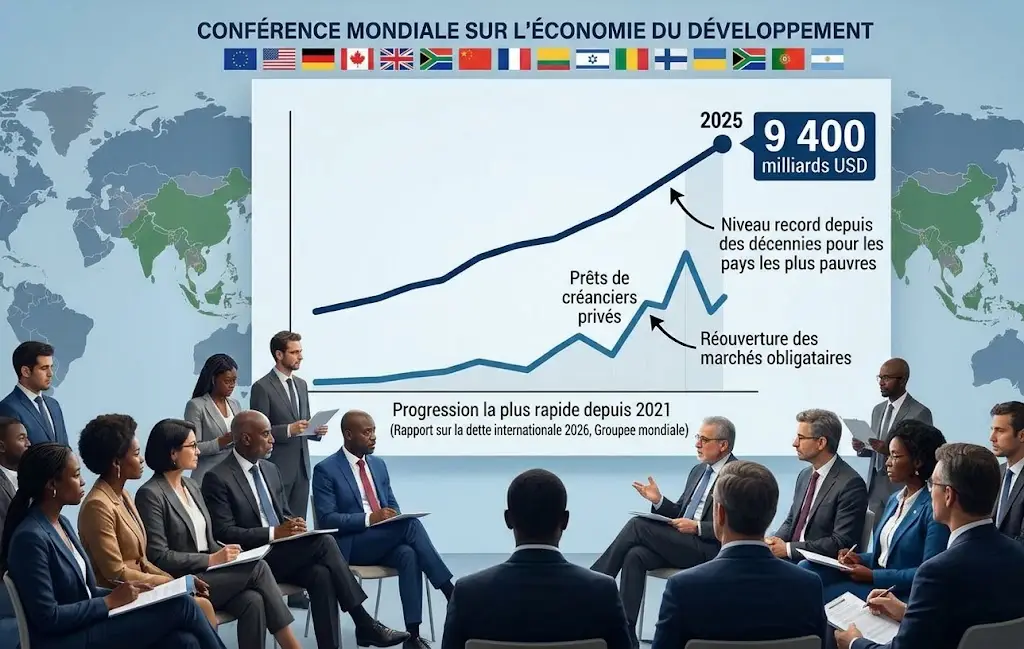
External debt of developing countries: a record amount of $9.4 trillion in 2025
The amount of external debt of developing countries reached $9.4 trillion in 2025. This is according to the World Bank Group’s 2026 International Debt Report released on November 5, 2026.
Private creditors are making a comeback, bond markets are reopening and the debt of the poorest countries is at its highest level in decades. According to the World Bank Group’s International Debt Report 2026, external borrowing by developing countries jumped 5.5% to reach a record $9.4 trillion in 2025.
Also read: Senegal external debt: $45.399 billion recorded in 2025
“This is the fastest progression since 2021 and almost four times higher than the average recorded over the period 2022–2024. Although access to international financing has improved, their cost remains high, and the heavy debt burden of the poorest countries could cause essential investments in human capital to disappear,” explains the World Bank in a press release.
Private creditors largely explain this increase, according to the same source. Thus, borrowing from the latter increased sharply, while bond issues by public entities increased by almost 35% to reach their highest level in five years, or $251 billion, thanks to the reopening of markets to many developing countries.
According to the World Bank document, external debt grew even faster in the most vulnerable countries, by 8.1 percent to reach $1.3 trillion in countries eligible for concessional financing from the World Bank Group’s International Development Association (IDA).
“The return of private lending to low- and middle-income countries is good news, but they are borrowing more, paying more and, in many cases, devoting fewer resources to long-term development. Managing debt responsibly means giving everyone, including future generations, a chance to prosper,” said Haishan Fu, World Bank Group Chief Statistician and Director of the Development Data Department.
New bonds issued to repurchase debts
Many governments have issued new bonds to repurchase maturing debts, better spreading repayment patterns without actually reducing the amount of debt, and often at higher interest rates.
Despite these costs, data collected in early 2026 shows that demand for international bond financing remains strong in low- and middle-income countries. By mid-August, more than 10 countries had already exceeded their emissions volume for all of 2025, while several others were returning to international markets.
“In 2025, countries eligible for IDA loans bore an average interest rate of 8.2%, the highest since 1989, on new commitments to private creditors and 9.4% on new bonds. The gap between the rates paid by these countries to public creditors and those of the private sector has widened, from 3.4 percentage points in 2016 to 5.5 percentage points in 2025,” we read in the text.
For comparison, countries eligible for non-concessional loans only from the World Bank Group’s International Bank for Reconstruction and Development (IBRD) borrowed at an average rate of 5.5% on their new bonds, up from 5.8% the previous year.
$1.4 trillion paid in principal and interest
“Debt repayment and interest payment pressures have remained high amid high global interest rates. Low- and middle-income countries paid $1.4 trillion in principal and interest in 2025, an increase of 1.9% and a fifth consecutive annual increase,” specifies the Breton Woods institution.
Payments to bondholders reached $363 billion, driven in part by debt buybacks and prepayments financed by new bond issues.
“Between 2022 and 2025, developing countries paid $436 billion more in debt service than they received in new financing. The trend, however, reversed in 2025: long-term debt flows went from net outflows of $118 billion in 2024 to net inflows of $45 billion,” reports our source.
Currency fluctuations also contributed to the increase recorded. Of the $303 billion increase in public and government-guaranteed debt, more than a quarter was due to the weakening of the U.S. dollar, which increased the dollar value of debt denominated in other currencies.
It is worth noting that for several of the largest borrowers receiving concessional financing, these exchange rate effects exceeded the principal repaid in 2025, so that reported debt increased despite continued repayments.
Mariama DIEME
