
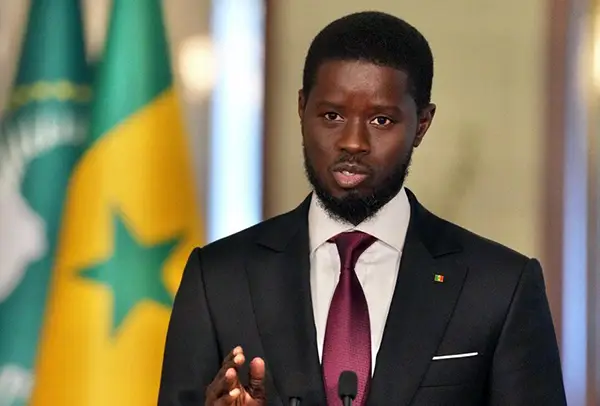
Armed Forces Day: President Bassirou Diomaye Faye reaches out to ECOWAS in the face of border threats
For the 25th Armed Forces Day, celebrated at Dial Diop camp, President Bassirou Diomaye Diakhar Faye, Supreme Chief of the Armed Forces, paid tribute to the fallen, injured or experienced soldiers, and greeted the ECOWAS chiefs of staff present with whom he wishes to collaborate to strengthen border security.
It is a meeting that the Senegalese republican calendar places among its most solemn. For the 25th edition of Armed Forces Day, President Bassirou Diomaye Diakhar Faye appeared this morning in front of the troops lined up in the Dial Diop district, surrounded by the Prime Minister, the President of the National Assembly, the Minister of the Armed Forces and the senior military hierarchy. In the stands, chiefs of staff from several ECOWAS countries, veterans in ceremonial dress and military families.
The Head of State began by recalling the origins of this day: “There are dates which continue, over the generations, to illuminate the destiny of a Nation. November 10, 1960 is one of them. » A few months after independence, the handing over of the flag of the 1st Senegalese Tirailleurs Regiment to the 1st Infantry Battalion marked, according to him, “a founding step in the building of our National Army”. He added that “the young Senegalese Republic thus affirmed its desire to fully assume its responsibilities in matters of national defense”.
This ceremony, he underlined, is first and foremost one of gratitude towards “those who, in the name of the Nation, have made the demanding choice of commanded service, discipline and sacrifice”.
“The world has changed profoundly”
The President then provided an unvarnished picture of the strategic environment. “The world has changed profoundly. The emergence and affirmation of power, the questioning of the multilateral order, the multiplication of contested spaces, the progressive disintegration of multilateral solidarity mechanisms and cross-border phenomena constitute the markers of a more than tumultuous global geopolitics. »
The region is not immune: “The persistence of terrorism and violent extremism, the growth of illicit trafficking, transnational organized crime and the multiplication of centers of instability are exerting increasing pressure on our States and on the living conditions of many populations. » To these threats are added, he listed, “the effects of climate change, tensions around resources, certain economic and social vulnerabilities, as well as emerging risks in the cybernetic and information domains”.
He pointed out a specific flaw: “Armed groups and criminal networks exploit cross-border mobility, the fragilities of certain territories and the inadequacies of coordination between national systems. » Hence his call for “the mobilization of regional energies and capacities by strengthening our anticipation, in-depth knowledge of threats and the operationalization of our response mechanisms”.
History as an argument for unity
To justify this “regional surge”, the head of state invoked history. “Long before the constitution of our modern States, our region was a space of circulation, exchange and human solidarity. The borders have consecrated our sovereignties; they have erased neither family ties, nor economic relations, nor shared cultural heritages. »
From this proximity arises, according to him, “a particular responsibility in the search for peace and in the prevention of crises”. He recalled that Senegal “has continued to be committed to collective security, continuing a long tradition of African solidarity”, and that its soldiers have taken part, “alongside their brothers in arms from the countries of the sub-region, in various operational commitments”. In his view, these shared experiences constitute “a valuable asset on which regional military cooperation could build to take new steps”.
Regarding the political upheavals sweeping through the sub-region, the President chose caution: “The political and institutional recompositions that our sub-region is experiencing require lucidity and discernment. They invite us to preserve the avenues of dialogue, to maintain relationships of trust and to patiently seek the convergences necessary for dynamic regional collective security. »
A direct message to the ECOWAS Chiefs of Staff
Then addressing the chiefs of staff of neighboring countries, he welcomed a “notable” presence which “also testifies to the fraternity which unites our countries and the wealth of experiences accumulated and shared over several decades of common commitments”. He described the contours of concrete cooperation: “They must combine operational preparation and reinforced cooperation. This requires better control of our capabilities, exchange of information through appropriate channels and the organization of joint exercises to strengthen mutual trust. »
He also defended the idea of regional and continental strategic autonomy. This ambition, he specified, “requires qualified personnel, anticipation capabilities, suitable equipment and financing and support mechanisms commensurate with the missions entrusted to the forces”. It also requires “balanced international partnerships, respectful of our priorities and attentive to the development of sustainable skills”.
Tribute to the dead, the injured and the elderly
The tone became more serious when the President spoke of the missing. “On this special day of commemoration, our thoughts go first to our soldiers who fell while fulfilling their noble duty. I bow with deep emotion to their memory. » He said he shared “the pain of their parents and brothers in arms”, by showing them “the recognition of the entire Nation for the sacrifices made in the name of the ideals of peace, harmony and solidarity”.
The wounded, sick or experienced soldiers have had their share of attention: “The courage and the spirit of sacrifice which has always animated them are to be saluted. I reaffirm all our compassion for them and wish them a speedy recovery. »
To the “great Elders” present, he reserved a personal word: “I feel great pride in seeing you among us because your presence is one that is reassuring. Thank you for remaining faithful to the oaths of commitment, discipline and dignity that never left you, even after the uniform. You are a role model in many ways. »
