
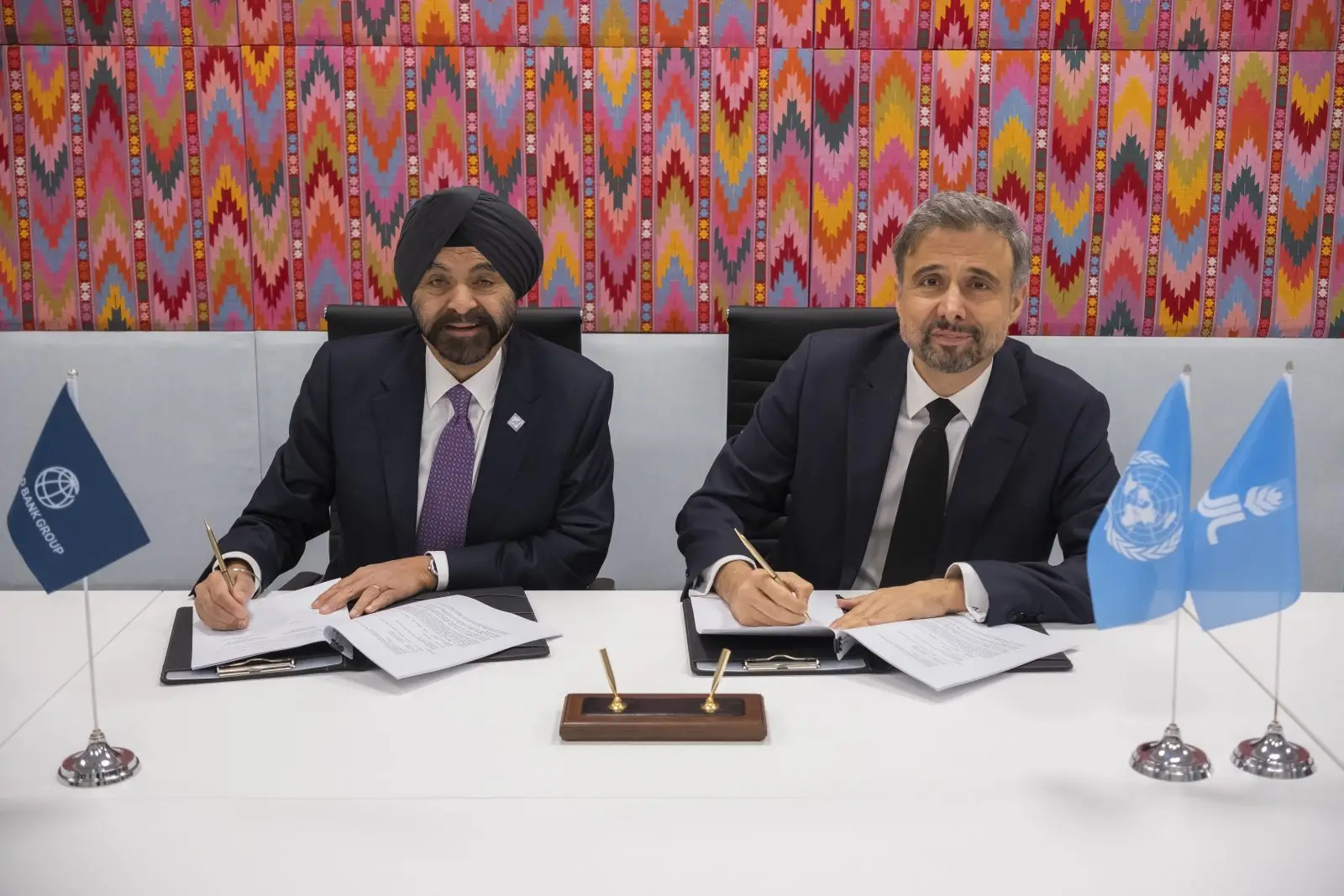
Co-investments in rural economies and food systems: the World Bank and IFAD are scaling up
The International Fund for Agricultural Development (IFAD) and the World Bank signed a new Cofinancing Framework Agreement on Tuesday, September 13, 2026, aimed at increasing their joint investments in rural transformation and food systems.
Signed during the 2026 Annual Meetings of the International Monetary Fund and the World Bank Group in Bangkok, this agreement will, according to a joint press release from the two institutions, strengthen collaboration between the two institutions.
Its aim is to build resilience, promote entrepreneurship and foster job creation in rural areas, at a time when the largest generation of young people in history is entering the job market amid slowing growth and increased economic uncertainty.
“Together, the World Bank and IFAD have the scale, reach and expertise to transform rural economies and agri-food systems. This agreement will allow us to translate our shared ambition into more investment, more jobs, stronger resilience and better food security for millions of people,” explained IFAD President Alvaro Lario.
300 million small agricultural producers targeted by 2030
In fact, the agreement extends the partnership between the two institutions through several initiatives, including AgriConnect, which aims to contribute to the transformation of agriculture for the benefit of 300 million small-scale agricultural producers by 2030, and Water Forward, which aims to improve water security for one billion people by 2030.
“The next generation needs opportunities, and agriculture can be a powerful engine for jobs, growth and food security. This is what AgriConnect is designed to do,” said World Bank Group President Ajay Banga.
Also read: Debt: the IMF and the World Bank reform their evaluation framework
“By combining the financing capabilities and global reach of the World Bank Group with IFAD’s deep expertise on rural communities and food systems, we can help small-scale agricultural producers increase their productivity, access markets, attract private investment and create jobs where millions of young people live,” he added.
IFAD cofinancing volume increases from approximately USD 646 million in 2021 to USD 1.56 billion in 2025
It should be noted that the World Bank Group remains IFAD’s main multilateral development bank partner. Their collaboration concerns co-financing or policy consultation as well as global initiatives.
“The volume of IFAD cofinancing with the World Bank’s International Development Association (IDA) more than doubled, from approximately USD 646 million in 2021 to USD 1.56 billion in 2025,” the text reads.
Thus, this new agreement will make it possible to systematically identify and develop, throughout the investment cycle, new joint operations extending current collaborations, including a national investment of USD 70.5 million in Lesotho.
Nearly 1,500 jobs created
This program has already created nearly 1,500 jobs and provided nutritional education to 217,000 people. More than 106,000 people have adopted climate-compatible agricultural practices, while agro-meteorological services have benefited more than 900,000 people.
“This agreement will also contribute to the implementation of the priorities of the fourteenth replenishment cycle of IFAD (IFAD14, 2028-2030) by accelerating investments that strengthen resilience, broaden economic prospects and transform livelihoods in rural areas,” informs the same source.
The agreement is a continuation of the historic cooperation between IFAD and the World Bank, which dates back to 1978. The renewed framework preserves the policies, financing decisions and accountability requirements specific to each institution. The agreement will initially be in effect for five years and then automatically renewed for an additional five years.
Mariama DIEME
