
An ebony princess from Djilor November 24, 2026
At 27, Jeanne Mariane Diam combines studies in international business with a career as a top model. A native of Djilor, she presented herself under number 10 at the fourth edition of the “Mosaan” Festival, where eleven contenders, from ten municipalities in Senegal, competed for the crown. A maestro’s number, which she honored until the last dribble before seizing the crown.
“He who traces the temple. » It is with this formula that Cheikh Anta Diop, in his works “Negro Nations and Culture and Genetic Kinship of Pharaonic Egyptian and Negro-African Languages”, shed light on the etymology of the word Serere, linking this people to the sacred builders of the Nile valley. Millennia later, this invisible link between the stone of the temples and the memory of the ancestors found its most vibrant incarnation in the spotlight of the 2026 “Mosaan” Festival.
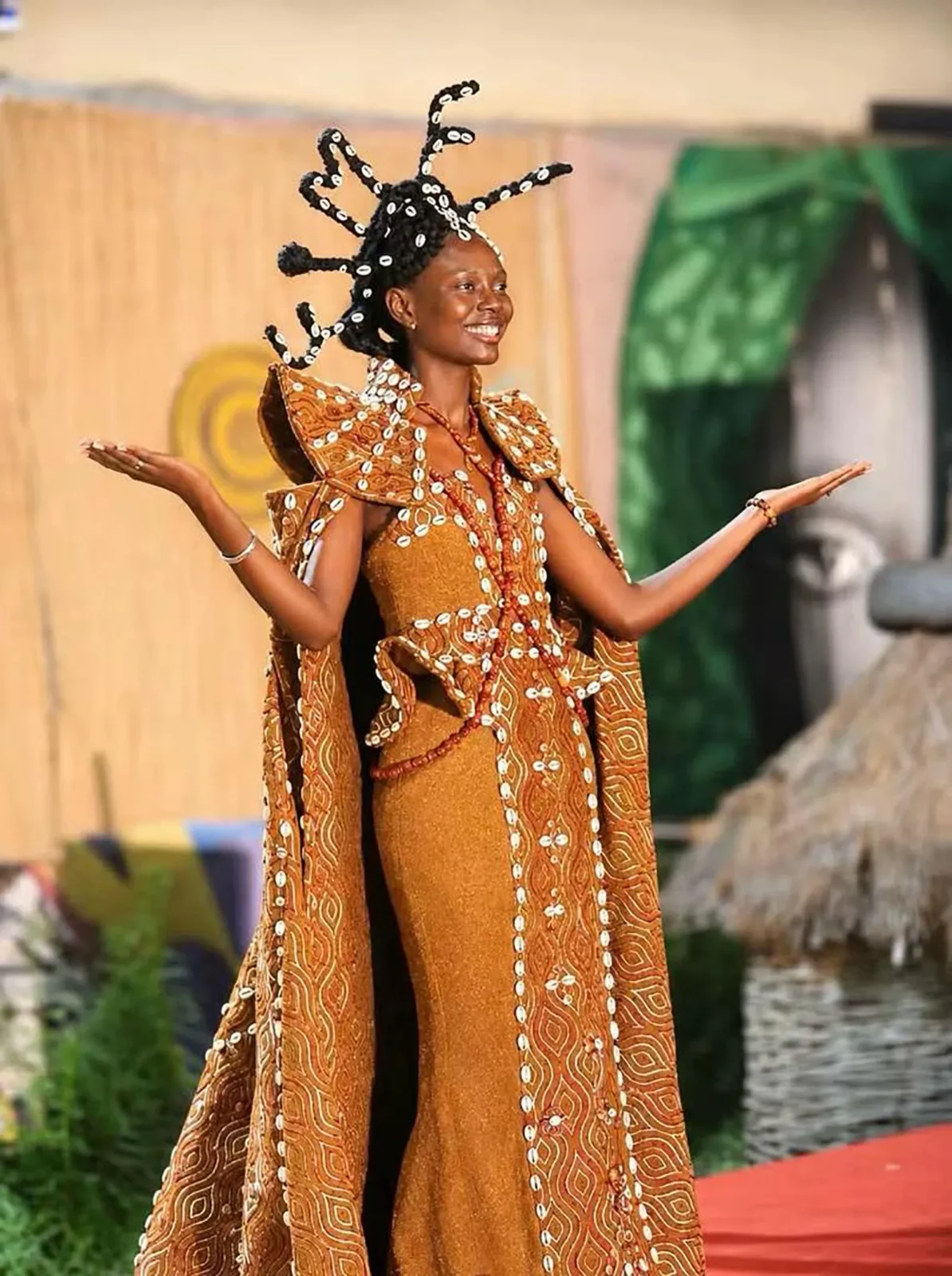
At the center of the stage, Jeanne Mariane Diam appears like a figure escaped from the verses of Senghor singing of the nobility of the Signares and the queens of Sine. The child of Djilor Djidiack, standard bearer of the commune of Fimela, has the hieratic appearance of an ebony princess with a sovereign head carriage. Her traditional hairstyle, a veritable architecture of braided antennae and studded with a crown of white cowrie shells, creates a sacred halo around her face.
Dressed in a tunic in warm shades of terracotta and ocher, embroidered with geometric patterns and dripping with amber pearls and marine shells, she embodies the fertile land of her region. Her gaze, deep and calm, lights up her fine features as she holds a spray of roses against her white “Mosaan” 2026 scarf. Her black complexion, glowing like ebony under the caresses of the sun, magnifies her slender silhouette and her admirably defined waist. Her immaculate smile completes this picture of grace and elegance.
Behind this royal grace and the controlled cadence of the professional dancer and model from the Lamina Evens agency lies a patiently constructed intellectual journey. Jeanne Mariane Diam forged her skills far from shortcuts: from Djilor primary school to Ndangane Campement middle school, then to Dioguoye Basile Senghor high school in Fimela, before flying to Morocco to follow training in accounting. Back in Senegal, she is now preparing for a third year of a degree in digital marketing and international trade.
A demanding trajectory, supported by a family base which she cites as her primary source of energy, and nourished by a secret passion for writing.
“Wearing the crown of “Mosaan” is not an end in itself, it is a responsibility. Every young Serer girl must be able to sit down at school to chart her own destiny and become a free woman,” she asserts with conviction.
Carrying your terroir over your shoulder
For the winner, who has ambition deep in her heart, the crown is neither an achievement nor a simple pageantry. “Being a “Mosaan” means having the bravery and discipline of our ancestors, while having the audacity to build the future,” she confides, with a quick retort.
For the 27-year-old, authenticity is a daily requirement of humility. If it has given itself the mission of promoting Serer culture, its commitment goes beyond the sole heritage framework. Jeanne Mariane has made the education of young Serer girls her priority fight. Convinced that school benches constitute the first lever of emancipation, she intends to use her new platform to break the glass ceilings and open the path to freedom for her young sisters.
Confident in her strengths and driven by unfailing determination, the Queen of Fimela already sees beyond the borders of Sine-Saloum. If she harbors the ambition of one day wearing the Senegal scarf on international podiums, her real horizon remains economic.
“My dream goes beyond the podiums. I want to become a businesswoman capable of creating jobs here, to show the youth of Sine-Saloum that excellence has no borders,” she says in a smooth voice.
His entrepreneurial ambition is echoed in the message carried by the festival. Sobel Dione, anthropologist and specialist in Serer culture, defends with “Mosaan” a conception of beauty free of prejudices and reductive canons. “You are beautiful just as you are,” he insists to Serer women and, more broadly, to all black women.
He wishes to recall the virtues that he associates with the Serer woman: a taste for work, honesty, dignity and intelligence. With Jeanne, the jury said they recognized this happy alliance of presence and human qualities.
His mother, Nafy Bakhoum, smiles: “You never completely get rid of your soil. »
The eldest of three children, the image does not say everything. “Mosaan” knows the rough edges of existence. In 2011, her father passed away, leaving behind a void that she learned to tame from her mother and grandmother. It is in this family cocoon, sheltered from the tumult, that she forges her first bearings.
Education, respect and a sense of family constitute the foundation of his childhood. But she advances without ever losing her direction and makes her way with the strength of her wrist.
Charles Diagne knew Jeanne at the age when memories are formed like a child. In Djilor, to the antiques market, she accompanied her mother, an art dealer. “His mother entrusted his care to me, since I am his uncle,” he remembers.
From this childhood surrounded by art objects and merchant palaver to the excitement of parades, time has dug its furrow. Jeanne grew up, continued her studies, then developed an inclination towards modeling. Charles Diagne was the privileged witness of this change.
Fire from all woods
Having become her manager, he has lost none of his affectionate outlook on the woman he describes as an authentic, affable young woman who wears her heart on her sleeve.
The Serer soul irrigates Mariane’s deepest loyalties. She carries its customs, precepts and memory with a fervor that the years have not dulled.
Since her childhood, she has cultivated a deep attachment to Serer culture and has always stood out for her courtesy,” confides her mother, her confidante.
According to her, in her human relationships, Mariane cultivates exquisite deference. “Daddy”, “mama”, “uncle”, “Auntie”: the kinship of the heart exceeds that of the blood for her.
What could possibly take away from her the glory of what education has so deeply ingrained in her?
His election does not end a story. It gives it a new horizon. Daughter of Djilor, the new “Mosaan” now has the opportunity to make her notoriety a link between her region and other horizons.
Beyond the sash and the crown, there is the responsibility to uphold the Serer cultural heritage and to exalt its singularities.
Adama NDIAYE
