
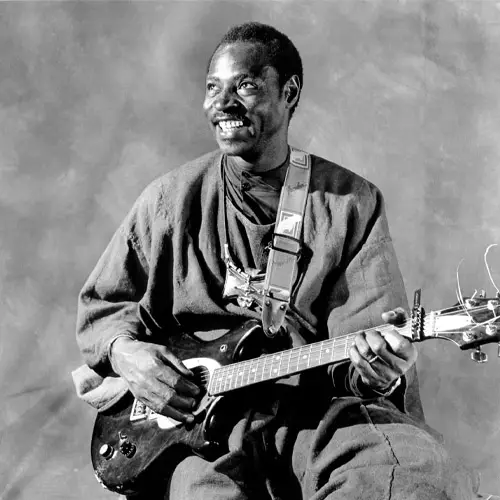
Aly Farka Touré, the self-taught genius
His music has gone far beyond the borders of his native Mali, to establish itself on the biggest international stages. Aly Farka Touré will have throughout his career defended the roots of the blues, a sound whose African paternity he proudly claims.
There are those who are born with natural predispositions. There are those who shape themselves over time, through learning, work and self-sacrifice. And then, there are those, rarer, which combine the two. They benefit from innate abilities to which is added a tireless desire to learn, progress and constantly question themselves. It is often from this complementarity that talent, and sometimes even genius, is born. Aly Farka Touré undoubtedly belongs to the latter caliber.
A guitar virtuoso, the Malian musician did not attend major art schools nor follow the academic paths that usually shape great instrumentalists. His school is that of life, tradition and listening. He drew on Malian musical heritage to build a musical identity that would gradually transcend the borders of his country and dialogue with American blues. Listening to him play is an experience that transcends musical rules. Connoisseurs recognize the mastery of a talented guitarist, laymen are pleasantly carried away by the beauty of the sound.
Aly Farka Touré was born in 1939, in the Timbuktu region, Mali. In the publication “Desert Blues / Entre Dunes Et Savanes” which looks back on the artist’s career, it is noted “Aly Farka Toure learns by observing the griots, by immersing himself in traditional Fulani, Songhai, Tamasheq and Bambara music that circulates along the river. He made his first guitar himself, from a single string stretched over a homemade resonance box. This sound instrument, anchored in traditional repertoires, shapes his electric guitar playing. Faced with his breathtaking talent and his legendary mastery of notes, Western critics nicknamed him “the African John Lee Hooker”. A nickname that didn’t excite him, because he said, with pride, “American blues descends from West African music, and not the other way around.”
Notoriety and Grammy Awards
His career really took off in the 1980s, when he signed a contract with the British label World Circuit. Its sound immediately transcends Mali. But it was the album Talking Timbuktu, recorded in 1994 with American guitarist Ry Cooder, which propelled him onto the world stage. He also won a Grammy Award. He obtained a second, posthumously, for “In the Heart of the Moon”, recorded with the kora master Toumani Diabaté. This collaboration symbolically seals the dialogue between two great instrumental traditions of Mali.
Farmer at heart
Aly Farka Touré refused to make music a full-time activity. He defined himself above all as a farmer. He devotes himself fully to agriculture and breeding. He built a power station at his own expense to supply his native village. In 2004, he was elected mayor of his city. He will hold this mandate until his call to God, refusing any salary for this function.
Aly Farka Touré died in March 2006, shortly after completing the recording of the album “Savane”, released posthumously in July of the same year. This album is hailed as one of the most accomplished of his work. Today, his music remains an essential reference for anyone interested in the African roots of blues.
O.BA
