
African Critics Laboratory: Moka Kamara, from laureate to knowledge broker
Winner of the NOOCULTURES Prize for Art Criticism in Africa in 2020, Mamadou Oumar Kamara, known as Moka Kamara, returned five years later to the laboratory which helped shape his career. In Ouagadougou, the journalist for the national daily Le Soleil and film critic took on the role of facilitator with young African critics, on the occasion of the 14th edition of Récréâtrales. An experience placed under the sign of transmission and intercultural dialogue.
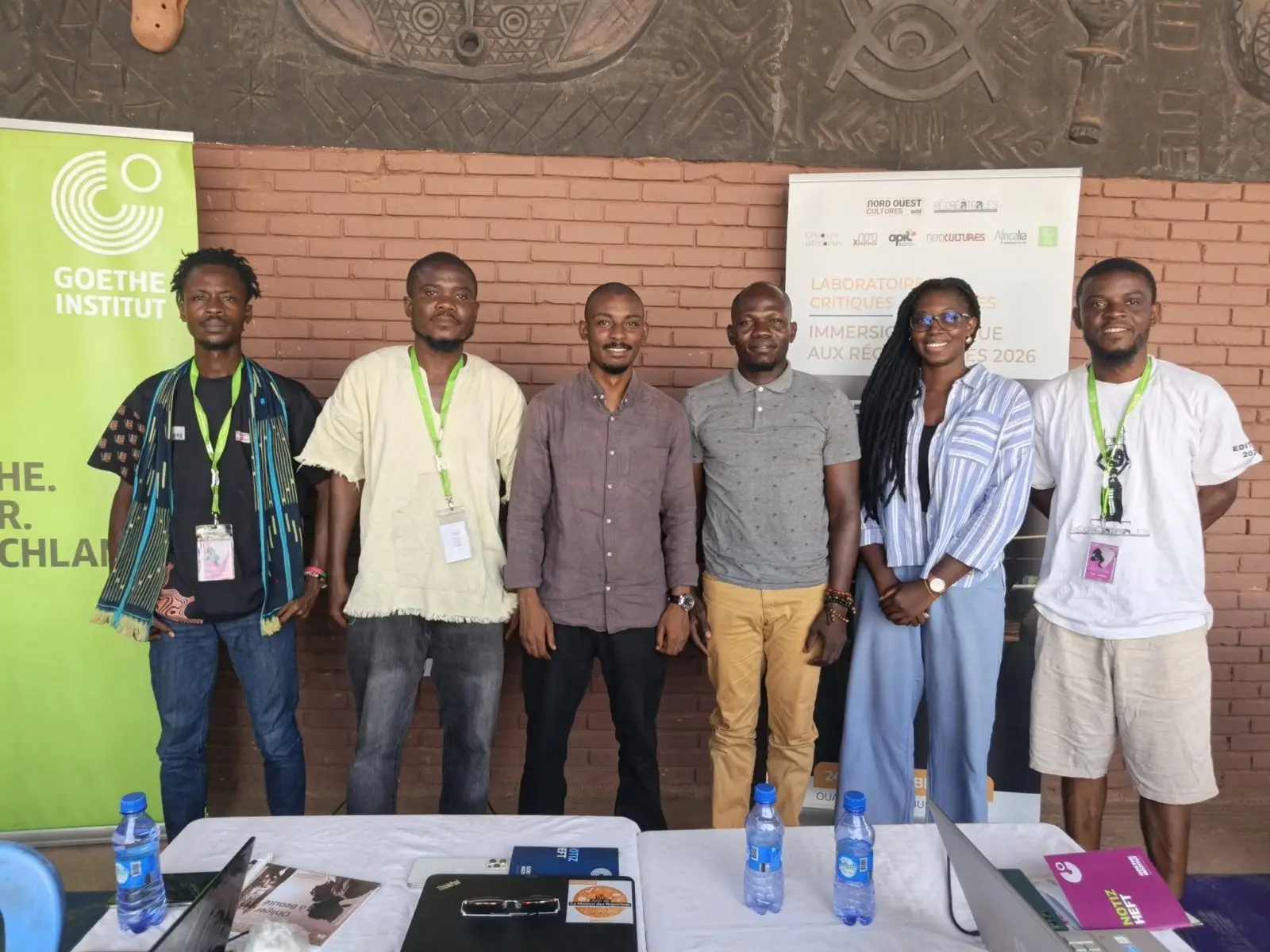
On the other side of learning, transmission. Five years after benefiting from a training program supported by NOOCULTURES, Mamadou Oumar Kamara, better known as Moka Kamara, found the African Critics Laboratory in a new position: that of facilitator. From October 24 to 31, in Ouagadougou, he accompanied the finalists of the 2026 edition during their immersion residency at Récréâtrales.
On the program: daily editorial conferences, individualized monitoring of productions and participation in the jury for the 2026 African Critics Prize. A responsibility that is part of the continuity of a journey built around cultural journalism and art criticism.
His history with NOOCULTURES programs dates back to 2020. That year, the deputy head of the Culture department of the national daily Le Soleil won third prize in the first edition of the NOOCULTURES Prize for Art Critics in Africa, dedicated to cinema. A year later, he was one of the 19 participants in the film criticism workshop organized on the occasion of the 27th edition of the Pan-African Cinema and Television Festival of Ouagadougou (FESPACO), in collaboration with the African Federation of Film Critics.
Five years later, he is back in a criticism laboratory, this time devoted to theater. For him, this experience has above all transmission value. “I had a lot of fun being a supervisor in this laboratory, in the sense that it allowed me to be a conduit. I value transmission, which resolutely allows us to extend meanings and principles. I had the opportunity to pass on what I received five years ago,” he confides.
Ouagadougou, between creation and resistance
Beyond the supervision of young critics from different French-speaking African countries, this immersion was also a human and cultural experience. The choice of Ouagadougou, a city that he describes as a “city of arts and symbols”, gave a particular dimension to this meeting.
Placed under the theme “Forcing beauty”, the 14th edition of Récréâtrales offered an artistic reflection on war, conflicts and their consequences on individuals and communities. A program that did not leave the journalist indifferent.
“The artistic proposals in this festival had as a common thread war, conflicts and all that they generate in terms of chaos and intimate and community upheavals,” he underlines. Despite the seriousness of the subjects covered, he retains the power of the creations presented. “Despite this picture of disasters, the performances were all beautiful, powerful, brilliant. »
For Moka Kamara, art is not just about representing tragedies. It gives them a human dimension, by putting faces to statistics and making perceptible the tragedies experienced by populations, particularly in the Democratic Republic of Congo (DRC) and Burkina Faso. “That struck me in that art humanizes these wars in the DRC or Burkina Faso, gives faces to the statistics and makes us deeply aware of these tragedies,” he explains.
The critic, a mediator between the work and the public
This experience also relates to his conception of the profession of art critic. Far from reducing this function to a subjective appreciation or a value judgment, Moka Kamara insists on its role of mediation. The critic accompanies the public in the discovery and understanding of the works, going beyond what is immediately shown.
“In general, the critic is a mediator between the work and the public. It allows him to understand better, and to understand beyond the images that pass by or the stage. He analyzes, he deciphers, he describes and he puts forward an argued point of view,” he explains.
Beyond his role as a film critic and art critic, he collaborates with specialized magazines and daily newspapers in Africa and Europe. His expertise has also led him to sit on several juries, notably that of the anthem of the Youth Olympic Games (YOG) Dakar 2026, StLouis’Docs and the Senegalese national preselection for the 2025 Oscars.
Arame NDIAYE
