
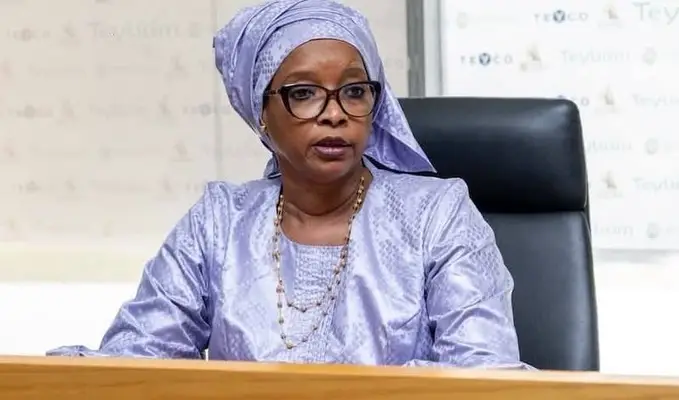
Dak’Art 2026: Minister Mame Coumba Diop describes the preservation of archives as an issue of cultural sovereignty
The preservation of archives, the circulation of African artists and dialogue between the peoples of the continent must occupy a central place in cultural policies. This is the message conveyed by the Minister responsible for Culture, Creative Industries and Historical Heritage, Mame Coumba Diop, during the opening of the SUTURA exhibition, Sunday November 22, at the Suspended Villa, at Point E.
Part of the OFF program of the 16th Dakar Contemporary Art Biennial and the Partcours network, this exhibition brings African archives and contemporary creation into dialogue.
In front of the cultural actors, partners and artists gathered for the occasion, the Minister attached to the Minister responsible for Culture, Creative Industries and Historical Heritage defended a vision of culture which goes beyond mere artistic promotion to touch on the issues of sovereignty, African integration and transmission. “Governing a country also means ensuring the continuity of its memory,” she affirmed, emphasizing the responsibility of the State in the preservation, classification and accessibility of documentary heritage. For her, “protecting the traces of our cinema, our architecture, our struggles and our daily lives is an act of national and pan-African sovereignty”.
Mame Coumba Diop also made the mobility of artists an issue of continental integration. Bringing together six creators from Benin, the Democratic Republic of Congo, Morocco and Senegal, the SUTURA residency illustrates, according to her, the need to remove obstacles to the circulation of African talent. “Africa must be the first space for circulation and legitimization of its own creators,” she declared. She also called for a horizontal conversation between African territories, a prerequisite for a balanced dialogue with the rest of the world.
More than 150,000 digitized and cataloged references
The exhibition gives substance to this ambition by mobilizing the collections of the African Archives Fund for the Safeguarding of Memories (FAASM). Created in 2021, the collection brings together more than 150,000 digitized and cataloged references, covering more than a century of history. Photographs, glass plates, negatives, films, magazines and heritage documents provide content. So many materials that artists have explored to produce original works.
The president of the Biennale, Abdoulaye Diop, welcomed an initiative faithful to the spirit of Dak’Art, whose OFF program constitutes, according to him, “one of its beating hearts”. Including SUTURA in the theme of this 16th edition, “(anti)fragility”, he considered that the exhibition transforms “what could have remained a vulnerable or frozen heritage into a source of creative energy”.
Initiator of the project and founder of Éditions et Résidences Vives Voix, Ghaël Samb Sall, for her part, recalled that this residency is part of nearly twenty years of commitment to artistic creation and research. “An archive lives when it is shared and questioned,” she underlined, defending the opening of collections to artists as a way of bringing out common stories and transmitting memory to new generations.
Through “SUTURA”, the organizers intend to make archives a living material, in the service of creation, education and cultural sovereignty. After its official opening on November 22, the exhibition continues from November 26 as part of the Partcours.
O.BA
