
Opening of Dak’art 2026: The scene awakens to the rhythm of (anti)fragility
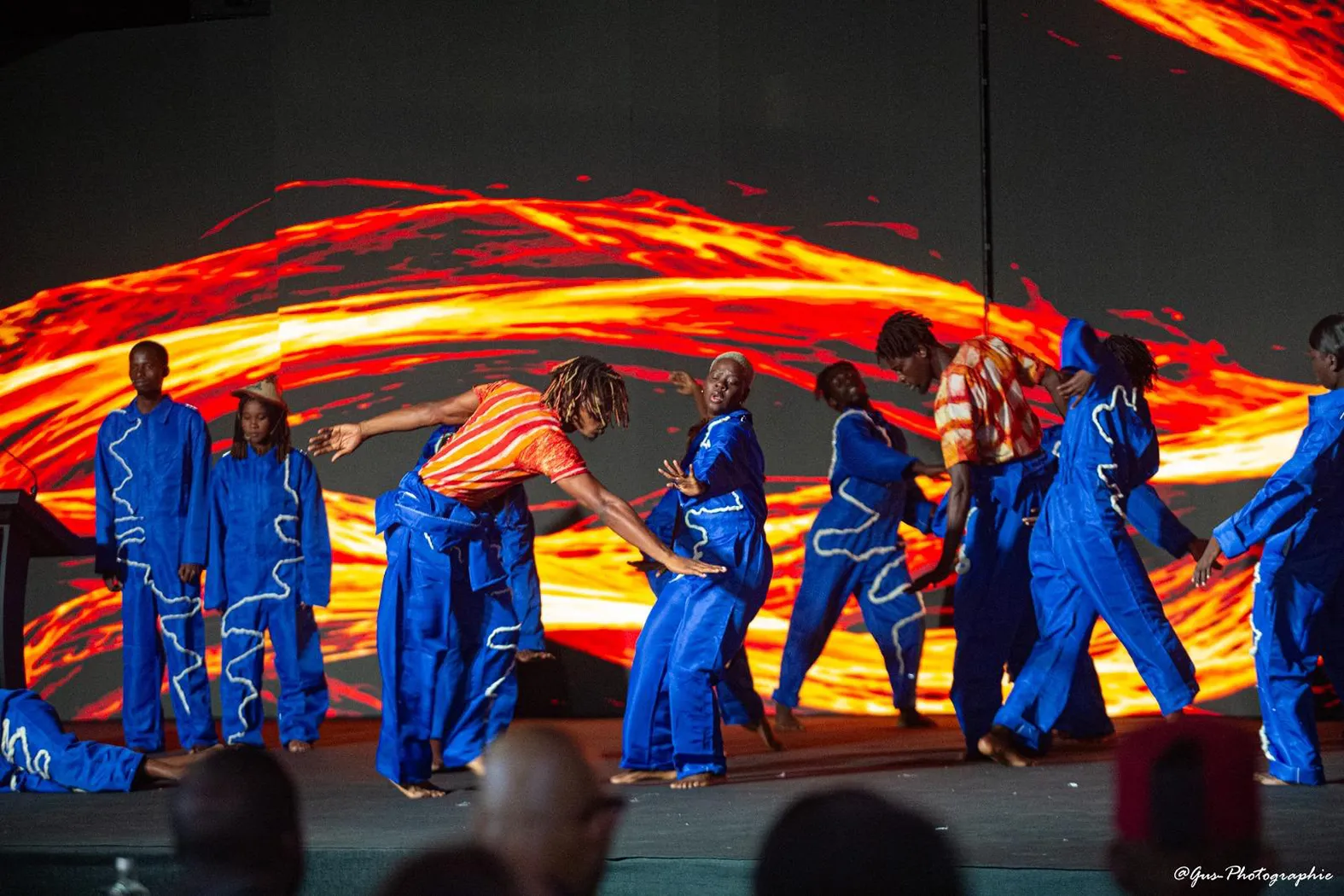
The opening ceremony of the 16th Biennial of Contemporary African Art, on Thursday, November 19 at the Old Courthouse in Dakar, reserved an important place for the performing arts. The voice of Oumar Pène, the movements of the Bakalama troupe, the choreographic creation “Dëgërlu, the moult of the living” and the appearance of the Congolese Fally Ipupa gave this inaugural evening a musical and choreographic color, between Senegalese roots and Congolese openness.
At the Old Courthouse of Dakar, art also found expression in the voice, rhythm and movement of bodies. To accompany the opening of the 16th Dakar Biennale, on Thursday November 19, 2026, the stage remained throughout the evening, a space for meetings between several musical and choreographic worlds. Three moments particularly marked this artistic sequence, with proposals that placed music and dance at the heart of the celebration. Oumar Pène set the first tone with “Sénégal”. Accompanied by the “Bakalama” troupe, the singer performed on stage a song which makes attachment to the country and peace its common thread. His voice, familiar to fans of Senegalese music, opened this artistic parenthesis under the sign of a collective message. The choice of this title also placed the performance in a symbolic dimension, at a time when Dakar welcomes artists and delegations from different backgrounds.
The presence of the “Bakalama” group brought particular substance to this interpretation. Dance thus came to accompany the voice and inscribe the rhythm in a bodily expression. This first sequence masterfully combined two artistic languages, song and movement, in highlighting Senegalese musical heritage. Oumar Pène carried the message through his voice, while the dancers contributed to its stage translation. The program then took a choreographic direction with “Dëgërlu, the molt of the living”. The title, which evokes the idea of transformation, places the living at the center of the artistic proposition. The creation brought together the Bakalama troupe and singer Woz Kaly, under the direction of Madiaw Ndiaye. “M’bote na yoo” The meeting between these artists opened a space where dance and music responded to each other and participated in a scenic co-construction. The movement carries an artistic intention, the music accompanies the expression and the title provides a key to understanding the metamorphosis. “Dëgërlu, the moulting of the living” is thus part of a research around transformations, cycles and forms of life. This presence of dance in the ceremony also recalls the diversity of disciplines that the Biennale brings together around contemporary African creation. With the singular and legendary voice of Woz Kaly, the performative piece took part in a creation designed around the dialogue between movement and music. Two artistic frameworks which showed, doubtless, different possibilities of expression of the body on stage.
The Democratic Republic of Congo, guest country of honor for this edition, also brought its musical signature to the ceremony with Fally Ipupa. The Congolese artist performed a short performance in front of the public. His presence has placed the Dakar scene in another musical geography, that of Congolese music whose influence goes far beyond national borders. This intervention continued the dialogue between cultures that ran through the artistic program.
After the Senegalese song and the choreographic creation carried by artists from the country, the appearance of Fally Ipupa gave a place to the Congolese scene. A nod to the Democratic Republic of Congo (DRC), whose participation as guest of honor, occupies a special place in this 16th edition. The succession of these performances gave the inaugural evening an artistic composition made up of voices, rhythms and movements. Through these proposals, the ceremony recalled the place of performing arts in major meetings devoted to African creation. Music, dance and performance thus accompanied the entry of Dak’Art in a new edition, with Senegal and the Democratic Republic of Congo united on the same stage.
Amadou KÉBÉ
