
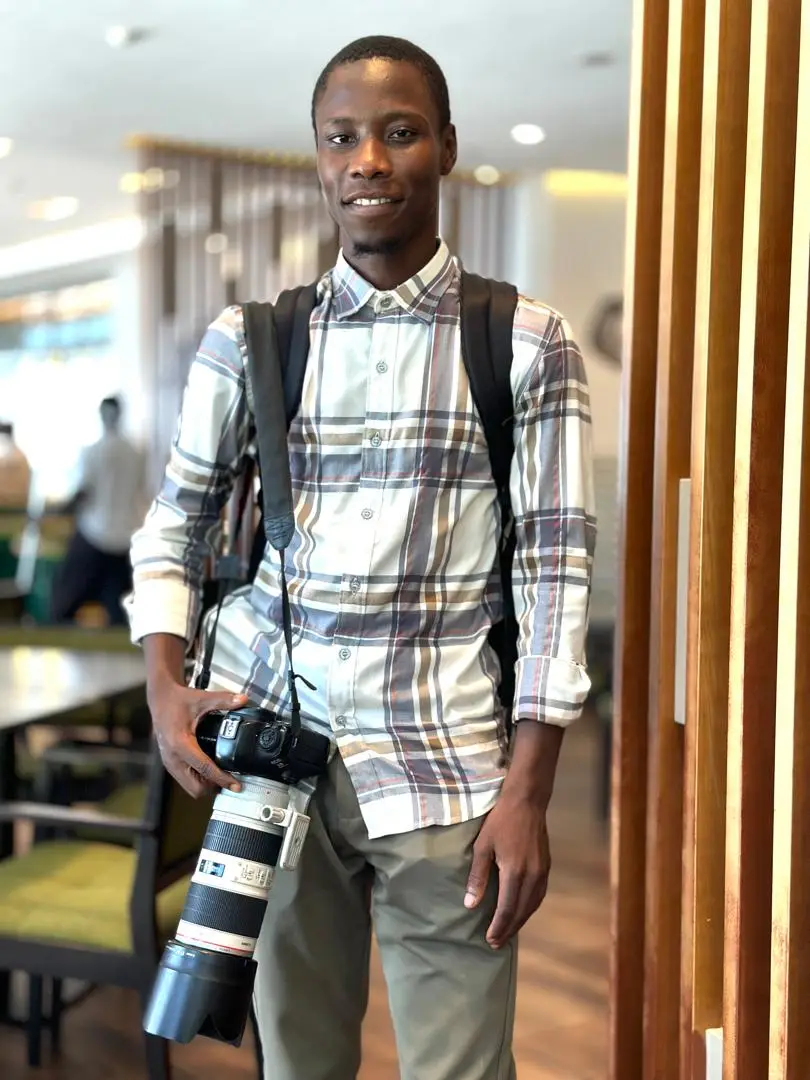
The art of telling the story of institutions in images November 24, 2026
Winner of the Best Institutional Photographer prize at the 5th Oscars of African Photography, Mamadou Alassane Ndiaye sees ten years of passion, work and perseverance rewarded. From his first steps in multimedia to covering major international events, this audiovisual technician has gradually made photography an art and a profession. Portrait of a man for whom an image must tell much more than an event.
There are paths that are built through encounters, experiences and choices. That of Mamadou Alassane Ndiaye was shaped around a passion that became, over time, a real profession: photography. Today a photographer and audiovisual technician, he has just reached a new milestone with the prize for Best Institutional Photographer, won at the 5th edition of the Oscars of African Photography, in Lomé, Togo organized from November 12 to 14, 2026.
A distinction that crowns a decade of learning and perseverance. However, nothing particularly predestined this image enthusiast to embrace this career. After obtaining his baccalaureate in 2011, he went to the Faculty of Law at Cheikh Anta Diop University in Dakar. But interest in image professions eventually took over. In 2012, he began training in computer graphics before turning to multimedia.
Initially, it was mainly the video that caught his attention. Then, gradually, photography took over. A discovery that changes its relationship to the image. “I was struck by the ability of a photograph to tell a story, to transmit an emotion and to keep track of a moment,” he confides. What was only an interest then becomes a passion, then an assumed professional choice.
From passion to recognition
Behind the lens, Mamadou Alassane Ndiaye learns to look differently. For him, photography is not just about pressing a shutter button. It’s observing, anticipating, composing and seizing the right moment. A requirement that he has cultivated since his first experiences. “Like painting or sculpture, it requires a look, writing and sensitivity of its own, and not just a camera,” he emphasizes when speaking of photography.
His professional career led him notably to Malcom Prod, a production structure, then to Walfadjri. Experiences that allow him to consolidate his skills and discover different media environments. In 2019, he took another step forward by founding Realise Studio, a personal project through which he developed his own vision of photography and audiovisual production.
Since 2023, he has worked within the Communication Unit of the Ministry of Industry and Commerce of Senegal. An environment in which he puts his know-how at the service of promoting institutional missions and activities. His expertise has also led him to participate in the coverage of several international meetings, including the 13th Ministerial Conference of the World Trade Organization (WTO), in Abu Dhabi, the Universal Expo in Osaka, Japan, the 14th Ministerial Conference of the WTO, in Yaoundé, as well as the Dakar International Forum.
So many experiences that helped shape his outlook and strengthen his ability to adapt. Because institutional photography meets specific requirements. It is not only a question of immortalizing official ceremonies or personalities, but also of making visible the women and men who bring an institution, its initiatives and its achievements to life. “It is therefore not limited to official ceremonies or protocol photos,” he specifies.
For him, this discipline has a dimension that goes beyond immediate communication: that of memory. “The images produced today will, tomorrow, be able to bear witness to the actions carried out and the transformations to which an institution has contributed,” he explains. A responsibility which involves combining aesthetic quality, fidelity to reality and understanding of the issues.
The requirement of the gaze
In this universe where institutional imperatives can sometimes frame creation, the photographer wishes to preserve his artistic sensitivity. Framing, light, composition and choice of moment constitute all spaces where freedom is expressed. “Even in the service of an institution, photography remains an art: it requires a personal look, visual writing and real sensitivity,” he defends.
This permanent search for quality constitutes, according to him, one of the elements which have contributed to its African distinction. Rather than simply showing that an event took place, it seeks to restore its meaning. “I always try to tell something, rather than simply show that an event took place,” he insists.
To achieve this, he pays particular attention to expressions, details and composition. But also research and continuing education. He is particularly interested in the work of Senegalese and African photographers, while observing developments in photography in other countries. A way to nourish your thinking and renew your visual writing.
Because in a constantly changing sector, staying up to date is a constant challenge. “Techniques, tools and expectations change; we must therefore continue to learn, to question ourselves and to renew our practice,” he recognizes. A path that has not always been easy, between the opportunities to be seized and the sometimes difficult conditions on the ground. If he had to summarize the lessons of this experience, he would remember one word: “resilience”.
A distinction, new ambitions
The award obtained at the Oscars for African Photography thus represents much more than a trophy. For the winner, it salutes “ten years of work, learning, perseverance and passion for the image”. The competition also allowed him to confront his work with other photographic sensibilities and to measure the wealth of talent on the continent.
In Lomé, during the awards ceremony, emotion was naturally present. But Mamadou Alassane Ndiaye refuses to consider this recognition as an individual success. He would like to recall the role of colleagues, managers, partners and loved ones who accompanied his journey. A distinction that he also welcomes as an opportunity to fly the colors of Senegal high.
Far from resting on this consecration, the photographer sees it above all as an invitation to go further. “I see it as an important step, not as an outcome,” he says. Its ambitions are now focused on new collaborations, international projects and the development of Realise Studio.
In the longer term, he also wishes to pass on his experience to young photographers and audiovisual professionals, in particular by supporting them in their first steps. An ambition that matches its desire to tell the continent differently, through images capable of revealing its realities, its talents and its transformations.
Arame NDIAYE
