
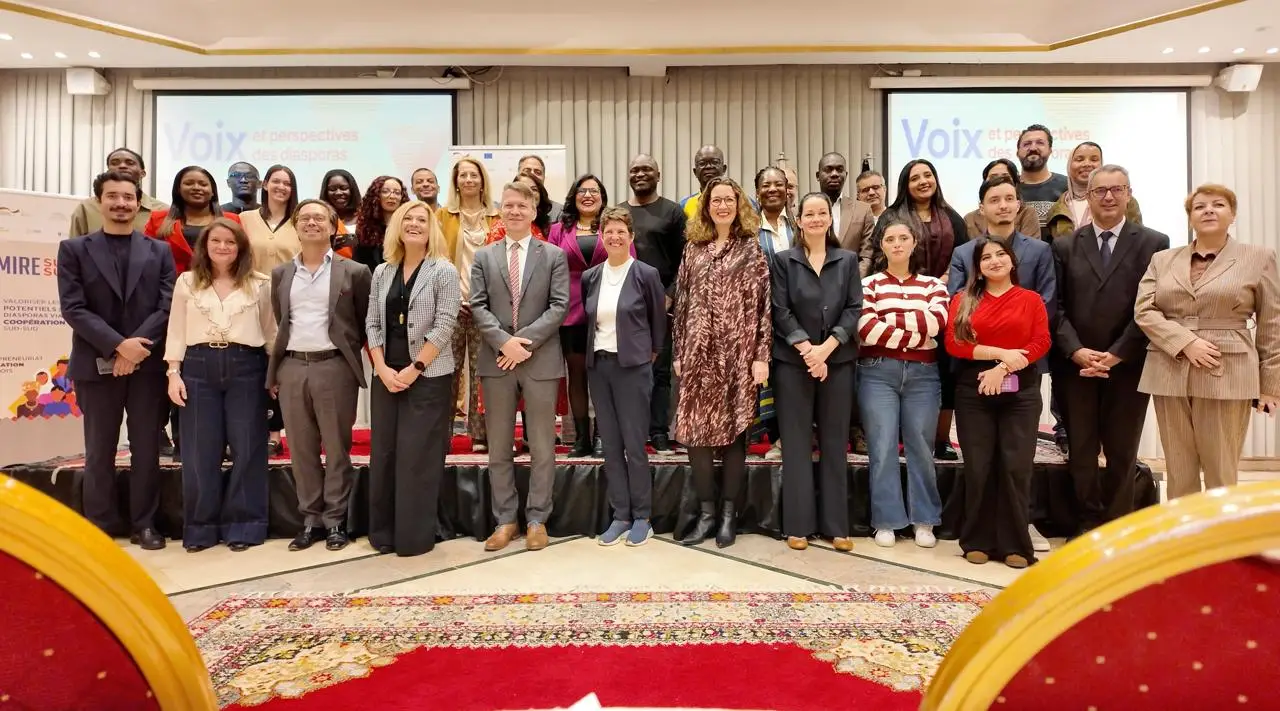
African diasporas: journalists trained to tell migration differently November 18, 2026
Thirteen journalists from Senegal, Morocco and Ivory Coast have been meeting in Rabat since Monday. They are participating in the launch of “Voices and Perspectives of Diasporas”, the media component of the Pomire South-South project, co-financed by the European Union and the German Ministry of Development.
Sami Badreddine, head of the Pomire project at the DW Akademie, declined the objective. It is about “promoting a balanced and inclusive perception of migration”, by promoting the successes of diasporas and documented media stories. Concretely, the project aims to enable diasporas living in Morocco, Ivory Coast and Senegal to share their successes, strengthen South-South networking and contribute to local development. For him, originality lies in geography. “Usually, when we talk about diasporas, it is often a diaspora that is located in a northern country. » This time, the emphasis is on mobility between countries in the South.
Anta Seck, journalist at RTS, wants to go beyond the story of irregular immigration. “How can we tell the story of the Senegalese diaspora today? How can it participate in the economy of countries, without necessarily only talking about money transfers? » Pierre Dipomelin, from the New Ivorian Channel (NCI), wants to highlight legal migrants who contribute to the economy of their host country and enrich it culturally. According to him, journalists must “learn to change their discourse”.
Senegal is one of the six project countries, along with Ivory Coast, Guinea, Mali, Morocco and Tunisia. Endowed with 5.8 million euros over three years, Pomire Sud-Sud has three objectives, recalls Léo Julien Pagnac, project manager at GIZ Morocco, namely “strengthening links between institutions, improving employment and entrepreneurship of diasporas, and better informing about their presence. This is why we are here today,” he emphasizes.
Els Mortier, head of the “Migration and Resilience” team at the EU Delegation to Côte d’Ivoire, expects from participants “content that will give a positive image of the diaspora”. Representatives of the department responsible for Moroccans living abroad and civil society also attended the opening.
The workshop, led by DW Akademie trainers, continues until Friday.
Abdou Khadir SECK, in Rabat (Morocco)
