
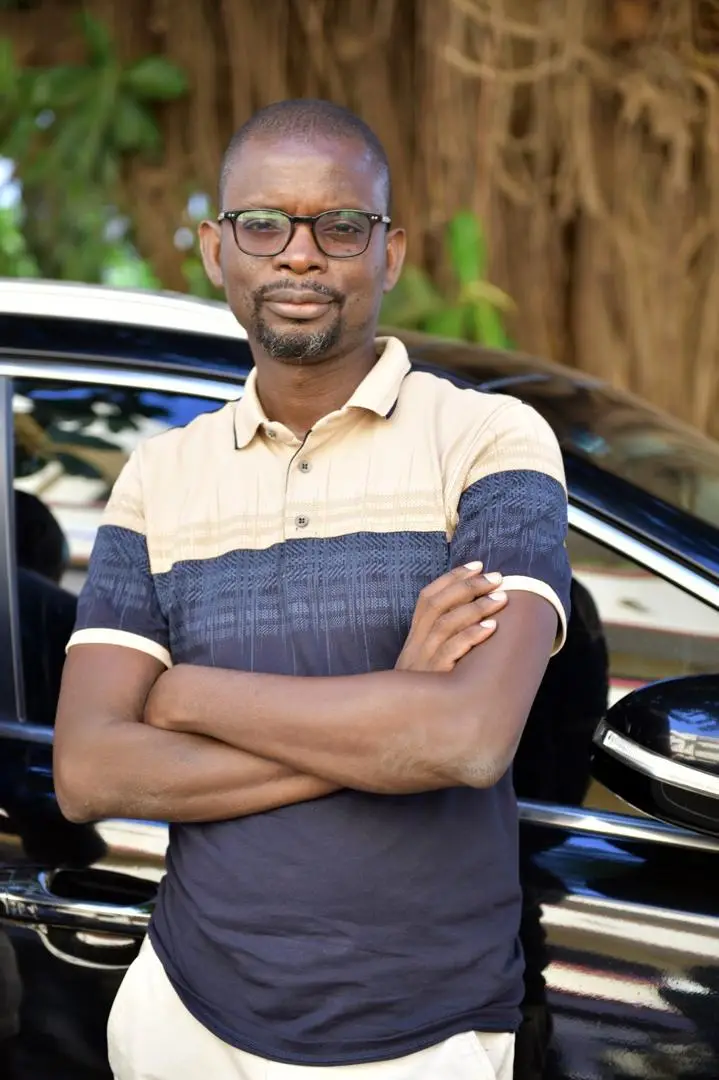
Samba Oumar Fall signs a romantic triptych November 2, 2026
A mother who hides her cancer from her children, travelers ready to die to reach a promised land, a man who sets out again in search of his wife kidnapped in Libya. With “The Silence of Impotence”, “100 Hopes” and “God is not Senegalese”, published by Edisal, Samba Oumar Fall marks this literary return with a romantic triptych which gives flesh to the great distresses of our time.
Every true word conceals a background that its literality is not enough to exhaust. We still need to know how to untie meaning from its envelope, listen to the unspeakable and consent to this slow decantation of thought by which intelligence, freed from immediate evidence, ends up exhuming its substance.
This initiatory sapience, whose hermeticism an old man had jealously preserved, reverberates with singular acuity at the edge of the work of Samba Oumar Fall (SOF). “I hope that this book will participate, to its extent, in this fight which concerns us all: I have decided to donate all of my royalties from its sale to the Senegalese League for the Fight against Cancer. This is my way of giving a concrete extension to this project. Ensuring that each copy sold becomes, however modestly, a gesture of solidarity towards those facing cancer,” SOF proudly affirms
He could have kept the fruits of his literary labor with him. The journalist for the national daily “Le Soleil” has instead chosen to convert the product into a solidarity resource for the benefit of those whose struggles he brings to the attention of the public. There is no ostentation in this approach, even less any inclination to drape oneself in the trappings of heroism.
Salimata, dying without daring to say it
The gesture nonetheless reveals a rare disposition to make creation an extension of human commitment. Her humanist gesture acquires a unique resonance in this month of October dedicated to raising awareness of female cancers. It gives, beyond its scope, additional depth to the first of the three novels that the writer is publishing this year with Edisal.
With “The Silence of Impotence”, “100 Hopes” and “God is not Senegalese”, Samba Oumar Fall takes the reader into the interstices of a bruised humanity.
After twenty years spent in France, Salimata Fall returns to Senegal with a secret that eats away at her soul: incurable cancer. Her daughter Raby, a lawyer in Paris, and her son Doudou, based in Montreal, know nothing of the evil that condemns her. Out of love, this mother chooses to keep silent about the inevitable, even if it means facing the terror of her last days alone.
Samba Oumar Fall gives this pain a singular form. In the novel, the cancer takes shape, comes to sit in front of Salimata and converse with her. The illness, invisible to others, becomes his daily interlocutor. She speaks of death, of the time that remains, of the life that continues around a condemned body.
This troubled presence transforms Salimata’s days. Perhaps the cruelest thing is not knowing that we are going to die, but having to continue to live with this knowledge without being able to place it in the hands of those we love.
It is to these women that Samba Oumar Fall wanted to dedicate his book. “The Lord inspired me to dedicate a book to women, especially those who courageously fight cancer. It seems only natural to me that the fruits of this work do not only benefit me,” confides the journalist.
In “100 Hopes”, the pain changes its face. She leaves Salimata’s room for the disturbing lands of a fresco where mythology and fantasy give the human drama dizzying proportions.
Every 333 years, Lightning emerges from the darkness to lead a handful of chosen ones to a promised land of eternal spring. Since its last appearance in 1687, a plague has decimated nearly half of humanity.
“100 hopes”, when the dream from elsewhere demands its tribute
On a beach, 2,020 fighters clash, a hundred survivors are retained, but only 33 will reach the other shore. Under the guidance of the Ferryman, an immortal ferryman with a tortured body, travelers cross 18 deadly gates, bewitching cities and the kingdom of shadows.
Among them, Aljana, consumed by revenge, Rahma, a pregnant mother in search of redemption, Dieuwrigne, blind from birth in search of El Dorado, and Amul Yaakar, whose Wolof name means “without hope”, each bear the scars of a battered existence.
A former migrant who went through detention in Libya, Nicaragua and expulsion from the United States, the latter embodies the disillusionment of a quest which sometimes transforms the promise of elsewhere into the way of the cross.
Beneath the trappings of the marvelous, the novel thus unearths the contemporary tragedy of exile. These departures where we risk our lives for a better land, without the certainty of never reaching the other shore.
But if the work “100 Hopes” ends with the uncertainty of the other shore, “God is not Senegalese” explores the disenchanted tomorrows.
With Makhou Sarr, forced to return to Libya to find his kidnapped wife, Samba Oumar Fall examines the wounds of an exile whose torments survive at the borders.
At 52, Makhou Sarr believed he had staved off the vicissitudes of exile. After nine years of hiding in Italy, his regularization, his marriage to Léna and his return to Senegal, the pandemic shatters this fragile balance.
Hospitalized for twenty-eight days, he received this enigmatic sentence from an old dying imam: “God is not Senegalese. » The formula is taking shape in a country battered by insecurity, riots and disillusionment.
But fate has a new ordeal in store for Makhou: Léna is kidnapped in Libya. He must leave again, face the dangers and criminal networks to find the one he loves.
After long years dedicated to writing, following the flashes of inspiration and the intermittences of creation, the time of publication sounded like a death knell for waiting.
To those who would be surprised to see three novels published together, after nine other publications, Samba Oumar Fall contrasts the patience of a work matured in the secret of the imagination. “Writing is a delicate exercise,” he says, smiling.
Yes, writing obeys its own clockwork.
And if literature is a matter of accuracy, football, which the author loves, offers a beautiful metaphor: “A ball out of bounds will never shake the nets”.
SOF, for its part, chose its trajectories, sharpened its shots and found its way to consciousness.
These three books are therefore neither hasty nor gratuitous profusion. They mark the culmination of a long literary gestation.
By Adama NDIAYE
