
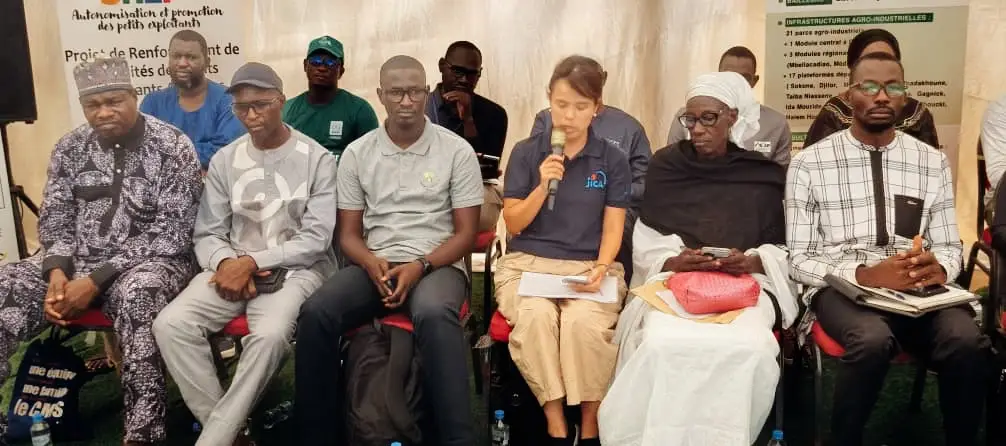
Business relations in agricultural value chains: actors in the central zone trained in new mechanisms
The National Agricultural and Rural Advisory Agency (ANCAR), through its South Peanut Basin zone management, with the support of the Agropole Center Project and the SHEP 2 project, organized, this Wednesday, October 28, in Kahone (Kaolack), a forum for exchanges and sharing of experiences. The objective is to strengthen the capacities of stakeholders and promote business relationships within agricultural value chains.
The ANCAR headquarters, in Kahone, hosted this forum to connect stakeholders in plant value chains, as part of the second phase of the SHEP 2 project. According to the organizers, this meeting aims to establish business relationships between producers and other actors in horticultural value chains, in order to reduce information asymmetry. It also constitutes a framework for exchanges on financing, the supply of agricultural inputs and equipment, as well as the marketing of production. “It is a project which tries to strengthen the capacities of producers in order to make them autonomous. It’s about enabling them to make decisions based on market realities,” said Serigne Modou Mbaye, director of ANCAR in the central zone.
After a first phase carried out from 2017 to 2021, the project intends to reach a new milestone. For the JICA representative, this forum promotes contacts between producers and partners likely to provide them with solutions to the constraints identified. The meeting brought together stakeholders from the plant value chains from the regions of Fatick, Kaffrine, Diourbel and Kaolack, including buyers, processors, suppliers of inputs and agricultural equipment, as well as financial institutions.
In this dynamic, the Agropole Center Project has established a partnership with ANCAR to improve the productivity of agricultural value chains in these four regions. “The presence of Agropoles at this forum is justified by the value chain approach that they advocate. The SHEP tool constitutes a strategic input for networking and intermediation between stakeholders,” explained Babou Dramé, national coordinator of the execution unit of the Agropoles Sud and Center projects.
Lasting three years and worth more than 200 million FCFA, financed by the African Development Bank (AfDB), the agreement covers advisory support to producers, the intensification of production systems and the development of contractualization in the peanut, millet, sorghum, corn and salt sectors. Producers welcomed this initiative, while drawing attention to the persistent difficulties linked to the marketing of their crops.
