
A brilliant business October 29, 2026
Laundromats, laundries and dry cleaners are multiplying in the Dakar neighborhoods, attracting customers looking to save time. Behind this thriving business, investors face many challenges: rising rents, high electricity bills, expensive detergents and machines that often break down.
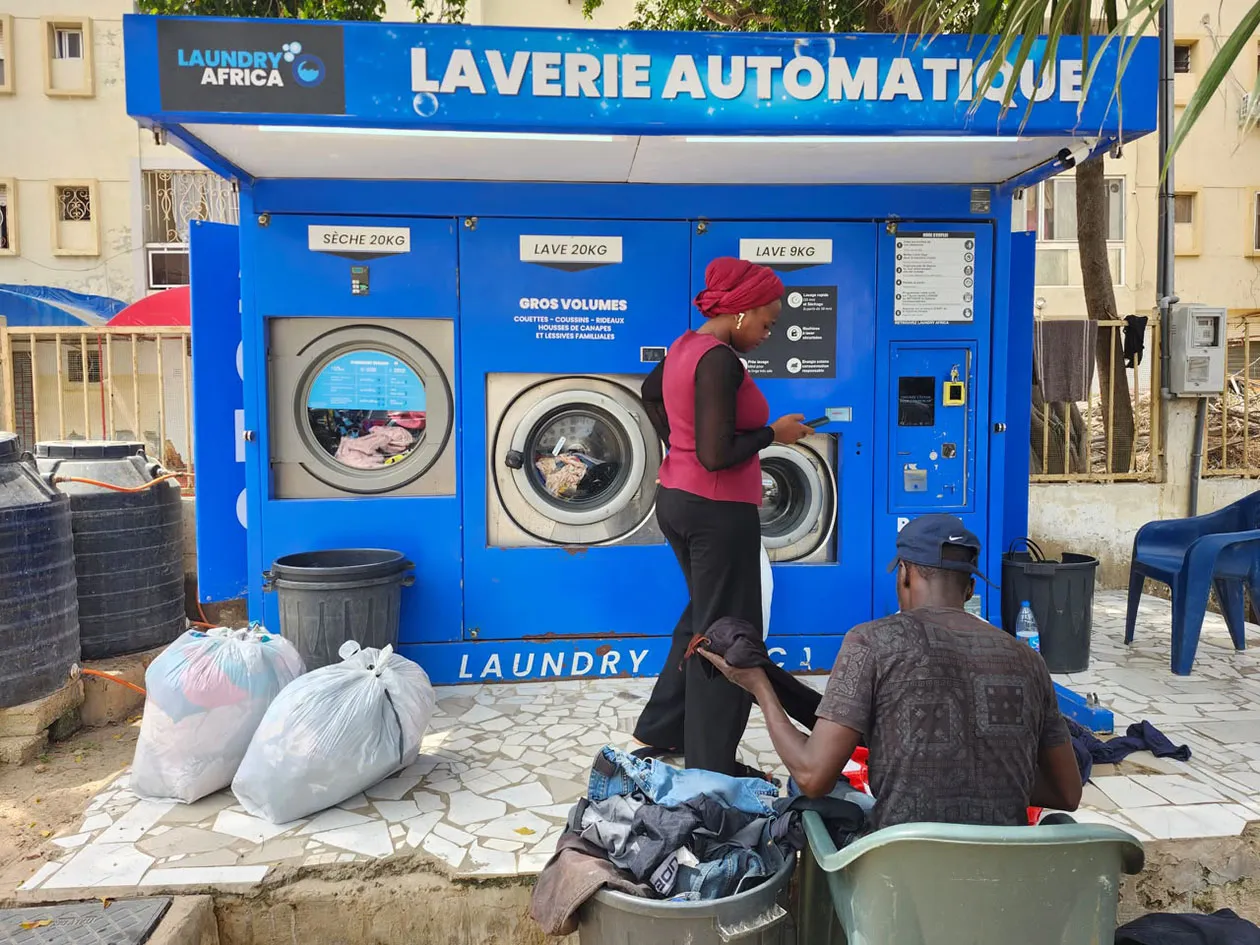
In the lively streets of the Medina, a working-class district of Dakar, the excitement never wanes. Coffee sellers call out to passers-by, while motorbikes and vehicles compete on narrow roads, creating long traffic jams. It is in this noisy atmosphere that a growing phenomenon has taken root: laundries, also called dry cleaning or laundries. Discreet or conspicuous, they have taken over almost every corner of the capital’s neighborhoods, offering services ranging from simple washing to complete ironing. Automatic or traditional, these establishments attract an increasing number of customers, attracted by the convenience of a turnkey service.
In front of his store located in the heart of the Medina, Alpha Bâ supervises his team of three employees. Already washed clothes dry in the sun, exposed for everyone to see. Inside, the space is cluttered with plastic bags containing clothes of all kinds and qualities. The noise of washing machines sometimes disrupts conversations.
This light-complexioned man has been running his business for more than five years, which he says is “profitable despite the difficulties”. “I inherited two large machines, but I bought two others second-hand: one for 200,000 FCfa and the other for 125,000 FCfa,” he confides.
Diversified prices
His activity consists of welcoming customers who come to drop off their dirty laundry, which he weighs before agreeing on a price. Indeed, at Alpha Bâ, pricing is negotiable. Faced with the scarcity of customers, on certain days, he accepts lower prices to guarantee a minimum turnover.
The services offered are available in three options: washing only, washing with drying and the complete service including ironing. “For washing without drying, it is between 200 and 300 FCfa per kilogram. With drying, count between 400 and 600 FCfa. And for washing, drying and ironing, the price is 750 to 800 FCfa per kilogram,” he explains.
The payment method varies between customers. Some pay the full amount after weighing, others pay half and pay the rest upon collection, while a few only pay when the laundry is collected.
A few steps away, Moulay Salif Diallo runs his own laundromat with the help of his sister. Despite the incessant honking and stagnant sewage outside his premises, he goes about his business. Sweating, he explains that he uses four machines: two for washing, one combining washing and drying and another for drying only. An iron completes the equipment.
“The drying machine cost me 80,000 FCfa; the one that does the washing and drying, between 150,000 and 200,000 FCfa, and those for washing alone, 90,000 FCfa each,” he specifies. All were acquired second-hand, with the exception of the scale, purchased new at 14,000 FCfa.
Unlike Alpha Bâ, Moulay Salif Diallo applies fixed prices: 300 FCfa for simple washing, 500 FCfa for washing with drying and 800 FCfa for the complete service including ironing. “New customers pay in full after weighing. For the regulars, I sometimes show understanding,” he says.
In Fass, not far from the Medina, a similar atmosphere reigns. At one of the “Fotall service” laundromat points, the industrial machines are installed in the open air. Lissa Sarr, the sales director, indicates that these machines are of two categories: those which can contain a volume of 9 kg and others of 20 kg.
“For a volume of 9 kg, washing and drying are charged at 4,500 FCfa. If we add ironing, the customer must pay 3,000 FCfa more; which makes a total of 7,500 FCfa. For the 20 kg, washing and drying costs 6,000 FCfa, and ironing at 5,000 FCfa,” she explains. The company has around thirty employees, adds Lissa Sarr.
Pape Ndiaye, a loyal customer for more than two years, is full of praise for these services. Previously, he had to call on a laundress at home. “But, do you know what it costs? You had to pay for the laundry, buy the meal for the person, not forgetting the detergents and the small expenses that add up. The worst part was the time I wasted,” he remembers.
Now, he drops off his laundry in the morning and picks it up clean, folded and ready to wear. “I save at least half a day a week,” he says.
Pape, however, remains lucid: not all laundromats are equal. “You sometimes collect your laundry and wonder if it’s really been washed,” he says. According to him, the choice of address is essential.
Behind these pricing and turnover figures lie serious difficulties for investors. Alpha Bâ first mentions the cost of rent. “Since I have occupied the premises, the rent has increased from 125,000 to 250,000 FCfa per month. I spoke about it several times with my landlord, but he refuses to lower the amount,” he laments.
Difficulties abound
The cost of electricity represents a considerable additional burden. “Despite a daily budget of 5,000 FCfa, it happens that the recharge does not cover the entire day,” criticizes Alpha.
Added to this are expenses for detergent products: washing powder, disinfectant, liquid soap, the 20 liter can of which can reach 30,000 FCfa.
Another, more unexpected problem is raised by Alpha Bâ: some customers drop off their laundry and never return. “Clothes can stay here indefinitely without their owner coming to collect them,” he says.
For Moulay Salif, the difficulties are similar: rent, water, electricity and machines which often break down. For his cramped premises, he pays 200,000 FCfa in monthly rent and recharges at least 5,000 FCfa of electricity per day.
Despite these obstacles, these entrepreneurs continue to run their businesses, convinced that this booming sector still offers great prospects.
By Aziz Méthiour NDIAYE (Intern)
