
LFR 2026: the State reduces its investments in the face of falling revenues
The expected drop in public revenue and the increase in charges are forcing the government to review the 2026 budget. Presented on Sunday October 25, the amending finance law provides in particular for a reduction of 555 billion CFA francs in investment credits, some projects of which will be postponed to 2027.
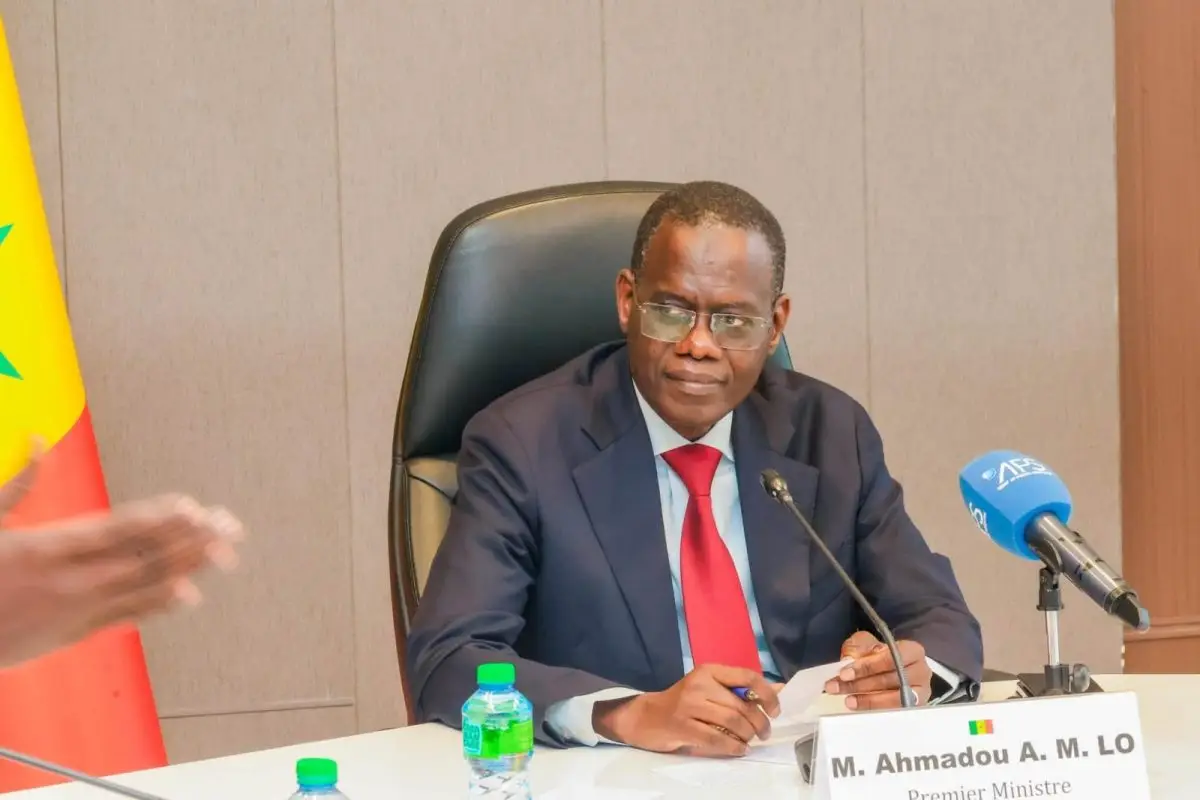
The revision of the 2026 budget should allow the State to adjust its expenditure to the resources actually mobilized. During a press conference held on Sunday October 25 at the President Mamadou Dia Administrative Building, the Prime Minister, Ahmadou Alhaminou Mohamed LO, justified these arbitrations by the drop in revenues and the increase in public expenses.
“The amending finance law is an objective necessity. The balances have been modified; so we have to change them,” he said. According to the figures put forward by the head of government, revenues should decrease by around 340 billion CFA francs, while expenses would increase by 540 billion. The executive thus intends to contain spending while ensuring the continuity of the essential missions of the State.
Falling revenue, spending under pressure
The Minister of Economy, Finance and Planning, Cheikh Diba, specified that public revenues were expected to fall by 340.3 billion CFA francs, mainly due to the resources expected from the Economic and Social Recovery Plan (PRES), which were not mobilized at the expected level.
The financial authorities nevertheless exceeded their objectives. At the end of September 2026, Customs and the General Directorate of Taxes and Lands had mobilized 81.2 billion CFA francs more than their respective forecasts, according to the minister. These results limited the effects of the decline in revenue, without being enough to compensate for it.
Energy costs also increase pressure on the budget. Initial forecasts were based on a barrel of oil at $64, while prices exceeded $110 and reached around $120 on the eve of the minister’s intervention, according to his statements. This increase increases subsidies to the energy sector and reduces the State’s room for maneuver.
Cheikh Diba also mentioned a budget deficit likely to reach 10% and financing needs exceeding 6,700 billion CFA francs. Such a situation, he warned, would complicate the coverage of public spending and could lead to new payment arrears.
In this context, the LFR project provides for a reduction of 555 billion CFA francs in investment credits. The Prime Minister stressed that these adjustments did not necessarily mean the abandonment of the projects concerned: certain operations would be postponed until 2027, when financing and execution conditions permitted.
At the end of September, revenues collected under the PRES amounted to 173 billion CFA francs. According to the elements presented, this mobilization led to the deferral of 295 billion CFA francs in expenditure, to which is added 239 billion CFA francs in external financing expected but not mobilized.
“A budgetary entry, yes, for a hospital, for water, for a borehole, but if that cannot be carried out, let’s postpone this credit to next year to be able to carry out other expenses,” indicated Ahmadou Alhaminou Mohamed LO. The government says it wants to prioritize projects with secure financing and expenses that are essential to the operation of public services.
According to the Prime Minister, more than 110 billion CFA francs could be financed from the PRES, notably for university projects, health infrastructure and the Ziguinchor airport. Several hospital operations are expected to continue in 2027, notably in Mbour, Kaolack, Ziguinchor, Saint-Louis and Matam. The sanitation works of Touba, certain health centers, agropoles as well as school and health infrastructures are also among the projects concerned by the arbitrations.
The LFR must also contribute to the settlement of State debts to businesses. Cheikh Diba estimated the stock of arrears remaining to be settled at 1,956 billion CFA francs. The government plans to include 300 billion CFA francs in the amending budget.
This envelope should help beneficiary companies to replenish their cash flow, resume their activities and complete certain projects. Payment delays particularly weigh on construction and public works companies, which must also honor their commitments to their suppliers and workers.
To cover its financing needs, the State intends to favor the regional financial market, in order to mobilize more domestic resources while limiting the use of new external loans, explained the minister.
Priority investments maintained
Present at the press conference, the Minister of Infrastructure, Déthié Fall, assured that the budgetary adjustments did not mean a general shutdown of construction sites. “No project undertaken by the Ministry of Infrastructure is at a standstill,” he said, referring however to slowdowns sometimes linked to wintering.
On the Ngaye-Mékhé-Péssé axis, the progress rate reaches 15%. The company responsible for the work received 1.7 billion CFA francs as a start-up advance, according to the minister.
In the health field, the program presented provides for the construction of 100 health centers in three phases, as well as five hospitals. The first phase covers 35 health centers and three hospitals; the second, on 35 centers and two hospitals; the last concerns 30 health centers.
For school infrastructure, an envelope of 62 billion CFA francs is planned to build 2,500 classrooms, with 300 mini-drills, 300 hygiene blocks and 300 sanitary blocks. The minister also mentioned work carried out with the Department of Higher Education for the delivery of university infrastructure.
The 2,000 kilometer road program is also among the projects that the ministry intends to pursue, in coordination with the Ministry of Finance. Déthié Fall cited the Marsassoum-Bambaly and Bignona-Diouloulou axes, as well as 130 kilometers of roads planned in the north, notably in Dandémayo, with 13 bridges.
The urban modernization program carried out by Promovilles concerns 99 municipalities, 33 of which must make up a first phase which will be announced soon.
The Senegal 2050 course reaffirmed
Despite the financial constraints, Ahmadou Alhaminou Mohamed LO assured that the adjustments did not call into question the Senegal Vision 2050, focused in particular on economic sovereignty, social justice, the development of national resources and the sustainable creation of wealth and jobs. “This ambition has not changed,” he insisted, specifying that only the method had to evolve.
The Prime Minister called for placing the interests of the Senegalese at the heart of the debates on the amending finance bill. “The only objective that is valid for all of us is to lighten the burden of the Senegalese,” he declared, recalling the need for the State to honor its commitments, to guarantee the continuity of public services and to maintain essential investments.
The executive thus defends a strategy based on the review of expenditure, the mobilization of available financing and the maintenance of projects deemed priority. Its implementation will depend in particular on the realization of expected revenues, the progressive settlement of arrears and the capacity to relaunch deferred investments.
Yaya Sow
