
In the camera of a universal aesthete October 18, 2026
To visit “Les Dents de la mer”, named after the former home of the first head of state of Senegal, is to encounter the intimacy of a personality as shrouded in perpetual glory as he is endlessly booed. The house, which has become the “Léopold Sédar Senghor Museum” since 2014, still houses today the soul of this “mixture” of the universal, which affirmed its hybridity even in its “mbind”.
Before entering the former home of Léopold Sédar Senghor, one is inevitably tempted to imagine how the setting of an art lover and artist himself to the core, political to the nails, and humanist in all his words takes shape. The building, which faces the sea, at Fann-Résidence, on the western Corniche of Dakar, remains august despite the threat of dilapidation.
Crossing the threshold, we discover a vast area of 7,432 m2. The calm hides the road bustle from outside. The air inside is caressed by the sea breeze, although a little whipped by the horns and other backfires. But the visitor’s attention is more captured by the majesty of the residence, designed by the architect Fernand Bonamy and built between 1975 and 1978, which responds to the asymmetrical parallelism. The built surface area of 880 m2 is surrounded by a garden which remains only in the forecourt, with its fetish baobab which acts as sentinel. Behind and to the side, the thick trees almost form a windbreak hedge.
The oceans of the Negritude poet
A heavy solid wood gate opens onto the living space of the “Dents de la Mer”, which has become the “Léopold Sédar Senghor Museum” since 2014. Senghor, with his wife Colette and their son Philippe Maguilen moved here after his departure from power in January 1981. The visitor admires, from the vestibule, a large collection shelf. The compartmentalized piece of furniture keeps travel souvenirs and other gifts from counterparts of the first head of state of independent Senegal. Left as the couple stored them, the collection demonstrates the idea of universal civilization that Senghor cherished, while exalting the Cradle of Humanity. At the very top of the shelf, sits a Head of Pharaoh Tutankhamun. Yes, Pharaonic Egypt, pioneer civilization. It dominates the rest of the treasures from all over the world: Bamileke statue, present from a monastery in Normandy, vase from South Korea, Dogon relic, traces from Cabo Verde, Japan and Taiwan, the United States, etc.
Two other libraries provide information on the hybrid culture of Senghor. With two copies of the Koran and the Bible sharing the same box, Leopold expresses his deep-rooted but tolerant faith. Two statuettes of ceddo warriors (or cedo, Senghor would probably correct) playing wouré overlook the emblematic samurai helmet, which in turn sits alongside the coat of arms of the Japanese navy. One of its boats, at the last stopover in Dakar, deposited the new seals. On the very last level, a magnificent wooden plaque signed by the artist Mbaye Diop has under its feet an elephant tusk sculpted with anthropomorphic and zoomorphic figures and the medallion of the Duke of Lévis Mirepoix. Still on the ground floor, a tapestry by Papa Ibra Tall decorates the reception room, as if to extend the symbolism of the Banquet Hall. Just above this exceptional work, the sculpture that Senghor placed next to him during his addresses to the nation resists time and its erosions. The permanent light of this space is offered by a pool surrounded by glass and opened towards the sky, for the joy of Senghor who wanted to retire peacefully. Beyond the splendor, the installation gives freshness to Jean-Pierre Brossard’s decorative work.
Their souls still reside there…
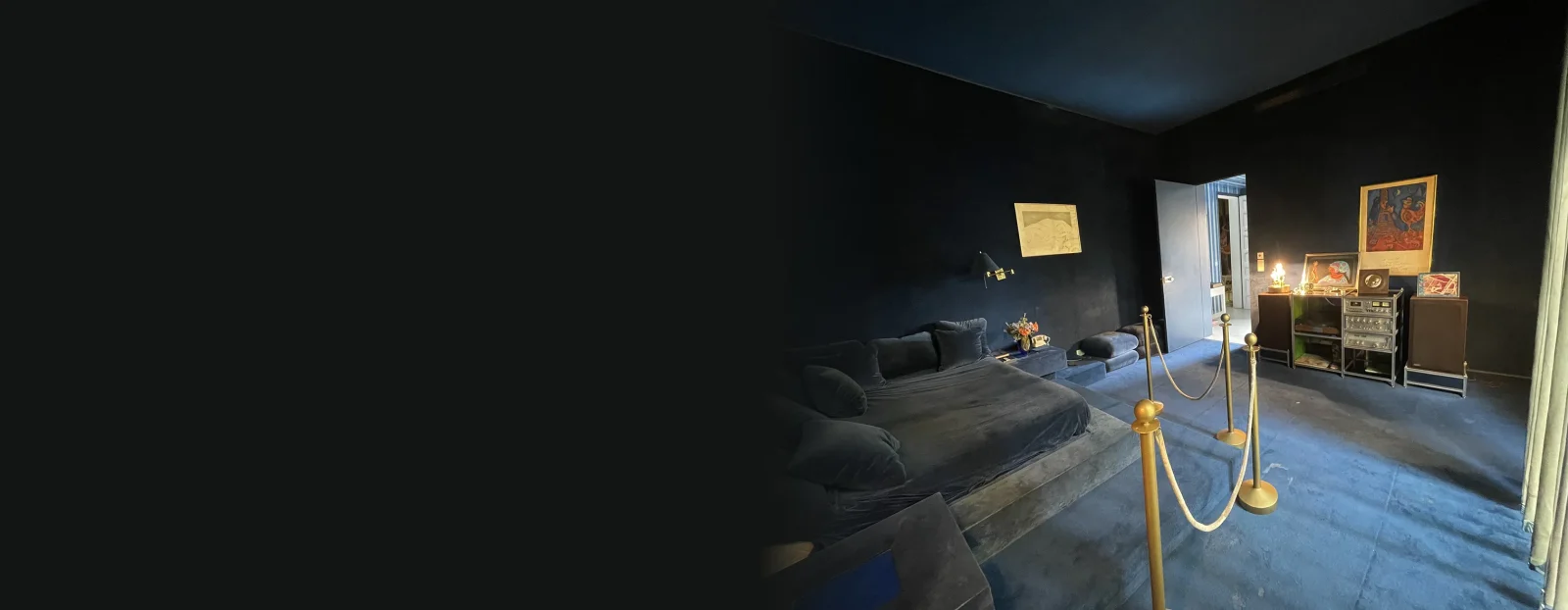
The decorative swimming pool also sparkled the eyes of the guests in the White Room, where Mrs. Senghor received, and in the Pink Room, the waiting room for Mr. Senghor’s office. This office is now occupied by Ms. Marième Ndoye, curator of the Léopold Sédar Senghor Museum. In the Green Room, in the private living room, we feel the femininity and distinguished allure of Ms. Colette Senghor. The color is her desire, moreover, she, the Norman who cannot live without greenery around. This is how green dominates the room, blocked by a window which relates a part of the couple’s love. A poem by Senghor has been displayed there since the 15th Biennale of Contemporary African Art. It says: “Now Senegalese to Senegalese women wanted to be the Norman of long lineage, with green and gold moire eyes”.
Ah, what a blue flower he is, good old Sédar. But his “Blonde d’amour” did him well. By cooking in the art of good food, by his loyalty, his dedication and his eye for the line. Look, it’s written by hand by Mrs. Senghor “Elevator broken” on the elevator door to force Léopold to climb the steps and exercise. A hallway then leads to the two guest bedrooms. In the first, we still keep the cradle of Philippe Senghor and designer dresses of Mrs. Colette Senghor. These imprints make the souls of the former occupants of the house survive, especially when the marks of tragedy arise.
By Mamadou Oumar KAMARA
