
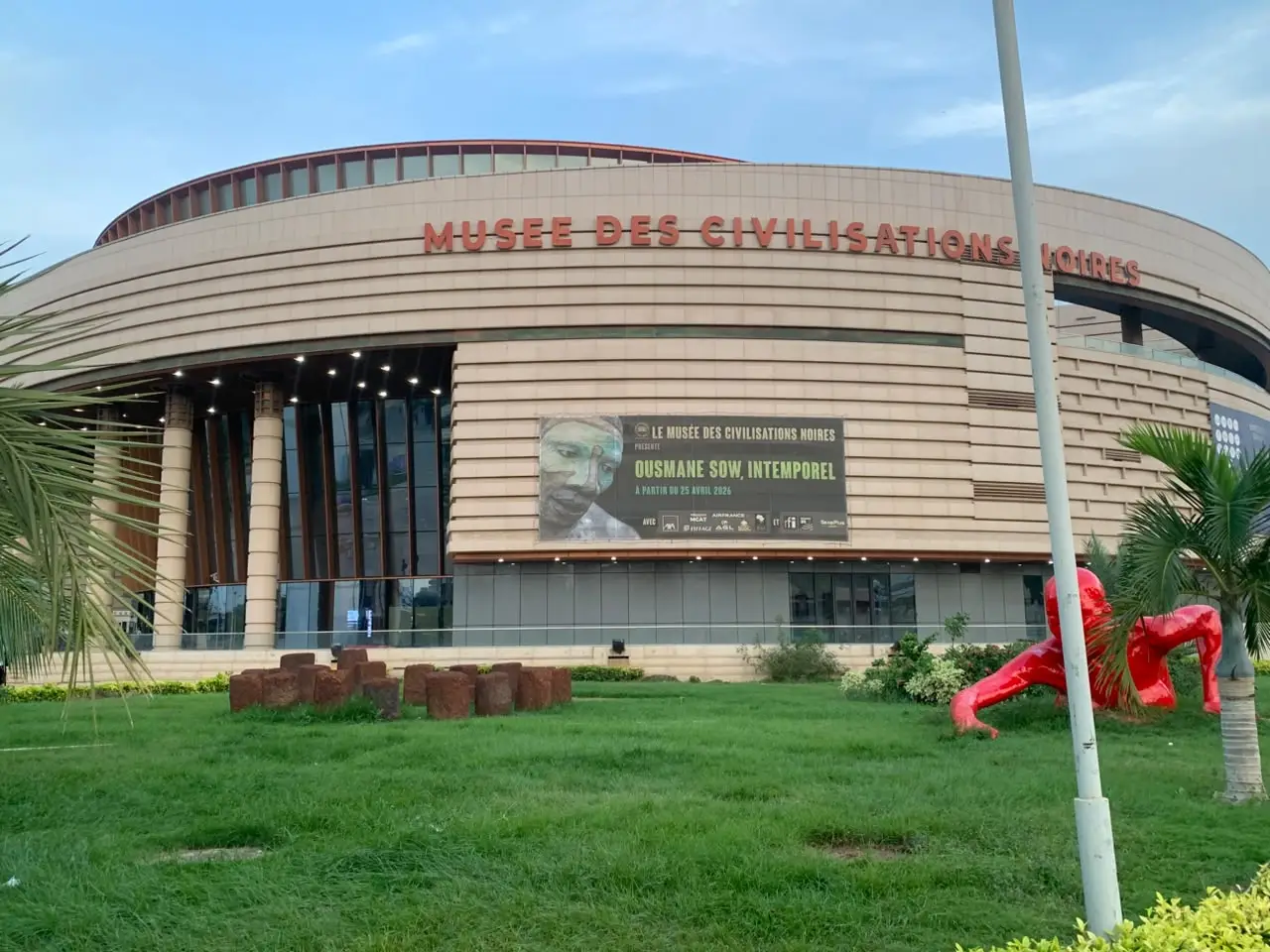
Culture: The Museum of Black Civilizations, a portrait of negritude
The Museum of Black Civilizations in Dakar is full of works of art. It also tells, through this plethora of artistic creations, history without forgetting the present. From North Africa, through the West, the East, the Center, to Southern Africa, this building is an open showcase that highlights black achievements and figures.
A timeless gate stands in the city center, behind the main Dakar train station. Dressed all in brown, this giant with feet that are anything but clay faces the Grand Théâtre Doudou Ndiaye Coumba Rose. As you walk along these fences that surround it, a strange creature seems to emerge, all red, from the ground. It’s 5:29 p.m. Looking up, you can see the inscription “Ousmane Sow intemporel” on an imposing poster. Below, behind this statue whose breasts plunge into the grass, megaliths form a circle. From the outside, this lair also takes on a circular shape.
A space-time portal
At the entrance to the museum, you must pay the fee for the visit: 2,000 francs, reduced to 500 francs if the visitor is a student. Security checks and there you have this cumulonimbus of history. A unique architecture. Head to the center stairs. By overlapping them, an iron structure, in the shape of a tree, marks the middle of the place. A security guard sits on a chair on the first level. He responds to a “salam” by nodding his head.
To the right, a representation of a cotton field dominates the path. Iron modeled in the shape of a cotton plant has finished flowering. Cottons ready to be harvested. Here, nothing is chance, everything refers to something, to someone who is at the origin. Two young people are walking in this field and their gazes are caught by two silhouettes hanging from the ceiling. The work is called “Premonition 1-2”, produced by Moustapha Dimé.
Straight ahead, in a corner, almost alone facing her destiny, a slave represented in metallic material stands. She is crucified in the void by her status as a Negro in a slave-holding America. A note announcing the public sale of slaves sticks to his chest. It is possible to read: “a valuable Negro woman, accustomed to all types of domestic work”. A first sentence to sell a mother of four children. She’s not the only one on the market during this auction. The sale took place on Tuesday March 5, 1833 at 1 p.m. “On Tuesday, March 5th, 1833 at 1:00 PM the following Slaves will be sold at Potters Mart, in Charleston, S. C,” an announcement made by a certain Richard Clagett. This work on which these young boys linger is signed Yrneh Gabon.
After the auction, on the left, a door leads to a gallery.
Images that play music
The first room, lit by hanging lights spaced about a meter apart, houses a large photo. This is a photo taken by Mactar Ndour during a Boukout ceremony in Diatock. It highlights shirtless men, crouching and with bows in hand. This photograph taken in 2015 opens the corridor which leads to the photographic galleries of the great icons of African music. On these blue, brown, purple and white walls in places, photos of Angélique Kidjo, Manu Gallo, Étienne Mbappé, Alioune Wade, Bembeya Jazz, Rokia Traoré, Alpha Blondy and others are hung. At the back of the room, alone on a portion of the wall, the portraits of Baba Maal and Ismaël Lô stand. As if to bear witness to the imprint with which they left their mark on Senegalese music. What can we say about Youssou Ndour?! The Senegalese star alone occupies the opposite wall in this other room. A capture illuminated by two light projectors. One on each side.
Lights that bring attention to these personalities who have already forced many people to illuminate them on stages around the world. An artistic creation attracts attention, turning back towards the room where the photo of Mactar Ndour is located. Gris-gris cling to a brown fabric. The latter, in turn, is hung on the wall. It is a creation by Abdoulaye Konaté: “Homage to the hunters of Mandé”.
In the large hall on the second floor, a field is planted there. No corn or rice, but matches. Some are burnt, others still intact, as if to say something. Here, everything speaks, although frozen by time.
It’s time to get down to the ground floor. From mathematics to writing, including the remains, the flimsy walls of this place return to the black man what belongs to him. A historical recognition which still serves to awaken a black civilization. This civilization which has long been drowned in a history marked by centuries of suffering.
A wall of memory bears men and women to the left of the main entrance. Political figures who fought for independence, such as Kwame Nkrumah of Ghana, Sylvanus Olympio of Togo, Amílcar Cabral of Guinea-Bissau, Sékou Touré of the Republic of Guinea, Patrice Lumumba of the DRC, Mamadou Dia of Senegal and many others.
Personalities who made black people aware of their value. This is the case of Senghor, Aimé Césaire, William EB Du Bois and Marcus Garvey. Women who, in a racist America, demonstrated strength of character during the fight against this same segregationist system. Angela Davis, Rosa Parks and Mary McLeod Bethune are among them. But also athletes like Lewis Hamilton and Michael Jordan. Without forgetting Ousmane Sow, the artist of excess, as he nicknamed himself.
Ousmane Sow, the timeless
Precisely, his works are behind this “line of continuity”. A young woman in a green hijab jumps and cries: “I was scared.” She was surprised by the presence of a giant, “the wise one”, who stared at the entrants. He sits in the center of this room. The security guard approaches the young woman to find out what was happening. “It’s the statue,” she says, her hand on her chest. “There is something to be afraid of, yes! », replies the security guard.
On the left, other giants by Ousmane Sow. The first in this collection is a gentleman who seems to be focused on reading scriptures on a paper. His name is Toussaint Louverture. His clothing is reminiscent of that of French fighters during the medieval period. Another sculpture attracts the attention of the young woman in green and her friend. “They’re huge,” remarks her friend in white, who apparently can’t resist filming them. A man who is difficult to identify because he is wearing a hoodie hides a child in his clothing. He is “The Righteous One”. Behind his imposing works, it is possible to see photos of the artist sculpting his characters.
In the next room, the series of little Noubas is exhibited.
Ousmane Sow’s art is a work of staging. The sculpted figures belong to the Fulani, Nouba, Maasai and Zulu ethnic groups. And for each of them, moments which provide a lot of information about the identity of these human groups.
These include wedding scenes, animal sacrifices among the Fulani, wrestlers with sharp bracelets among the Noubas, the Zulu warrior quenching his thirst with, next to him, his wife on his knees, as well as the scene of the blood drinker and the buffalo among the Maasai.
In the back room, following the arrows on the ground, to the right, a projection features Ousmane Sow. In the courtyard of his house, he is bringing his characters to life. An enclosure filled with works which sometimes suffer from the passage of rain. A film accompanied by almost dull music which punctuates the visit to the exhibition of the first African to be elected to the Academy of Fine Arts.
By the will of the arrows, this visit ends with the recognitions that the artist received. Four young girls lean over a table occupied by distinctions: national order of the Legion of Honor, national order of the Lion, commander of the order of Arts and Letters. Next to these medals, in a manuscript, Ousmane Sow thanks men who, without a doubt, left their mark on him. With his father in mind. A statue in the exhibition also bears his name: Moctar Sow.
It’s almost 6 p.m., the museum doors will soon be closed for today.
The museum attracts a lot of tourists. The upcoming Youth Olympic Games will show the tourism potential of Senegal, but also, through these places, raise awareness of black civilizations and the people who made them shine.
Boubacar Diop
