
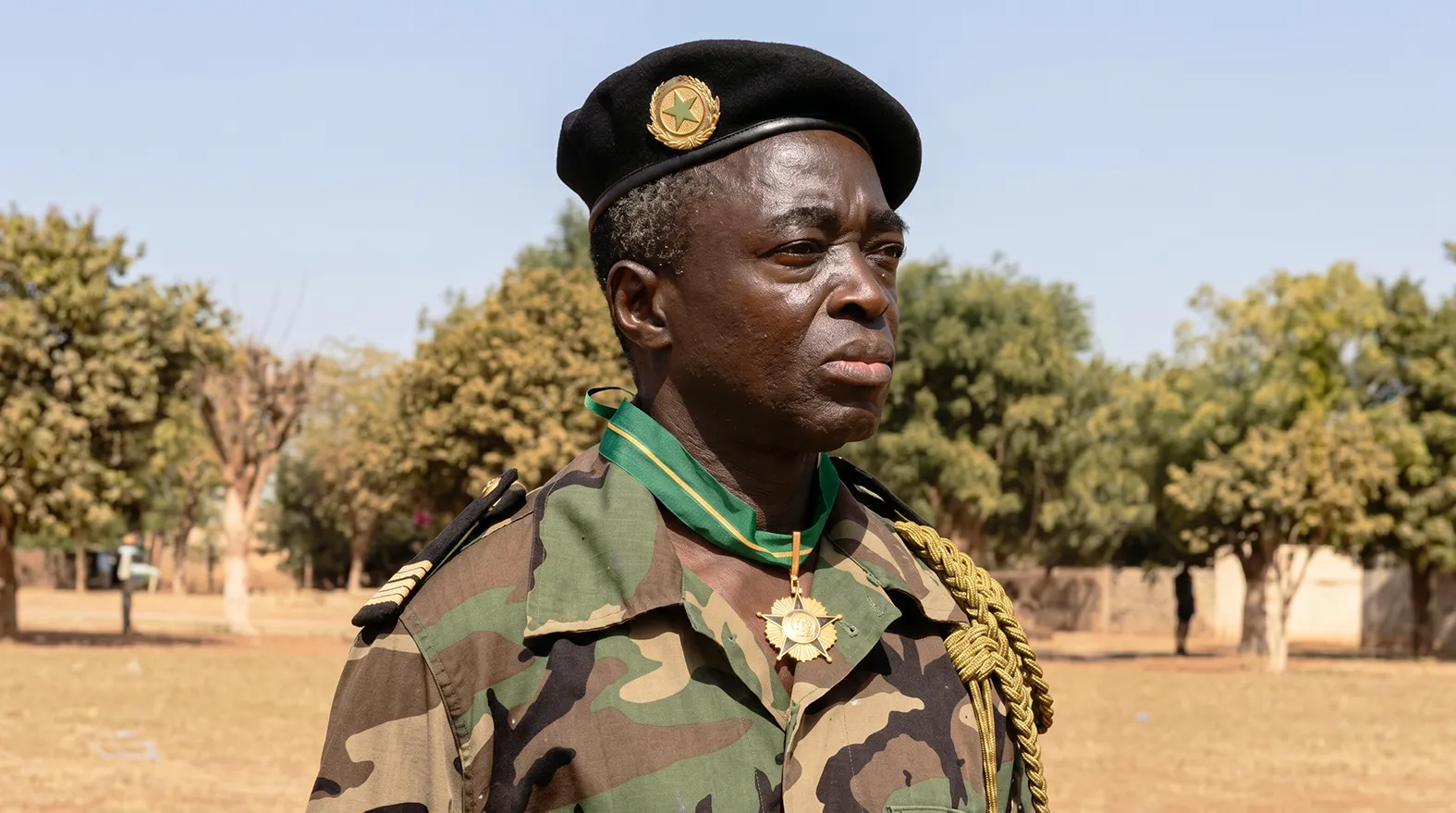
Late Colonel Georges Boissy: The immortal officer
Even though he has been missing for more than twenty years, the name of the late Colonel Georges Boissy remains alive in the memories of Casamance. Former respected military leader, architect of the return of displaced populations and builder attached to his land, this Senegalese army officer remains a tutelary figure in Mandina Mancagne.
ZIGUINCHOR – In the sacred calm of the Mandina Mancagne cemetery (Ziguinchor department) located not far from the church, a tomb still attracts attention. That of Colonel Georges Boissy. Here, silence speaks as much as words. More than twenty years after his disappearance on February 11, 2005, the memory of this senior officer of the Senegalese army remains intact in his village. In Mandina Mancagne, Georges Boissy is not considered missing. He is a presence. A living memory. A collective pride. Born on April 24, 1938, son of Raphaël Boissy, the former corps commander of the 5th infantry battalion left his mark on the military history of Senegal, but also that of Casamance scarred by decades of conflict. His journey still commands respect. His name was even given to the military camp of the 5th infantry battalion of Ziguinchor, as an eternal recognition of the Nation towards one of its most loyal sons.
But, beyond the stripes and military responsibilities, it is the man deeply rooted in his land who continues to move the inhabitants of Mandina Mancagne. Hyppolite Minkette evokes the name of the late colonel with admiration. In his voice, the pride is palpable. For this young village executive, Georges Boissy now belongs to the moral heritage of an entire generation. “Colonel Georges Boissy held very high positions in the Senegalese army. He notably directed the National School for Active Officers (Enoa) in Thiès between 1987 and 1990 before commanding military zone number 5 in Ziguinchor. Despite this exceptional career, he never severed his connection with his village. Seeing him today resting in Mandina Mancagne reflects his visceral attachment to his terroir,” confides Hyppolite Minkette.
One of the architects of the return of displaced people
Looking towards the reconstructed houses of the village, he especially recalls the capital role played by the former senior officer in the return of displaced populations after the tragic events of 1997. “After his retirement, Georges Boissy invested himself completely in the reconstruction of Mandina Mancagne. He was one of the main architects of the return of the inhabitants. In the negotiations for peace in Casamance as in the efforts to rehabilitate the villages, the deceased had an enormous influence. Many consider him here as the conductor of this renaissance,” explains Mr. Minkette. In the alleys of the village, some remember his visits to the concessions, his proximity to families and his commitment to the education of children. “He represented a model for the Mancagne community and particularly for the young people of the village. His journey has inspired several generations of officers and senior executives. Even today, Mandina has many military and justice executives who identify with its heritage. Georges Boissy was a real catalyst,” continues Hyppolite Minkette. The tribute paid by the Senegalese army, with the baptism of the military camp of the 5th battalion in its name, nourishes immense pride in Mandina Mancgane. “The fact that the camp bears his name shows how much the Republic recognizes his commitment and his sacrifices. Even after his retirement, he continued to serve peace in Casamance. Today we are trying to perpetuate its values of unity, coming together and love of the land,” says the young executive.
An absentee always among his own
At Mandina Centre, Dominique Mancabou reveals an emotion that is difficult to contain when he evokes the memory of the late colonel. “Here, Georges Boissy remains the most absent person. His journey continues to inspire younger generations. He played a major role in the rehabilitation process of villages affected by the conflict in Casamance,” he testifies, recalling that this senior officer was a “discreet notable” and always ready to support community initiatives. “He fought a lot for his village. The elders particularly appreciated him because he remained very close to the populations. He contributed to the construction of the church as well as the elementary school. His love for Mandina Mancagne was immense. Moreover, he himself had wanted to be buried here, near his family,” says Dominique Mancabou.
Time passes, but the memory remains. Among young people too, the need to pass on their history becomes almost a duty. Artist from the village, Boris Ntab wants to immortalize this heritage through music. “Colonel Georges Boissy was a great man. We are currently working on a song in his honor to salute everything he has accomplished for Mandina Mancagne and for Casamance,” he announces. In the village, the name of the late colonel passes through the generations like a precious heritage. The man is gone, but his mark remains engraved in hearts.
In the stories of elders, in the ambitions of young executives, in the newfound peace of certain localities in Casamance or even in this military camp in Ziguinchor which now bears his name, the colonel continues to exist. Like these rare men that time never erases!
By Gaustin DIATTA
