
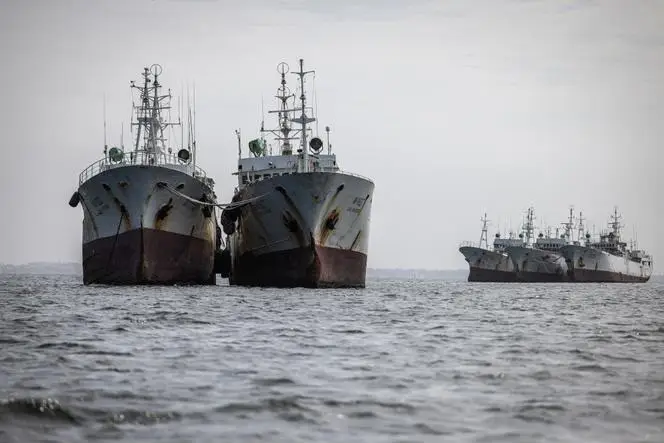
The hidden side of the national pavilion (4/4)
For Patrice Brehmer, researcher at the Research Institute for Development (Ird), it is important not to directly attribute the pressure exerted on fishery resources solely to the status of mixed companies. “It is not the legal status of a mixed company in Senegal that exerts pressure on the resource, but the vessels it controls, their fishing capacity, the targeted species and the areas frequented,” he explains. Mr. Brehmer, scientific advisor to the Permanent Secretary of the Sub-Regional Fisheries Commission, calls for more transparency on the actual owners and beneficiaries, but also for better supervision of fishing capacities.
Oceanographer and specialist in the ecology of marine ecosystems and fishing, Mr. Brehmer considers that investment should not result in an increase in effort on already overexploited resources. “The ecological limit must be set before the investment,” he summarizes.
These figures which raise questions about the explosion of new registrations
The analysis of the Group of Shipowners and Fishing Industrialists in Senegal (Gaipes) of the list of vessels flying the Senegalese flag, published on May 6, 2024, reveals a significant evolution of the fleet between 2019 and 2024. Nearly a hundred new registrations appear over the period. Among the 101 newly registered trawlers, 52 will have a license in 2024. And 41 of them, or nearly 80%, are authorized in the “deep demersal fishing fish option” category.
The Ministry of Fisheries and Maritime Economy, following the promise of the new regime, in place since March 2024, published in May the list of vessels in the Senegalese flag, for the first time since 2019: 132 national boats and 19 foreign vessels. “Le Soleil” was able to access a study carried out in 2024 by Gaipes. According to the organization, some of these registrations correspond to vessel substitutions.
In total, Gaipes identified 101 newly registered trawlers. “Among them, 52 have a license in 2024, while 49 do not appear with a license this same year. The future of these 49 ships constitutes one of the questions raised by the professional organization. Are they still under the Senegalese flag? Have they been deregistered? Have they changed activities? », asks the organization.
But the most significant figure concerns the nature of the licenses. “Of the 52 licenses held in 2024 by these new trawlers, 41, or almost 80%, concern “deep demersal fishing with fish option”, note the industrialists. However, according to the Gaipes analysis, only two vessels flying the Senegalese flag had this category of license before 2019. “In 2024, there will be 43,” says the organization. In five years, the number of ships concerned would therefore have multiplied by more than twenty.
Read also: Joint companies or the hidden face of the national flag (1/4)
This progression raises the question of the scientific bases that accompanied the new attributions. Gaipes affirms that no study from the Dakar-Thiaroye Oceanographic Research Center (Crodt) would have confirmed to the allocation commission an increase in the resource capable of justifying this development. We contacted the director of Crodt, Dr Ismaila Ndour, to measure the impact of mixed companies on potential. He promised to come back to us. Despite our multiple reminders, he did not respond to our questionnaire.
Alioune Thiam, president of the Coalition of Fishing Stakeholders in Senegal: “We are not nominees”
Finally, Alioune Thiam, president and CEO of the Baye Niasse Establishment and president of the Coalition of Fishing Stakeholders in Senegal (Caps), agreed to respond to Le Soleil’s requests. He categorically refutes accusations that Caps is an organization made up of mixed companies or serving as a relay for foreign interests. “We are not nominees. My company is not mixed. I am the president and CEO of Establishment Baye Niasse, which is 100% Senegalese,” he says.
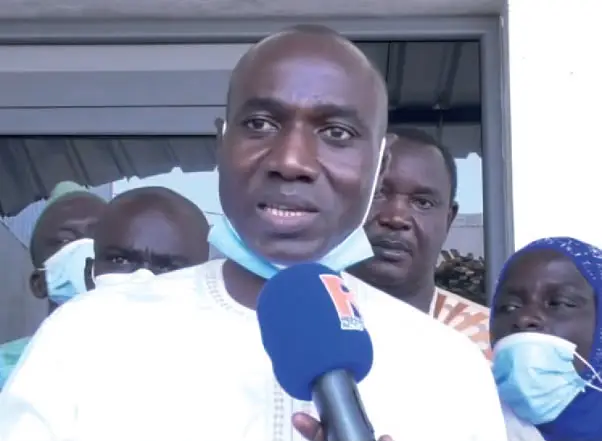
He acknowledges working with foreign operators, particularly Chinese, but rejects the idea of foreign control. His company, present in distribution, handling, transit and processing, would have “more than 400 jobs”. “Why do we have to skip all these nationalities to target the Chinese who are the latest arrivals? », he asks.
Greenpeace warns about ship traceability
Changing name, flag or operator can make it difficult to track ships and their real owners, underlines Dr Aliou Ba, head of Greenpeace Africa’s Oceans campaign. For Greenpeace Africa, the analysis of a ship should therefore not be limited to its flag or its commercial name. “Monitoring effective ownership and control would make it possible to better identify the beneficiaries of its activity,” notes Dr Aliou Ba. He cites in particular, in the “Sea-sickness” report, the Asian fleet “Fu Yuan Yu”.
To follow the journey of a ship despite changes in identity, the International Maritime Organization number constitutes, according to him, the main reference, since it remains associated with the ship throughout its existence. “Data from the automatic identification system and the ship surveillance system, supplemented by satellite imagery, can also make it possible to reconstruct the movements of ships, their areas of activity and certain suspicious behaviors,” explains Mr. Ba. Greenpeace Africa recommends better monitoring of the national flag, vessels, mixed companies and their effective ownership.
When will the flag audit end?
Our questionnaire sent to the communications department of the Ministry of Fisheries and Maritime Economy did not receive a response. However, a senior ministry official told us that the audit of the pavilion is underway. But this evaluation is starting to take time.
Since Aminata Mbengue Ndiaye, it has been announced, that is to say in April 2019, i.e. 7 years. In the meantime, Alioune Ndoye, Pape Sagna Mbaye and Fatou Diouf passed the baton to each other at the ministry without a result being made public. Minister Amy Mbacké is expected around the corner.
By Babacar G.DIOP
