
Palmarin aquaculture project: an alternative for local fishing impacted by climate change
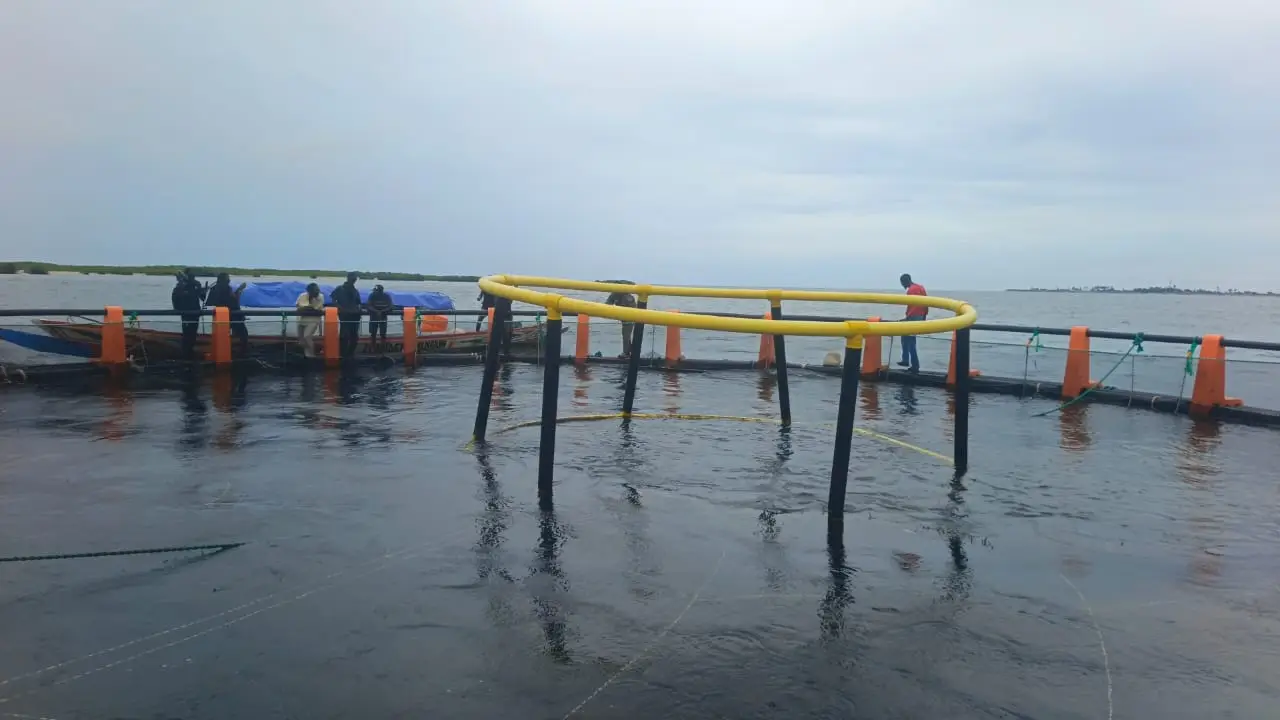
A delegation from the Spanish Embassy visited the Palmarin (Fatick) aquaculture pilot project on Monday October 12, 2026, where two cages were installed. Initiated and supported by the company Atlantic Mariculture, in partnership with the National Aquaculture Agency (Ana), this project established in the maritime zone is an alternative for local fishing which faces the impacts of climate change. It is also a way of combating irregular migration and also contributes to the food security of the area, or the country, in general.
FATICK- At the initiative of the Atlantic Mariculture company, the pilot project for aquaculture in the maritime zone established in Palmarin (Fatick) took shape with the installation of two cages off the coast of this commune in the Fatick department. This, in partnership with the National Aquaculture Agency (Ana). Monday October 12, 2026, a delegation from the Spanish Embassy, as the first European country producing aquaculture products, visited the two devices whose hatchery launch is planned by January 2027. According to Saïd Memene, president of Atlantic Mariculture, this unique project of its kind, in West Africa, makes it possible to find an alternative to local fishing whose yields have been in sharp decline in recent years. Thus, with just these two cages, 68 tonnes of fish could be harvested in one cycle, over eleven months. Better still, the boss of Mariculture aims to go further by providing twenty cages, or even more, in the Palmarin maritime zone.
“If we manage to install several cages in Palmarin and generally on the Senegalese coast, we will have contributed to Senegal’s food sovereignty,” he reassured. According to him, through this project, the town of Palmarin can become a central hub for fish production, particularly sea bream and sea bass. “From Palmarin, we can create a center of aquaculture excellence for researchers and academics with a view to disseminating the knowledge acquired here. Please note that this is a project which is above all not in competition with local fishermen. On the contrary, it is made for them,” he says. He also believes that this aquaculture infrastructure could generate several permanent jobs with the presence of cleaners, divers, technicians, etc. Not to mention temporary jobs, especially during the harvest period when the need for labor increases. Added to this are indirect jobs, namely trade, transport, catering, among others.
For the mayor of Palmarin, who deliberated on this maritime space a few months ago, this project is good news for the island population in general. Mame Singui Sarr declared: “With global warming which has impacted our area, fishing resources are becoming increasingly scarce. This is why it is important to make this project available to the population, particularly those involved in fishing, which will also fight against the massive departure of our young people to Europe aboard canoes”.
