
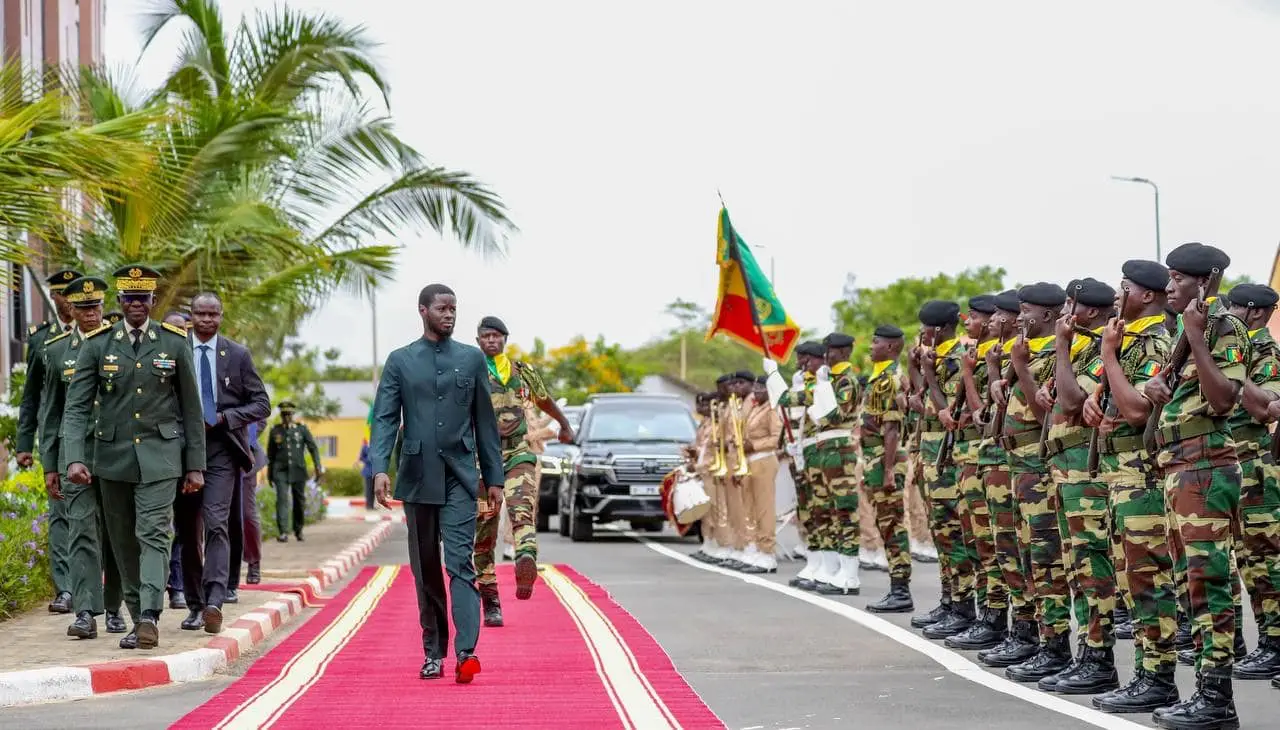
Independence Day, beyond Dakar, the regions
From Kaolack in 1975 to Thiès, via Diourbel and Louga, the relocation of the national holiday of April 4 is part of a long tradition. With the Kaolack region designated for 2029, President Bassirou Diomaye Faye displays his ambition to make this meeting an additional lever for territorial development.
The national holiday of April 4 constitutes a moment of representation of the State, of national communion and of highlighting the territories. By announcing, during the Council of Ministers of October 13, 2026, the relocation to Kaolack of the holding of the taking of arms followed by the Grand parade marking the national holiday of April 4, 2029, the President of the Republic, Bassirou Diomaye Faye, brings to the forefront an old practice.
The choice of Kaolack is not unprecedented. It refers to a history that dates back to the first years of independence. Léopold Sédar Senghor, first president of Senegal, already showed a desire to relocate major national celebrations from the capital Dakar.
In 1975, 1977, 1979 and 1982, the towns of Kaolack, Diourbel, Thiès and Louga successively hosted the celebration of this special day. After several decades of interruption, the process was relaunched in 2026 in Thiès, before Kaolack was again designated for 2029.
Under Senghor, the first experiences of relocation
In 1975, fifteen years after Senegal’s accession to international sovereignty, Léopold Sédar Senghor chose Kaolack to host the national holiday. At that time, the region, under the name of Sine-Saloum, occupied a central place in the economic and administrative organization of the country. This vast historical ensemble today corresponds to the regions of Kaolack, Kaffrine and Fatick combined.
By temporarily transferring the center of gravity of the celebrations to this part of the country, the head of state gave national visibility to an important city for trade and agricultural activities.
Two years later, in 1977, the choice fell on Diourbel. The town of Baol hosted the great popular parade. In 1979, Thiès took over. The rail capital was the recipient of ceremonies in the presence of President Senghor and the main authorities of the State. In 1982, Louga in turn became the center of April 4 celebrations.
These relocation policies were not solely the result of a desire to renew the decor of the national holiday. They made it possible to bring the representation of the State closer to the populations, to promote regional capitals
After the editions organized in the 1970s and early 1980s, the national holiday was continuously celebrated in Dakar. We had to wait until 2026 to see relocation resume with Thiès.
Kaolack 2029, a choice with strategic scope
The designation of Kaolack to host the national holiday in 2029 is all the more significant as the city had already hosted the ceremony in 1975. Fifty-four years will thus separate the two editions, if the announced schedule is maintained.
Located in the center of the country, Kaolack occupies a pivotal position between several economic and territorial spaces. Its history is closely linked to trade, agriculture, the peanut basin and trade with neighboring regions. Its function as a crossroads gives it significant potential in the movement of goods, the organization of agricultural sectors and the service of different parts of the national territory.
A “Special Independence Program”
In the Council of Ministers of October 13, 2026, the President of the Republic, Bassirou Diomaye Faye asked the ministers concerned to design, under the supervision and coordination of the Prime Minister, Ahmadou Al Aminou Mohamed Lo, a “Special Independence Program” for the Kaolack region. This program must integrate the construction of priority public infrastructure and the revival of the local economy. The Head of State also asked the Prime Minister to report, every quarter to the Council of Ministers, on the progress of projects and validated work.
The choice of Kaolack clearly reflects a desire to bring the State closer to the populations and to give concrete scope to the territorialization of public policies. The mobilization of funding, the involvement of local businesses, the use of regional skills and the development of cultural and artisanal activities could amplify the impact of the event.
O.BA
