
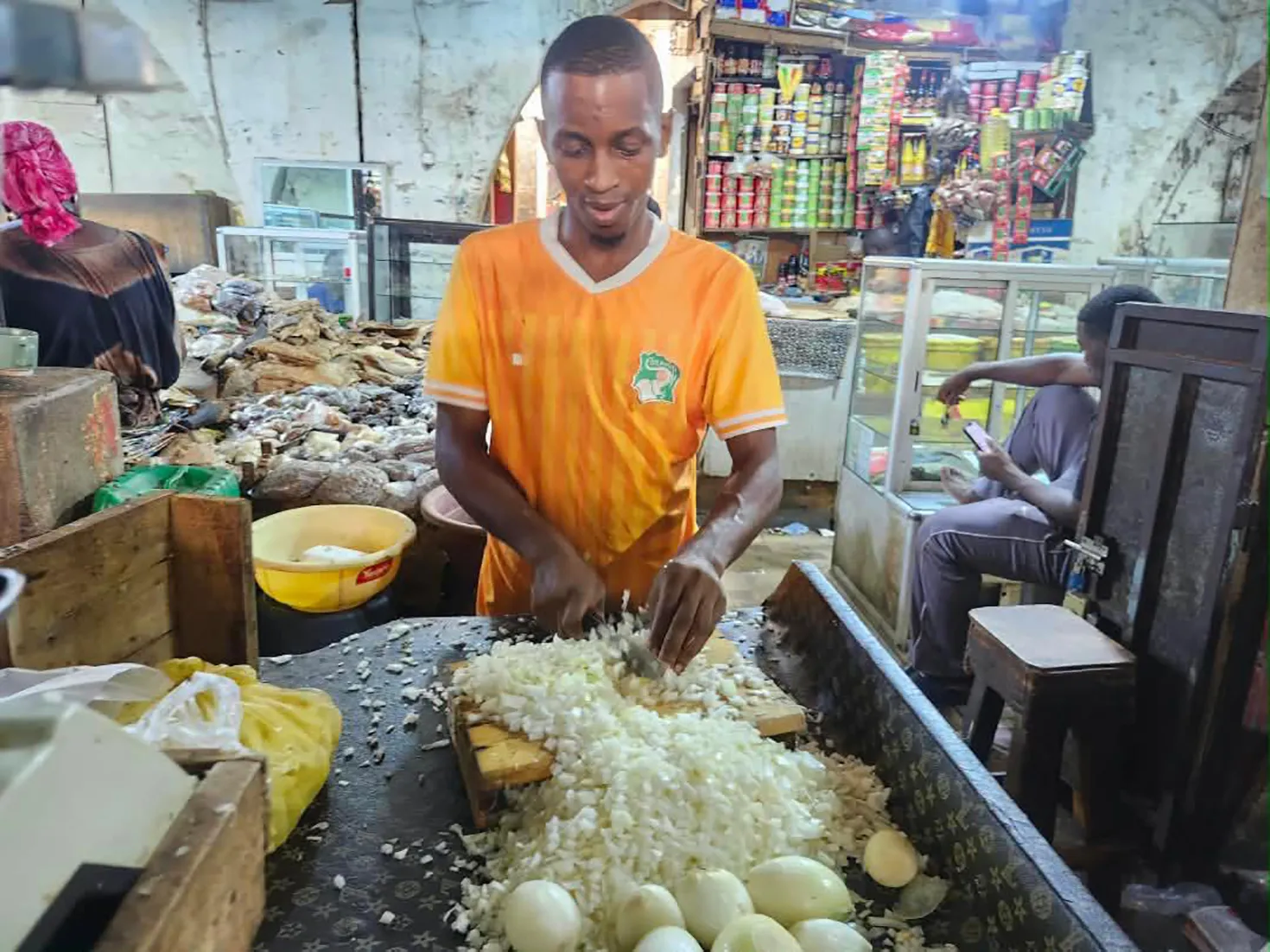
Onion cutters in Tilène: A tearful, but profitable activity
At the heart of the Tilène market, an activity attracts crowds: onion cutting. This activity responds to a growing need to save time in urban kitchens, but players must deal with volatile prices.
The Tilène market, nestled in the heart of the popular Medina district of Dakar, is a labyrinth of narrow streets where apartment buildings, stalls and modest sellers’ stalls coexist. As soon as you enter, peanut and coffee grinding machines sit alongside rows of freshly plucked broiler chickens. The atmosphere is stifling, but vibrant, despite the constant crowds. Inside, metal sheets, sometimes rusty, plastic sheeting and canvases serve as a roof. Meat, fish, vegetables and other foodstuffs are piled up on the tables. But one activity catches the eye: onion cutting. From each corner, we see a small table, knives and mounds of onions. This business, most often run by foreigners or people from within the country, is very popular. For a newbie, the acrid and pungent smell emanating from onion stalls is almost unbearable. The tears flow quickly. However, Boubacar Camara is used to it. Standing behind his table filled with carefully peeled onions, sharp knife in hand, this young man of around thirty, dressed in a yellow t-shirt of questionable cleanliness, cuts the onions with disconcerting speed, under the distracted gaze of two customers.
Originally from the Tambacounda region, he has been selling onions in this market since 2011 and started cutting in 2017. According to him, beyond retail sales, this service provides him with considerable income. It allows him to pay his two employees up to 1,500 FCfa each per day. “For a kilogram of onion that the customer brings, I cut it for 100 FCfa. If I am the one supplying the onion, I reduce the price of cutting to 75 FCfa per kilo. Knowing that the kilo of onion currently costs 550 FCfa, with cutting, this comes to 625 FCfa for the customer. For a 25 kilo bag, the service is invoiced at 2,000 FCfa,” he explains.
Boubacar emphasizes that running a table in this market is not an easy task. He pays 9,000 FCfa in municipal tax each month and must pay his two employees, regularly renew his equipment and cope with inflation in the price of a bag of onions.
The fear of charges
Despite these charges, he claims to make a daily profit of 4,000 to 5,000 FCfa, just for cutting. “Women now prefer to have their onions cut here rather than bringing them home. This saves them valuable time,” he explains.
Amy, a loyal 19-year-old customer of Boubacar, is patiently waiting for her two kilos of cut onions. Housekeeper in a house in the Gueule-Tapée district, she confides, smiling, that every time she has to prepare “yassa” or an evening dish requiring a lot of onions, she comes here, with the agreement of her employer, to buy ready-made ones. However, she believes that the price remains high and would like it to be reduced to 50 FCfa per kilo.
Before she has finished delivering her spontaneous testimony, another voice rises, authoritarian and peremptory, without anyone having given her the floor. It is Khoudia, a woman elegantly dressed in a vibrantly colored wax boubou, the scarf carefully tied and fitted on her head. For her, buying onions and peeling them at home is a household headache. A chore that she tries to avoid by all means. The lady prefers, by far, to have everything done directly at Boubacar. Khoudia, with a convinced tone and emphatic gesture, affirms that the current trend in urban kitchens is the purchase of products already ready to use, a guarantee of modernity. “Since I got married, I rarely bring onions home to peel them myself. Frankly, I advise all women to follow my example. Not only does it make life easier, it keeps our hands soft and our nails spotless, away from stubborn odors and skin irritations,” she explains.
Not far from there, in a different setting, Mamadou Diallo, originally from Guinea, watches over his younger brother working on the cutting job from inside his shop. Flies, omnipresent, seem to be the inseparable companions of this activity.
The price war
From his counter, Mamadou confides that the main obstacle remains the instability of the price of a 25 kilo bag of onions, which currently fluctuates between 13,000 and 15,000 FCfa. He started this activity in 2018, after observing the evolution of the lifestyle of Senegalese women, who were increasingly inclined to reduce the time spent in the kitchen. To respond to this trend, Mamadou Diallo acquired the necessary equipment. “While others cut the kilo at 100 FCfa, I do it at 75 FCfa.
Sometimes, especially during major holidays like Tabaski or Korité, when demand is high, I lower the price to 50 FCfa per kilo. I also work with restaurants,” he says. The owner specifies that he sells at least two 25 kilo bags per day, or a daily turnover of 3,750 FCfa and 112,500 FCfa per month, for the cutting activity alone. With a smile on his lips, he seems delighted with this performance, while his brother, concentrated, handles the knife carefully to avoid cutting his fingers.
Four canteens further, the table of Amadou Diouldé Sow, originally from Kolda, is stormed. Dressed in a blue shirt soaked in sweat in the oppressive heat, he seems to be dictating his law. His table is overflowing with onions already cut and others still whole. The customers are getting impatient: “Diouldé, hurry!” Diouldé, I’m in a hurry! » Among the women, a tall bearded man, who wished to remain anonymous, said he regularly comes to buy already chopped onions. “Since my marriage, to make things easier for my wife, I prefer to buy these onions. Here, it’s much cheaper, between 50 and 100 FCfa per kilo, far from the supermarkets. Plus, it allows my wife to prepare meals faster and more efficiently,” he says with a laugh.
Aziz Méthiour NDIAYE (Intern)
