
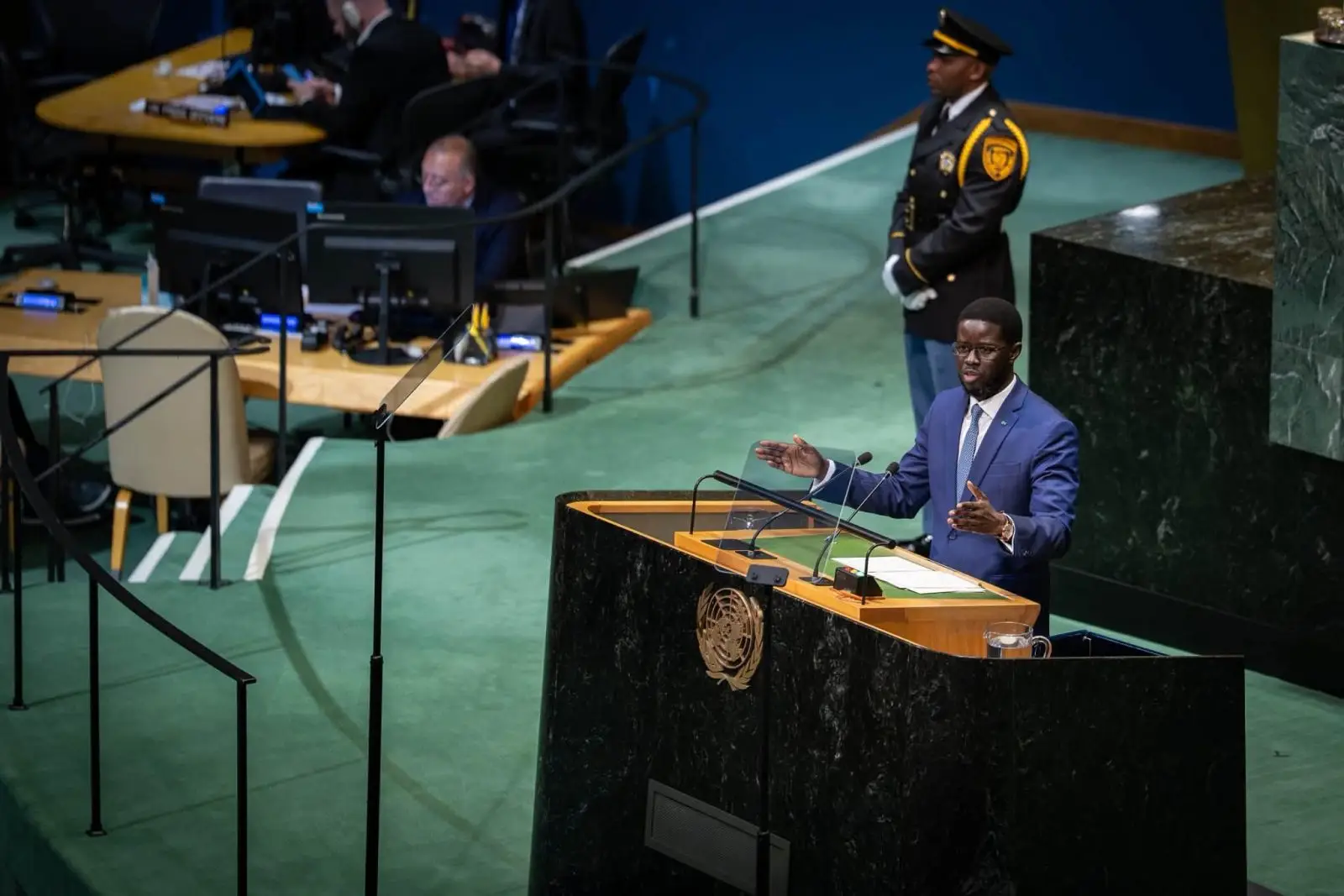
81st UN General Assembly: a special advisor to the Presidency sheds light on Senegal’s diplomatic choices
For Pape Sadio Thiam, Special Advisor to the Presidency, the speech of the President of the Republic, Bassirou Diomaye Faye, at the 81st General Assembly of the UN constitutes a signal on the place that Senegal intends to occupy in the new international order.
The first salient point identified by the Special Advisor to the Presidency is the crisis of confidence that runs through the multilateral system: distrust between States, loss of confidence in international institutions and questions about the effectiveness of international law. But, underlines Pape Sadio Thiam, “the President is not proposing the abandonment of multilateralism. On the contrary, he defends his reform, through a more representative, more effective UN and more adapted to contemporary realities.
The African question occupies a central place in this vision. Pape Sadio Thiam notes in particular the reference to the Sahel, terrorism and the reform of the Security Council. For him, Senegal thus places its position in a continental demand: Africa must be better represented in the bodies where major international decisions are taken, in accordance in particular with the Ezulwini consensus.
The Presidential Advisor also underlines Senegal’s desire to diversify its diplomatic agenda. “Development, digital technology, artificial intelligence, space, climate and water are becoming areas through which the country seeks to assert its role.” The satellite, the United Nations House in Diamniadio and even the YOG participate, according to Pape Sadio Thiam, in this construction of a Senegal as an actor rather than a spectator of globalization.
Another major element of his analysis appears on the candidacy of Macky Sall, for the post of Secretary General of the UN. Pope Sadio Thiam sees it as “the expression of a conception of diplomacy which favors the continuity of Senegal’s strategic interests beyond political alternations”. President Faye’s support for his predecessor thus illustrates, according to him, a desire to preserve the country’s diplomatic capital.
Finally, Mr. Thiam gives particular significance to the conclusion devoted to the Youth Olympic Games. After conflicts, terrorism, inequalities and crises of multilateralism, the speech ends on youth, sport and rapprochement between peoples. For Pape Sadio Thiam, this conclusion gives the presidential statement a universal and hopeful dimension.
O.BA
