
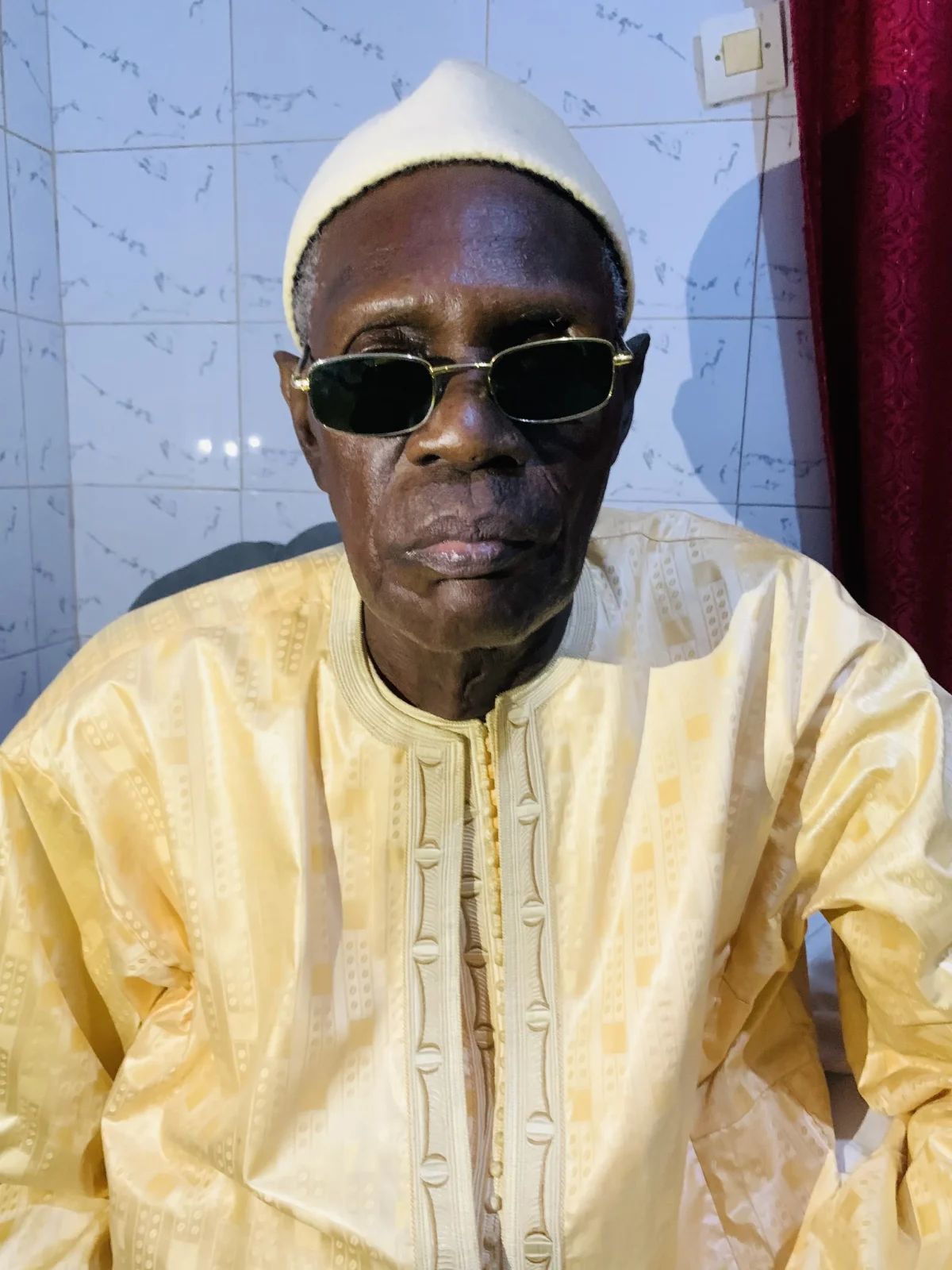
El Hadji Mbassou Ngom: The guardian of the memory of Rufisque September 23, 2026
From his shattered dream of becoming a doctor, the resilient septuagenarian El Hadji Mbassou Ngom was able to get back up and chart his path to the rhythm of the tom-toms, where he was an undisputed master. A Griot at heart and gifted with real oratorical talent, he recounts the history of his hometown, Rufisque, with disconcerting ease, in a digestible manner.
“The words of the griot Mamadou Kouyaté”, prologue to the work “Sundiata or the Mandingo epic”, published in 1960 by the Guinean writer and historian Djibril Tamsir Niane, could be used to describe the personality of El Hadji Mbassou Ngom, griot and master in the art of speech. He is the custodian of a memory which contains secrets dating back several centuries.
From Kounoune, home of the Lébous in the Cape Verde peninsula, to the cultural, political-administrative and economic history of Rufisque, he delicately exhumes the past. He particularly remembers the suppression of the autonomous commune of Rufisque and its attachment to Dakar in 1964, in accordance with Law No. 64-02 of January 19, 1964, until its detachment in 1984.
At Mbassou, the art of speaking has no secrets. Without him, the names of the mayors of the historic city could fall into oblivion. With his elephantine memory, the 79-year-old man knows, in chronological order, the list of mayors since Ngalandou Diouf, in 1919: Maurice Guèye, Ibra Seck, Ousmane Socé Diop, Mamadou Cora Fall, Mbaye Jacques Diop, Ndiawar Touré, Badara Mamaya Sène, Daouda Niang and Oumar Cissé.
The Jaraaf of Rufisque, Mamadou Diop Thioune, recognizes his usefulness to the community and believes that the city is lucky to count him among its own. “Mbassou is a traditional communicator, a producer of knowledge. He knows the story and is empowered to talk about it. His orality and his orality are digestible,” he testifies.
This is evidenced, according to him, by the twinning between Rufisque and Nantes, which notably enabled the creation of the Adja Khar Mbaye House of Arts. “I was present at the signing of this decentralized cooperation which linked the cities of Rufisque and Nantes in 1992, between the mayors Jean-Marc Ayrault and Mbaye Jacques Diop,” he remembers. The same is true of the reconnaissance visit by Pierre Darchicourt, mayor of Hénin-Beaumont (Pas-de-Calais, France), to the family of Ngalandou Diouf, to whom he provided his assistance.
The blossoming of a talent at the 1966 World Festival of Negro Arts
Born on September 11, 1947 in the popular Lebou neighborhood of Dangou, El Hadji Mbassou Ngom got his taste for passing on history from his father. However, the man has built a solid reputation as the chief drum major of Rufisque, a passion inherited from his maternal grandfather. Very early on, he was lulled by the rhythms of the drum with his brothers Maguette Thiam, El Hadji Mandioba Seck and Mamory Fall. Like a young wolf, it won’t take long to see a promising talent blossom. He remembers, with balm in his heart, his participation in the first World Festival of Negro Arts, in 1966. Drum major at only 19 years old, he had worthily represented the department of Rufisque alongside the late Gueye Seck of Bargny. “It was a big event, the first time I set foot in Sorano. I was given, as a participation bonus, 50,000 FCfa. It was the first time I received such a sum,” he recalls with pride. Generous, he said he gave all this money to his parents, explaining to them that he did not need it.
Several opportunities offered by the profession
Despite time, these human values of generosity, kindness and openness have never left him. The testimonies of those close to him, in particular his children and his niece, are unanimous. Mamadou Cora Ngom, whom his father named in homage to Mayor Cora Fall, says he is proud of him. “She is a beautiful soul, valiant and anchored in culture. We do not have a forbidden sense, because it serves as our passport wherever we go. He doesn’t look at our money,” he says.
Mamory Ngom, who takes care of the instruments, numbering 135 tom-toms, on which he applies palm oil to guarantee the longevity of the wood, describes his father as a friend, a model and a protector. “Our mother, before leaving this world, had charged him with watching over her offspring. So far, he has not deviated from these recommendations,” he attests. Mame Fatou Ndiaye, niece and son-in-law, describes her uncle as an “inexhaustible sea”. “He treats me with the same deference as his own sons. Beyond respect and consideration, he is not a distant man,” she adds. “I made a career out of drumming, which is why I didn’t regret it. It was through this work that I built my house, brought my mother to Mecca and went there as well,” he says. Unlike the new generation, Mbassou knew how to make himself rare. “I knew my worth. I didn’t play anywhere or anytime like young people do today. I managed to instill this value in my family. As many as they are, they work and do not rely only on percussion to live,” he adds.
Through his profession, he has forged deep ties within the corporation. “Doudou Ndiaye Coumba Rose maintained a sincere friendship with me. He was the one who took me to Mecca in 2000,” he says.
The shattered dream of becoming a doctor following a pelvic fracture at 13
Strong ties were also established with the mayors of Rufisque, where he served as a municipal councilor until his retirement. Among them, Cora Fall and Mbaye Jacques Diop particularly marked him, even if he remains grateful to the others. “It was Cora Fall who built this building in 1975. He gave me a ticket for the pilgrimage to Mecca which I gave to my mother,” he says.
Mbassou also emphasizes that it was Mbaye Jacques Diop who recruited him to the town hall, with a salary that he considered appreciable, until his retirement, with a pension to boot. “Ndiawar hired my eldest son. Mamaya also hired one of my sons, as did Daouda Niang,” he emphasizes.
After more than 30 years of career, Mbassou Ngom decided to retire in 1993, when his eldest son, Ndiapaly, took over. “I stopped when my son acquired the knowledge, at 20 years old. I told myself that I had a good succession,” he reveals. Everything he failed to accomplish during his rich career, his children carry on today brilliantly. “I haven’t had the opportunity to tour abroad, but my children have this privilege. The youngest in the family is at the Daniel Sorano National Theater, where he is the head drum major of the ballet La Linguère,” he emphasizes.
Far from being his initial choice, Mbassou Ngom embraced this profession following a painful ordeal experienced during his childhood. After being introduced to learning the Koran at the age of 4, until 1954, he started at the boys’ school to learn French. “When I had to do Cm1 and Cm2 classes, we were transferred to the Mérina school, which had just been inaugurated in 1958,” he remembers. His desire to become a doctor is then shattered by a terrible accident. “I had opted to become a doctor, but on the eve of my sixth grade, in 1960, I got into a fight with a friend and ended up badly. I broke my hip,” he recalls with bitterness, recalling this painful episode which put an end to his adolescent dream and kept him away from school. “I couldn’t take this exam. I was bedridden for five years, unable to walk, between operations and casts,” he explains, with a heavy heart. He has an after-effect that still follows him today: reduced mobility. “I wasn’t born like that. At the time, medicine was not developed as it is today to ensure good care,” he says.
Mbassou Ngom takes his destiny philosophically. “He’s a true believer. He accepts his physical handicap,” testifies Jaraaf Mamadou Thioune.
