
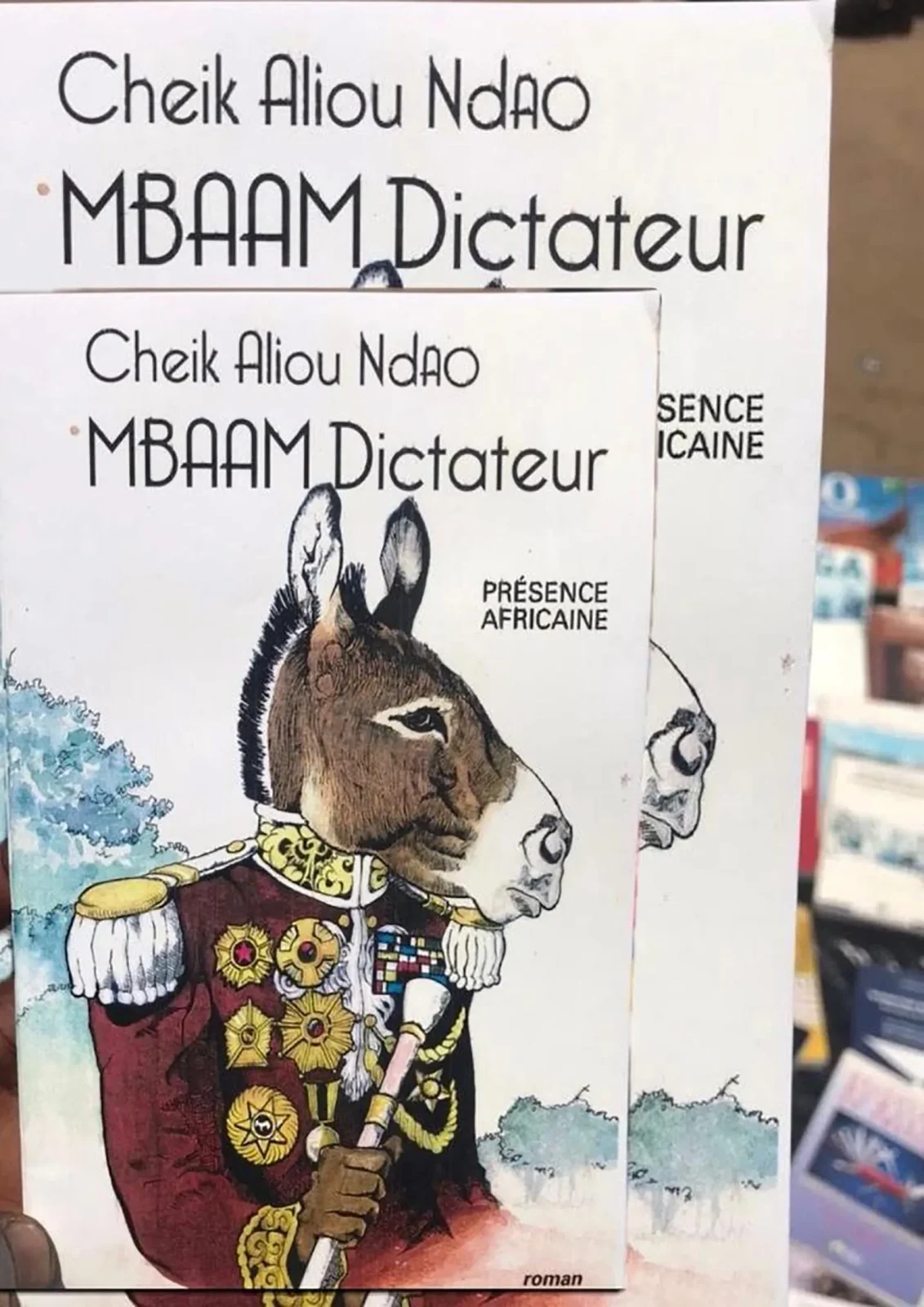
The donkey, the tyrant and the vanity of power September 23, 2026
In “Mbaam Dictateur”, a major satirical novel, published in 1997 by Éditions Présence Africaine, Cheik Aliou Ndao imagines the metamorphosis of a dictator into a donkey to better examine the mechanisms of tyranny, the servitude of elites and the fragility of human greatness. Beneath the laughter of the fable emerges a formidable reflection on power and its vanity.
Imagine a dictator who, at the end of an existence devoted to making men bend, suddenly wakes up in the skin of a donkey. He remains with the memory of his greatness, the memory of the palaces, the genuflections, the courtiers, the speeches in which his name came back like an incantation. He remembers the men who looked down, those who clapped too loudly, and those who learned, in order to survive, to approve before they even understood. Only that’s it. He no longer has a throne. No more procession. No more officials to terrorize. No more people to summon. It has four legs, hooves, a back that can be loaded and a mouth that only knows how to bray.
Funny. But it would be wrong to laugh too quickly. In this zoological misadventure, there is something much crueler than a joke. Man, who believed he possessed others, discovers what it means to belong to someone. It is in this reversal, both burlesque and metaphysical, that Cheik Aliou Ndao sets his novel “Mbaam Dictateur”. The find could just be a great invention. She is in reality a literary machine of remarkable precision. “Only fiction allows man to accept what reason rejects,” states the author in his novel. He just doesn’t bring down a tyrant. It even takes away the appearance of an exceptional man. The dictator is naked. And worse, he’s ridiculous. There is perhaps no more political fall than that. Tyrannies need majesty.
A donkey from elsewhere
They like endless titles and words that grow the man to the point of giving him an almost supernatural stature. The novelist undertakes precisely to eliminate this height. He brings down the dictator. Very low. Until the dust. The title of the novel already contained this insolence. Mbaam, in Wolof, means donkey. To this beast’s name, the novelist attaches the word “dictator”, as if two realities that the political order usually strives to separate had suddenly come to merge. On the one hand, power, sovereignty, pageantry. On the other, animality, servitude, the body exposed to blows and work. African political literature has often confronted the specter of the tyrant. After independence, when promises of emancipation sometimes turned into authoritarian regimes, the novel found itself entrusted with a task that journalism could not always accomplish. He had to talk about the confiscation of hopes, the erosion of freedoms, the corruption of ideals, the installation of the single party, obedience transformed into a system and fear becoming a method of government. From Mongo Beti to Ahmadou Kourouma, from Henri Lopes to Sony Labou Tansi, power has penetrated African literature like a disease whose symptoms had to be sought in bodies, institutions and consciences. But Cheik Aliou chooses an oblique path. He does not bring the tyrant to court. He makes him appear in front of laughter. It’s more subtle. The pamphlet accuses. Satire disarms. The tyrant can answer the accusation. He can censor it, turn it around, make it look like slander. It is much more difficult to fight against an image that has lodged itself in people’s minds. Once the despot becomes an ass, something of his majesty is irretrievably lost. It may still be dangerous, but it is no longer sacred.
The animal, in the literature of the world, has never been just a zoological creature. Since ancient fables, it has served as a mask for man in order to better reveal himself. La Fontaine did not really write about the fox, the lion or the crow. He wrote about our vanity, our cowardice, our appetite, our cunning and our servitude. Orwell did not need to have men utter the word “revolution” to write a political parable of universal significance. Cheik Aliou Ndao is part of this great tradition, but he does not reproduce it.
His donkey comes from elsewhere. It comes from an imagination where the visible world is not hermetically separated from the invisible world, where the words of the ancestors can still act on the destiny of the living, where the soothsayer is not a simple exotic character, but the intercessor of a world order that the political rationality of the tyrant cannot exhaust. The fall of Mbaam is therefore not only political. It is cosmological. Man, who had believed himself to be master of everything, discovers that he is not master of the order of the world. And this something can take the most ridiculous form possible. A donkey.
But “Mbaam Dictator” is not only remarkable for its political architecture. It is also so through its linguistic subject. And this dimension deserves attention, because it touches on one of the great wounds, but also one of the great freedoms, of modern African literature.
Cheikh Aliou Ndao is a Wolof writer who also writes in French and who has made the circulation between these two languages a real creative practice. The French novel comes from the Wolof text “Mbaam aakimoo”. This data is not secondary. It changes the way we read the work. Because the French of the writer is not quite a French that would have simply welcomed a few words in Wolof. It is French worked by another memory. It carries the fold of an orality, the cadence of a word, the density of the proverb, the logic of an image which does not necessarily come from the same imagination as that of the classic French language. One of the great illusions of colonial literature was to believe that a language could transport a civilization without itself being transformed. The great African writers gradually overturned this belief.
Conversation with Wolof
They took the French language, not to settle there obediently, but to move it. Kourouma broke it. Cheik Aliou Ndao puts her in conversation with Wolof. It’s no longer just a matter of knowing what language is written. It is a question of knowing what vision of the world manages to inhabit the language. This is why the proverbs, expressions, images and inflections of oral tradition take on an importance for him that goes beyond ornament. They are summaries of civilization. They carry a wisdom that is not expressed in concepts, but in images. The novel does not theorize tyranny. He makes us experience it through its grotesque underside. The dictator, having become a donkey, then enters another geography. He meets those he had perhaps never really seen. This is perhaps the supreme humiliation of the absolute sovereign. This discovery is almost metaphysical. It joins an ancient truth, that of the vanity of human greatness. Civilizations have produced countless stories about this disproportion between man’s ambition and the brevity of his passage. The pyramids themselves did not save the pharaohs from death. Roman emperors disappeared under their own statues. The conquerors who claimed to shake the centuries are often nothing more than names in textbooks. Power is always provisional. It is the man who forgets it.
By Adama NDIAYE
