
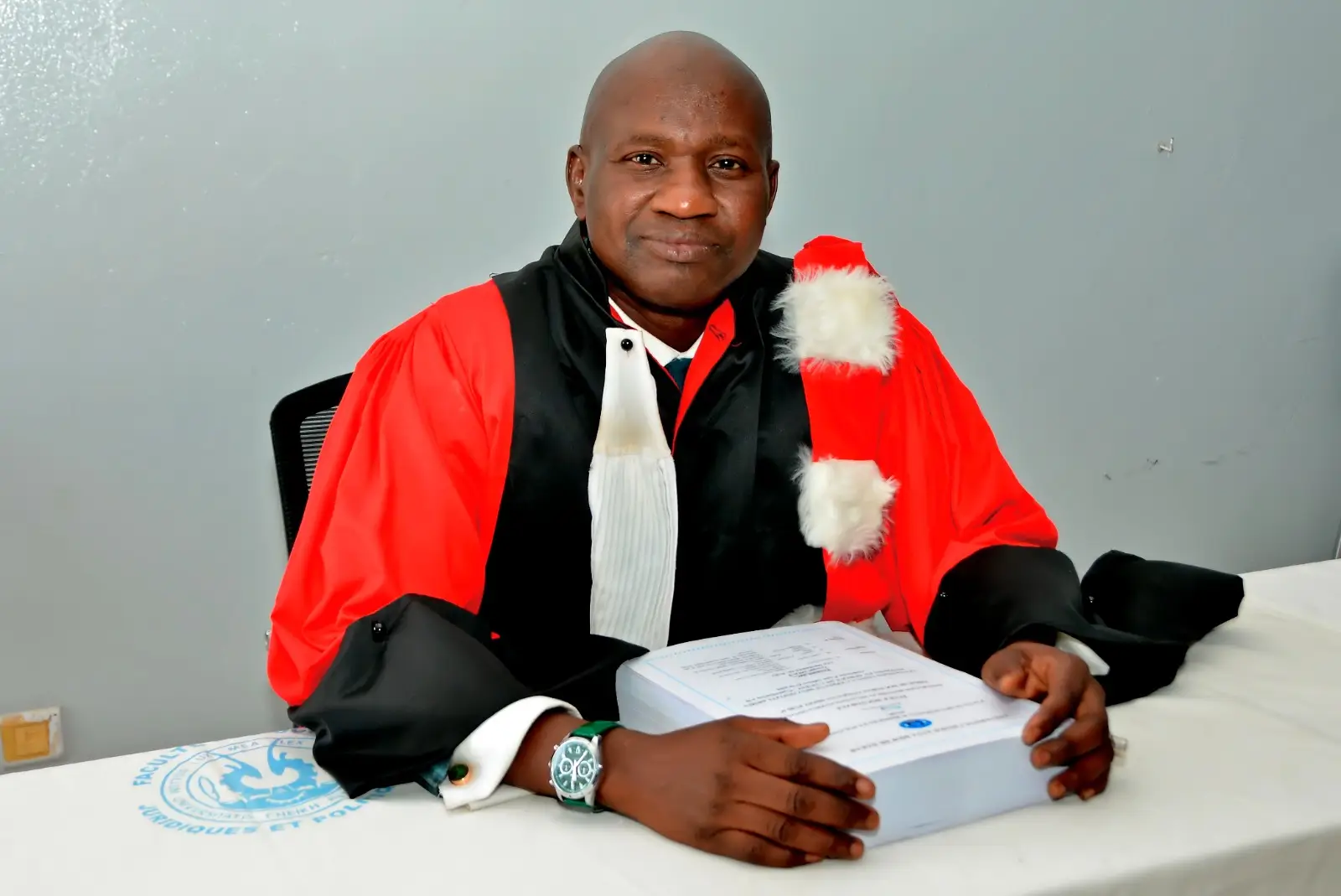
Dr Gorgui Diouf: “A world where 1.4 billion Africans do not have a permanent voice is profoundly unfair” September 25, 2026
As the 81st session of the United Nations General Assembly takes place, against a backdrop of persistent conflicts and rivalries between great powers, Gorgui Diouf, Doctor of Public Law, specialist in public international law, international relations and geopolitics, also an expert in UN law, takes a critical look at the state of multilateralism. In this interview, he analyzes the limits of the United Nations system, the paralysis of the Security Council, the challenges of its reform and the reorganization of the global balance of power.
The 81st UN General Assembly opens in a context of multiple conflicts and tensions between great powers. What state of the world do you think this meeting will highlight?
This 81st United Nations General Assembly will shine a light on a world that has lost its legal and moral bearings. We are witnessing a form of regression in public international law. The major principles which have founded the world order since 1945, such as collective security and the peaceful settlement of disputes (Chapter VI and Articles 33 and 38 of the Charter), as well as the prohibition of the use of force (Article 2, paragraph 4), are today trampled by the very people who should be their guarantors. The Security Council has become the scene of a confiscation of the legal authority of the UN by the five permanent members. Everyone uses the veto not to protect peace, but to protect their geostrategic interests. Result: conflicts like that of the Sahel, Sudan or the east of the Democratic Republic of Congo are getting bogged down and the UN is helplessly witnessing the decomposition of entire regions. This General Assembly will therefore be the mirror of a world where law is no more than an instrument in the service of power.
Faced with the multiplication of crises and the difficulties of the Security Council, does the UN still have the political means necessary to really influence major international conflicts?
The answer is no and you have to have the courage to say it. The UN no longer has the political means to carry out its mission because its very structure is flawed at the root. As part of my research, I analyzed in depth what I call the “congenital defect” of the UN system. The San Francisco Charter was written in 1945 by the victors of World War II for a world that no longer exists. It never anticipated the internal armed conflicts, the civil wars, the rebellions, the forms of terrorism which are tearing Africa apart. The UN has had to cobble together peacekeeping operations that have no explicit legal basis in the Charter. And today, these DIY projects are showing their limits. The Security Council is paralyzed by the veto. The General Assembly is reduced to recommendations without binding force. The Secretary-General is a political giant with his hands tied. The UN is not powerless by accident; she is powerless by construction. And this impotence is even more glaring in Africa where internal conflicts are complex, unpredictable and where powers often have no strategic interest in acting.
Security Council reform comes up regularly. Can we expect concrete progress, particularly with regard to the representation of Africa?
We must be lucid: there will be no major progress this year or next year. The five permanent members will never voluntarily give up their privilege. For them, the right of veto is an attribute of sovereignty, an instrument of domination. Africa has been asking for it for decades, but it has hit a wall. That said, this General Assembly is another opportunity for Senegal and the African Union to pose the problem in terms of justice and not simple technical reform. It’s not just about who sits on the Council, but what world we want. A world where 1.4 billion Africans do not have a permanent voice in the Security Council is a profoundly unjust world. And this injustice is a direct cause of instability on our continent. As long as Africa is not represented with dignity, decisions on peace in Africa will be taken without Africans and often against them.
In a context of growing rivalries between Western powers, China, Russia and countries of the Global South, are we witnessing a lasting restructuring of the balance of power within the United Nations?
Yes, we are witnessing a historical recomposition. The unipolar world dominated by the United States is giving way to a multipolar world where China, Russia, India, Brazil and the countries of the Global South are increasingly influential. But be careful: multipolarity does not automatically mean peace or justice. The risk is that this recomposition will take place in confrontation, in a new cold war which would use Africa as a terrain of confrontation. Senegal, like most African countries, refuses to be a pawn in this game. We must be players, not issues. This is why Senegalese diplomacy must be bold, non-aligned, but not neutral. Not aligned with the blocs, but firmly committed to international law, to justice and to peace.
Beyond peace and security, climate, development financing and the governance of Artificial Intelligence are on the agenda. What concrete results can African countries expect?
Expectations are immense, but the results will likely be disappointing. On the climate, Africa is bearing the brunt of the consequences of warming that it did not cause. Funding promises are not kept. On development, the international financial architecture is designed to keep African countries in structural dependence. On Artificial Intelligence, Africa risks being a simple market for other people’s technologies, without control or regulation. However, there is one thing that African countries can and must do: demand that these issues be addressed in a logic of global justice and not charity. Senegal must raise a strong voice for fair climate financing, for reform of global economic governance and for AI governance that protects human rights and the sovereignty of peoples. These struggles are inseparable from peace.
For Senegal, what should be the diplomatic priorities at this forum and what place can the country occupy in the debates on the reform of global governance?
Senegal has a card to play and it must play it with intelligence and courage. Its first priority is to carry Africa’s voice for the reform of the Security Council. Senegal has historical legitimacy: it is a stable, democratic, respected country, which has always contributed to peacekeeping operations. He must spearhead this battle for institutional justice.
The second priority is to propose a new approach to security in the Sahel. Senegal must plead for a strategy which is not only military, but which attacks the root causes, namely poverty, exclusion, lack of education.
The third priority, and it is the most profound, is to make Senegal the laboratory of a culture of peace in Africa. Senegal has an inestimable wealth: its culture of dialogue and tolerance. Our country has a history of mediation, of peaceful dialogue. It must transform this wealth into a true cultural diplomacy of peace. Concretely, this means investing massively in peace education, in the training of young people, in the promotion of the values of non-violence. “Peace is not decreed in New York; it is built in minds”, in schools, in villages. Senegal can and must be the pioneer of this approach.
· Interview carried out by Daouda DIOUF
