
(Video) River ecomuseum: Bringing to life the memory of commerce and the quay
At the beginning of the 2000s, Podor changed its face. The quay, which lived to the rhythm of boat arrivals and departures, is losing its central role. River traffic is becoming rarer, and with it, the businesses that depended on it. Memories disappear as quickly as the activities that carried them. The idea of a place dedicated to this memory was born in 2007, supported by the Left Bank Association and the Saint-Louis Tourist Office. But between the idea and its realization, it will take more than a decade and a precise family history to bring it to life. Mawdo Diop was one of the great figures in Podor’s business. After working at Galeries Peyrissac, he took over the premises when the brand left the city. For decades, his shop brought life to the quay: goods arrived by the river, traders got their supplies there, an entire neighborhood revolved around these exchanges. His son, Ousmane Diop, grew up in this setting and learned the trade on the job. “I studied until third grade and obtained my Dfem. After that, I left school to focus on business. It was my father who trained me,” he explains. He tries his luck at Richard-Toll, then returns. But the Podor he finds is no longer the one of his childhood. The boats are becoming rare, the quay is running out of steam. In 2006, the family store closed. The premises remain empty for several years, but loaded with decades of commerce and the memory of an entire neighborhood. Ousmane Diop then had a simple, almost obvious idea. “I had the idea of creating this eco-museum, instead of leaving the stores closed,” he says. The ambition born in 2007 finally finds somewhere to be embodied. In 2018, the Écomusée du Fleuve opens its doors.
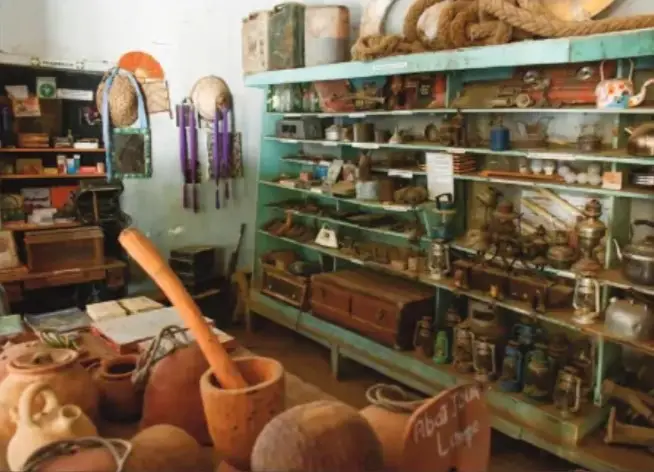
The collection seeks neither grandeur nor spectacular effect, but accuracy. We discover gum arabic, once the flagship of exports, alongside lamps, scales, irons, kettles, bricks, tiles, old records. Added to this are the remains of boats, silent witnesses to what the river has long transported. Nothing here is spectacular, and that’s precisely what makes the place strong. Taken in isolation, each object seems banal. Put end to end, they reconstitute an entire economy. According to Ousmane Diop, a scale does not only mean weighing; she talks about transactions, bargaining, trust between traders. An old lamp brings back the atmosphere of a shop from another time. A fragment of the hull evokes an entire vanished traffic: full holds, crowded docks, return trips to Saint-Louis and Mali. Gum arabic alone tells the story of the trade routes that linked Podor well beyond its own shores. It is this accumulation of details which gives the visitor a precise idea of what Podor was: a strategic trading post from the colonial era, where European goods, local products and population flows intersected. For Mamadou Diop, we do not visit the ecomuseum to admire collector’s items, we come there to understand why this city, now quiet, was one of the strongholds of colonial trade on the Senegal River. Each object is a fragment; together, they recompose a Podor where the river was an artery, and the quay, its beating heart. The history of the ecomuseum is divided into two threads which come together. The first is collective: the ancient desire to save a heritage threatened by the decline of river trade. The second is family: a son who transforms his father’s store into a place of transmission rather than leaving it abandoned. What was a space of commerce thus becomes a space of memory. Mawdo Diop circulated the goods, Ousmane Diop today circulates the memory of them. Trade has disappeared, river traffic has been reduced to almost nothing. But for Mamadou Diop, as long as these objects find someone to look at them, and someone to tell them about them, the Quai de Podor will continue, in its own way, to live.
SO FALL (Text), Assane SOW (Photo), Oumar B NDONGO (Video)
