
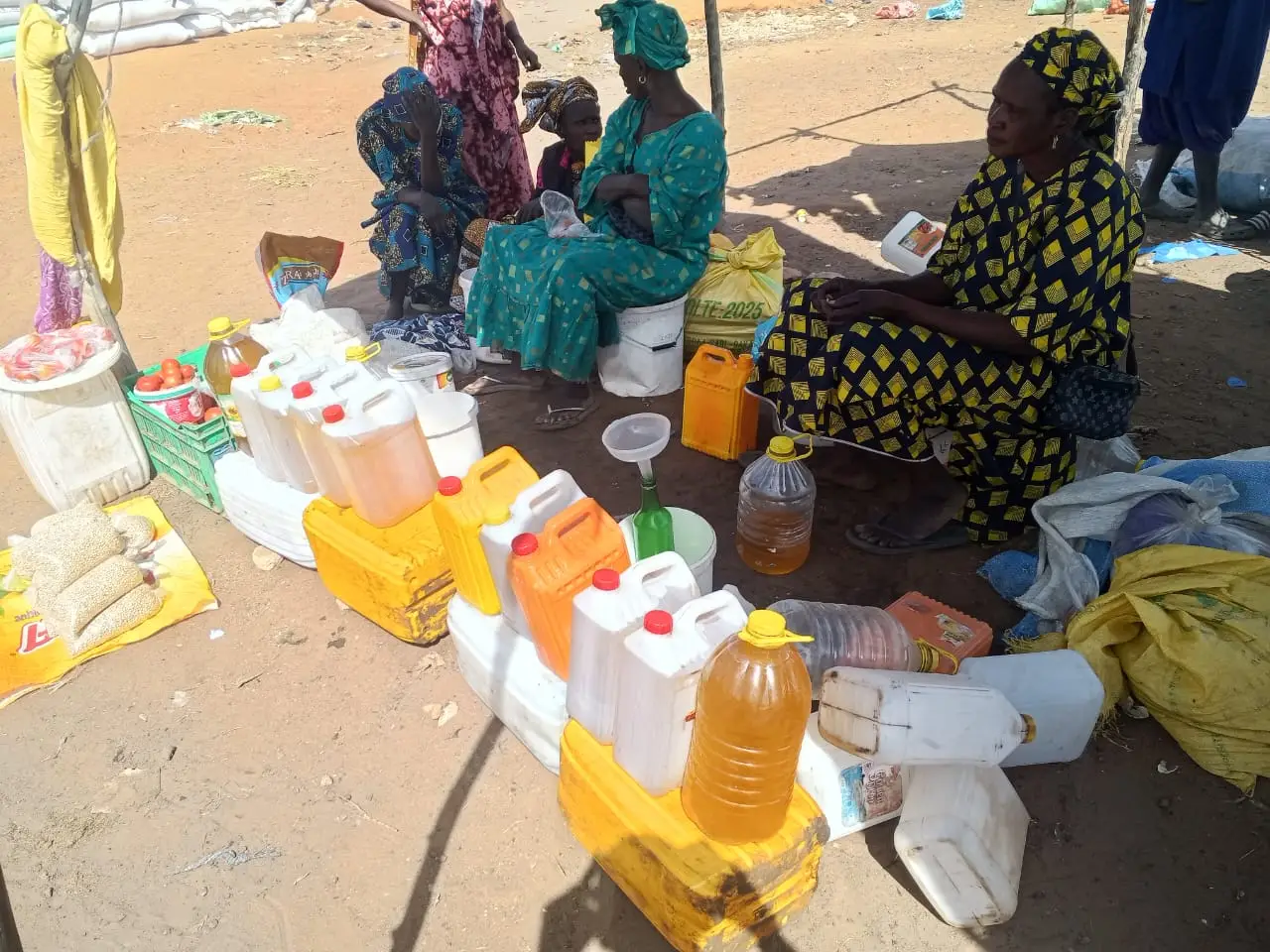
Women and peanut oil: a living know-how in Linguère
In the villages of the Linguère department, women perpetuate ancestral know-how: the artisanal transformation of peanuts into oil. This activity, carried out on a small scale with manual techniques, constitutes a source of income. It is also a vector of empowerment for rural women and a pillar of food security. Between tradition and modernization, these women face challenges linked to productivity, health quality and access to markets.
LINGUÈRE – The artisanal processing of peanuts into oil is a well-established tradition in rural areas of the country. In Linguère, where agriculture is dependent on unpredictable rains, peanuts remain a survival crop. Women are heavily involved in the artisanal processing of peanuts into oil.
Traditionally, processing is done on a small scale. After harvesting, the women hull, sort, roast, then grind the seeds to make a paste. Then comes the most delicate step: hot mixing, which separates the oil from the cake.
“We still use the manual techniques of our grandmothers. Explains Fatou Kiné Diop, 65 years old, living in Thiargny. But today, we have mechanical presses which make it possible to improve the quality of the oil. »
The oil produced is sold on the various weekly markets in the Linguère department. This oil is prized for its flavor and purity. However, tourtezu, which is a protein-rich solid residue, is often used to feed animals, including goats, horses and sheep. According to Aïssatou Sow, peanut oil processor at the Barkédji unit.
An activity at the heart of empowerment
Beyond food production, this activity is a real lever of economic emancipation for rural women. By grouping together into cooperatives, they pool efforts, sometimes access microcredits and develop skills in management, marketing and food hygiene.
“Thanks to this arduous activity, I manage to send my children to school and meet my needs without depending on people,” confides Awa Ndiaye, member of a women’s group in Loumbi, a village located in the commune of Ouarkhokh. She assures that she sells her oil in Linguère or Barkédji on the days of the weekly market.
Peanut oil actually contributes to the empowerment of many women in the region. Toura Sall affirms that she has been in the transformation since 2005. She confirms that she is originally from Kadji, a locality located in the commune of Dodji. This brave woman believes that peanut oil has given her everything. She started with rudimentary tools from the very beginning.
But today, she has been able to afford a manual machine which produces a large quantity of oil. She clarifies that the artisanal processing of oil nourishes her man. She managed to make a lot of achievements in her village. However, women who do not yet have a machine come to rent theirs and she earns money.
Madame Sall adds that she sells the liter for 1000 CFA francs. She manages to earn her profits. She concludes that five-liter cans are sold for 5,000 FCFA francs.
Another peanut oil processor, named Khady Bà, living in Nguith, gives her point of view on the profitability of this activity. “The oil we produce feeds our families and helps us send our children to school. But without machines, we work from morning to evening for small quantities. With the support of a local NGO, we obtained a mechanical press which increased our turnover, from where we sell to Louga and even to Dakar. »
Persistent challenges
Despite their determination, women peanut oil processors in the Linguère department face many obstacles, including the obsolescence of modern equipment, limited access to water, and marketing difficulties. These women are pleading with public authorities to obtain support with modern equipment and training on food hygiene.
However, some processors still remain precarious, they use rudimentary tools. These oils may contain aflatoxins because they are poorly filtered.
Processors also highlight the conservation of peanut seeds among the major challenges.
Mariama Sock, leader of a women’s group and oil seller at the Linguère weekly market. “The biggest challenge remains seed conservation. When stored improperly, the oil can be of poor quality. We need training and funding to improve our practices,” she added.
As for Mbayang Sarr, a processor, based in Doundodji, and owner of a small mechanical press machine, she believes that women processors have difficulty finding financing. She asks the State to support them and provide them with funds.
Ultimately, this model of artisanal processing, respectful of the environment and anchored in traditions, could inspire other Sahelian regions.
