
In Sansamba, the Falémé no longer feeds From Saraya to Sansamba, in the rain and on board a motorbike, we followed the traces of a once nourishing river. Today, the Falémé carries another story: that of gold, of disturbed lands and of water that has become unusable for the local populations. SARAYA…
From Saraya to Sansamba, in the rain and on board a motorbike, we followed the traces of a once nourishing river. Today, the Falémé carries another story: that of gold, of disturbed lands and of water that has become unusable for the local populations.
SARAYA – As we approach Kharakhena, the scenery changes. The gold galleries appear. Here, gold is everywhere: in discussions, in activities, but also in the landscape. The gaping holes, piles of earth and mining facilities remind us that this part of Senegal lives to the rhythm of the yellow metal.
From Moussala to Sansamba it is only about six kilometers. On this track, another story. The rain waters finely, but persistently. The water runs down the path and carves passages. Stones and rocks crop out here and there. On a motorcycle, every turn requires concentration. We slow down, we avoid a stone, we go around a puddle, then another. A few kilometers further, Sansamba finally reveals itself.
“Cursed water”
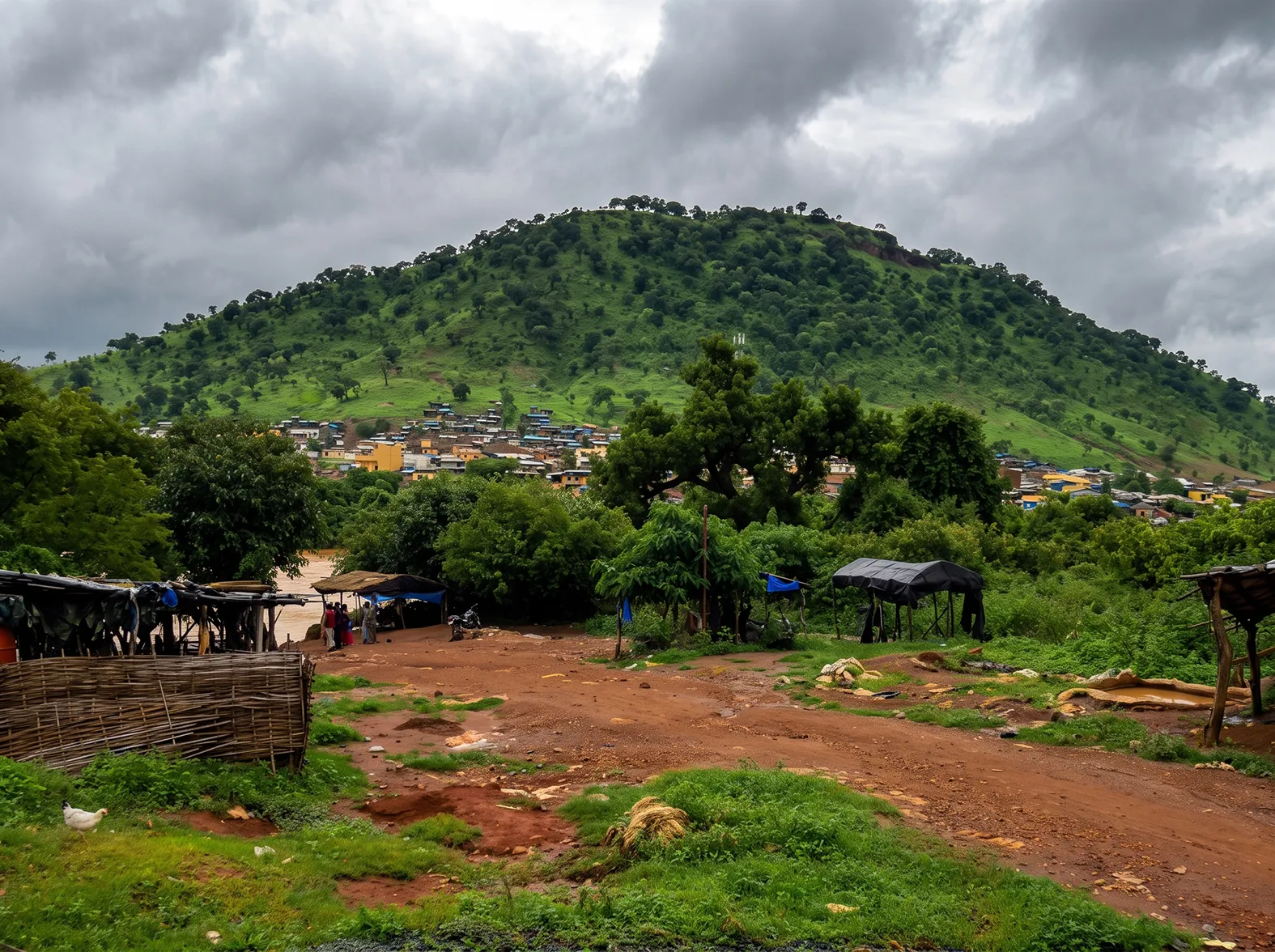
The village is located near Falémé, in a landscape of hills which, in this rainy season, offers generous vegetation. But behind this apparent abundance lies a paradox: living by the water without being able to really benefit from this resource.
In Sansamba, the Falémé flows a few steps away. During this winter period, the river is full. However, for the inhabitants, this water no longer rhymes with abundance.
“Today, the water from the Falémé is of no use at all,” says Banadji Diallo, president of the village women.
The observation is brutal but remains indisputable. No laundry, no market gardening, no watering of livestock. Even less human consumption. Even fishing, once practiced, has practically disappeared.
The color of the water is worrying. It is reddish.
“The water kills all our plants,” says Banadji Diallo.
To understand what happened, you just need to walk along the banks. Near the river, traces of gold panning are everywhere. Piles of sand, excavations, artisanal installations. Men work, wash, sort and grind on the banks of the Falémé.
Less than twenty meters from the riverbed, Zaré Abou is busy around his makeshift workshop, perched on the banks of the Falémé. This young Burkinabè arrived in Sansamba about two months ago. Here, he works in the “mould”, grinding and processing sand intended to recover gold.
The young man explains that he came to earn money and help his family. The eldest son, he says he has a special responsibility towards his family. He receives 3,000 FCfa per day.
Young gold miners collect the sand, grind it and wash it in the river. Zaré maintains that no mercury is used for sand washing. But even without chemicals, the activity leaves traces. The sand moved, washed and then rejected largely ends up in the watercourse.
In Sansamba, the concern is shared. Bacary Dramé, nicknamed Djaliba, speaks of “cursed water”. The expression alone sums up the paradox of the situation.
“We live by the water, but we can do almost nothing with it,” he laments.
In the past, children bathed in the Falémé. The women did the laundry there. The people fished there. Market gardening was practiced on the banks. Today, all this is almost a thing of the past.
Even fish are rare.
“At the time, fishing brought in a lot and easily. Today, there are almost no fish left,” he says.
To do their shopping, some residents cross the river to reach Sakhola Baada, in Mali, just opposite Sansamba. There, gold panning continues. This is one of the great paradoxes of Falémé.
Two banks, the same problem
On the one hand, Senegal has banned mining activities within a 500 meter perimeter around the river. The defense and security forces ensure the application of the measure.
On the other hand, gold mining activities continue. For the inhabitants of Sansamba, the problem cannot therefore be solved on a single bank.
“If we want a result, the two parties must agree and stop exploitation around the river,” said Mamadou Diarra, village chief.
According to him, the gold rush profoundly transformed Sansamba. Agriculture, once important, is in decline. Many young people and adults are now turning to gold panning.
For women, the situation is even more difficult. Banadji Diallo says that agriculture, small business and traditional gold panning were their main sources of income. Then came semi-mechanized mining.
“We lost our land where we practiced market gardening,” she says.
In addition, the river water, formerly used to water crops, is now considered too polluted. Result: women without work and families deprived of part of their income.
Today, the inhabitants of Sansamba are demanding processing equipment, financing, drilling, but also more school and health infrastructure. Because Sansamba does not only lack drinking water. The village also lacks essential services.
Mamadou Diarra, the village chief, insists on the need to strengthen basic social services. According to estimates, Sansamba has around 10,000 inhabitants. However, the locality remains faced with an infrastructure deficit.
From the Senegalese shore, you just have to look into the distance to see Sakhola Baada. The Malian village is so close that you just have to cross the river to be there.
But Falémé is more than a border. It is also the link that unites communities living for a long time on either side of its banks.
In Sakhola Baada, gold panning remains very present. This is part of the problem, according to Sansamba residents.
Souleymane Keïta, president of the village youth, welcomes the measures taken by the Senegalese authorities, in particular the ban on mining activities within a perimeter of 500 meters around the river. But, for him, that is not enough.
“We will have to speak with our brothers in Mali to find a common solution and save this river,” he pleads.
Cross-border cooperation
Falémé separates two states, but links them at the same time. What is washed up on one shore affects the other. What is extracted from the river bed ends up changing its course. What degrades the environment on one side necessarily ends up having consequences on the other.
Souleymane Keïta says the damage is visible on both sides. It evokes semi-mechanized mining activities, but also dredging and artisanal sand washing.
Abandoned holes, disturbed earth, destroyed arable spaces: the traces are numerous.
“Falémé is a gift of nature, but it is also a common border. It must be preserved by both countries,” he insists.
Moro Samoura, former president of the Bembou municipal youth council, shares this analysis. He recognizes an improvement on the Senegalese side since the withdrawal of some of the operators from the banks of the river. But, according to him, activity remains intense on the Malian side.
The problem is therefore far from being resolved.
“It will be very difficult if efforts are not coordinated,” he believes.
The formula comes back like a refrain among the residents we meet. They all talk about the same necessity: crossing the border to protect Falémé.
In Sansamba, the emergency is twofold. We must protect the river. But we also need to find alternative sources of income for populations.
Because behind every gold panning hole, there is a family. Behind every young person who pans for gold, there is often the absence of a job. Behind each woman who demands funding, there is a traditional activity that has disappeared.
