
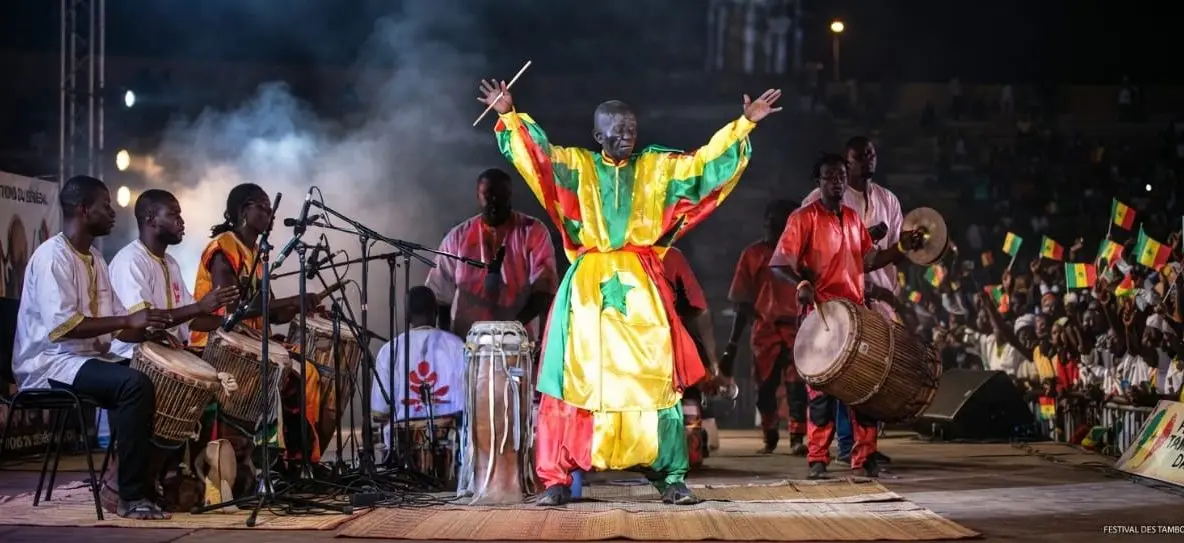
Doudou Ndiaye Rose (July 28, 1930 – August 19, 2015), the drummer who gave a rhythm to independence
On August 19, 2015, Senegal lost one of its most recognizable voices. A voice that did not speak, but beat.
Doudou Ndiaye Coumba Rose, whose real name was Mamadou Ndiaye, died at the age of 85 in the city where he was born, on July 28, 1930, in the former district of Kaye Findiw, now part of the Medina. Eleven years later, its name remains closely linked to two major symbols of national culture: the Grand Théâtre and the April 4 parade.
A national heritage
Coming from a family of Wolof griots, Doudou Ndiaye Rose discovered sabar at the age of seven. In this tradition where knowledge is passed on from one generation to the next, he learned from his elders before being noticed by Joséphine Baker during her visit to Dakar in 1959.
The following year, at the dawn of independence, he joined the Maison des Arts as a drum teacher. Léopold Sédar Senghor then appointed him chief drum major of the Daniel-Sorano National Theater. The young percussionist then became one of the main institutional ambassadors of the Senegalese sabar.
His talent quickly transcends borders. Under the direction of the ethnomusicologist Herbert Pepper, he contributed to the rhythmic part of the national anthem, the lyrics of which were signed Senghor. In 2006, UNESCO distinguished him as a “living human treasure”. His international fame led him to collaborate with artists like Miles Davis, Peter Gabriel and the Rolling Stones. But despite this worldwide recognition, he remains deeply attached to Dakar, to his neighborhood and to his troop, which he will also be the first Wolof master to open to women.
The rhythm of a nation
If there is a scene where his mark remains particularly vivid, it is that of the Independence parade. Present from the first celebrations, Doudou Ndiaye Rose led the percussion for several decades. From the 1960s, he helped give April 4 a uniquely Senegalese sound identity, breaking with the military codes inherited from the colonial period.
In 1975, with the choreographer Germaine Acogny, he created the parade of majorettes, another event that has become an essential part of the national holiday. Since his death, his heirs have perpetuated this rhythmic signature every April 4 on the Boulevard du parade.
His legacy goes far beyond music. In January 2020, the Grand Théâtre national de Dakar was officially renamed Grand Théâtre national Doudou Ndiaye Coumba Rose. A tribute worthy of the man who made the drum a language, the sabar a pride and rhythm an element of Senegalese identity.
Eleven years after his death, Doudou Ndiaye Rose continues to live through what was most dear to him: the sound of drums, the memory of the Senegalese and this collective pulse which, every April 4, reminds us that a nation can also recognize itself at its own rhythm.
Sheikh Gora DIOP
