
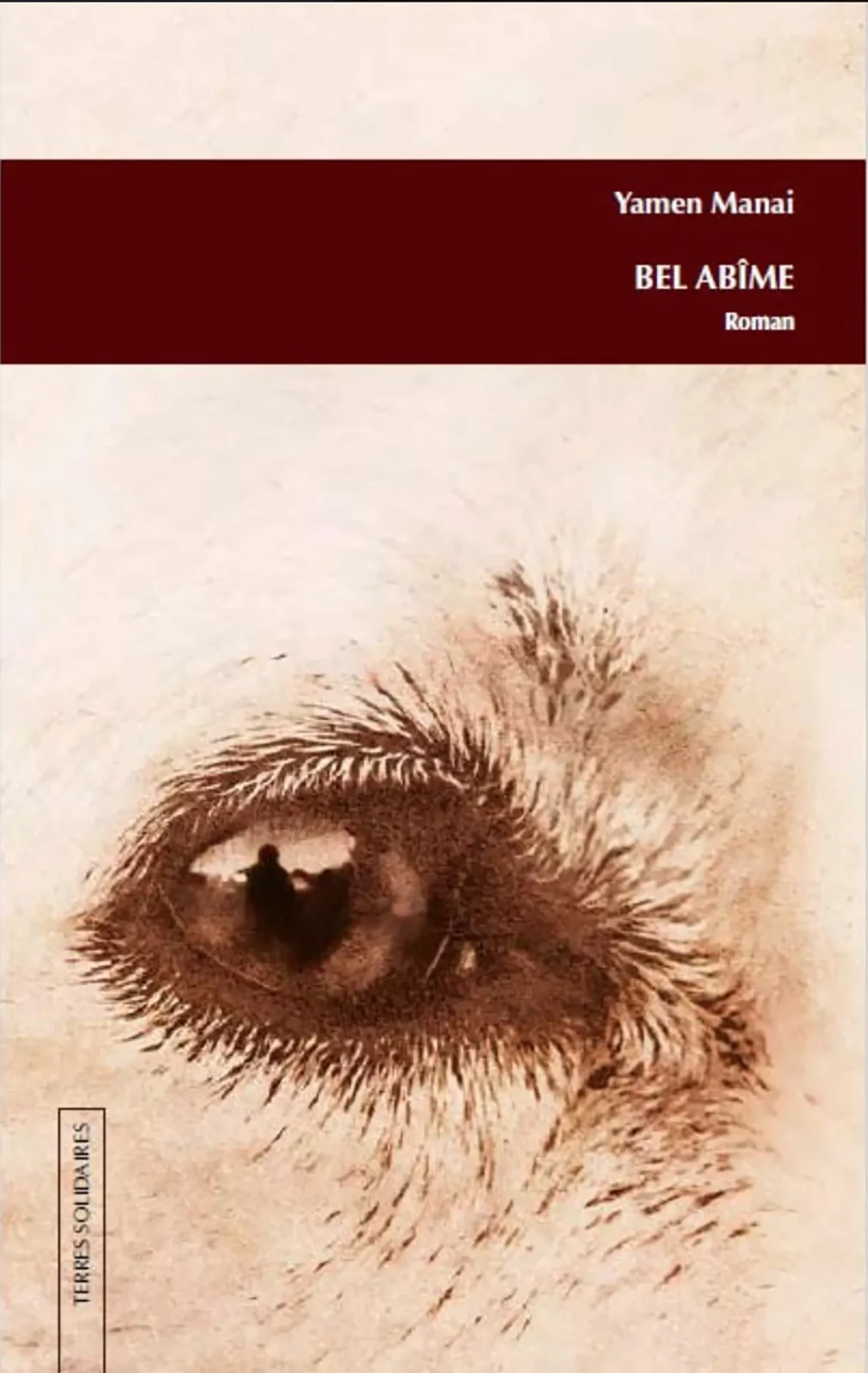
“Bel abîme”, the cry of a young outcast against the violence of men August 23, 2026
Published in 2021 by Elyzad Editions, “Bel abîme” by Yamen Manaï is a 112-page novel carried by the voice of a teenager who has become an outcast in a society which no longer knows what to do with its anger. His story begins in the intimacy of a deep relationship between a boy and his dog, before broadening into a reflection on violence, injustice and the brutality of adults. With a direct, tense language shot through with irony, Manaï makes this young narrator a witness as lucid as he is rebellious to a world which condemns without seeking to understand. Behind the singular destiny of this boy emerges a broader critique of Tunisian society, its fractures and its silences, in a text where childhood is not synonymous with innocence, but the place of desperate resistance in the face of human violence.
At fifteen, it is already too late to ask him to believe in adults. His father humiliated him, school taught him the law of the strongest, society taught him contempt and, in this universe where the weak are ordered to disappear, he found only one presence capable of giving him back a little dignity: Bella. A female dog. An animal that others look at with disgust, but which, for him, represents everything that men have not been able to give him.
In “Bel abîme”, Yamen Manaï tells less the birth of a criminal than the slow creation of a rage. Published by Elyzad in 2021, this 112-page novel received the Orange Book Prize in Africa and the Arab Literature Prize in 2022.
The book begins after the disaster. The boy is in prison. He speaks to his lawyer, to a psychiatrist, but also, more profoundly, to all those who would like to reduce his story to a legal file. He doesn’t really plead his innocence. He tells. His words return to the child he was, to his fear, his fragility, his complicated relationship with his father and to this decisive discovery by Bella.
The device is reminiscent, in certain aspects, of that of Camus’s The Stranger. It is therefore saying a man facing a judicial institution, a word which constantly shifts the question of the crime towards that of the way society views the person who committed it. But where Meursault seems foreign to the world, the boy from Manaï is painfully a prisoner of it. He feels too much. He loves too much. He takes too much.
This difference is essential. Meursault is overcome by a form of indifference which scandalizes those around him. The narrator of “Bel abîme” is anything but indifferent. His anger comes precisely from what he feels with an intensity that those around him cannot stand. He would like to be recognized, loved and respected. He wishes he could raise his head.
Bella allows him to do just that. Before her, the boy is described as frail, fearful, always obliged to reduce his presence so as not to attract blows or humiliation. Meeting Bella changes his relationship with the world. She waits for him, welcomes him, gives him a reason to return home.
Their relationship is nothing more than a touching episode intended to make the character sympathetic. It constitutes the boy’s real learning. With Bella, he discovers friendship, loyalty, responsibility and a form of love that requires no justification. Academic work devoted to the novel has also highlighted this dimension of “learning novel”, built around the relationship between the adolescent and his animal.
In the name of loyalty
Literature has long known these characters who find in animals a truth that men have lost. We think of Colloquy of the Dogs by Cervantes, the ambiguous relationships between man and animal in Kafka, or even Flush by Virginia Woolf.
But Manaï moves this tradition towards a very contemporary political question, that is to say, what does our way of treating animals reveal from our way of treating humans?
Bella belongs to the weak. The boy too. Both are considered cumbersome by a world organized around strength, authority and appearances. The animal is a sort of mirror. What the adults reproach Bella for, her dirt, her presence, her difference, joins up with what they reproach the boy for, such as his fragility, his refusal to conform, his inability to enter obediently into the role assigned to him.
The novel thus circulates violence between several spaces. It begins in family privacy, extends into the street, crosses institutions and ends up returning in a murderous form. A study devoted to the novel sees precisely in this relationship between man and animal a reflection on human cruelty, the violence done to the living and our way of inhabiting the world.
The father occupies a central place in this mechanism. He represents a certain conception of power, the one who commands because he is the father, the one who decides because he is the strongest, the one whose word cannot be challenged. Faced with him, the boy initially has only flight, books and imagination.
Reading gives him an inner territory. He discovers that words can provide what his environment denies him. This place given to books is not insignificant. In “Bel abîme”, reading already amounts to resisting. The boy gradually understands that he who owns words has a form of freedom.
Perhaps this is why his speech, once he is locked up, becomes so abundant. He has been physically reduced to a cell, but he responds with overflowing words.
The title itself concentrates this contradiction. “Beautiful abyss”. Beauty and fall united in two words. Bella is on the beautiful side. It is the bond, the trust, the loyalty. The abyss is what is growing around her like family, society and the teenager who discovers that the only true relationship he has can be taken away from him by those who claim to know what is good for him.
We could then compare the novel to Camus’ tradition of the absurd. In The Myth of Sisyphus as in The Stranger, man finds himself confronted with a world which does not provide him with a satisfactory answer. In Manaï, however, the absurd takes a social form.
And that’s what makes Bella’s disappearance so decisive. As long as it exists, the boy maintains a link with something pure. It constitutes his last space of confidence. His death destroys the last possibility of a different world.
Bella is killed in the name of a discourse of protection, but the violence we wanted to prevent was already established in human relationships. The boy isn’t making it up. He inherits it.
This idea gives the novel a scope that goes beyond Tunisia. But the mechanism is broader. Everywhere, societies produce their fragile children, then are surprised by their anger. They ask the humiliated to remain dignified, the poor to remain patient, the weak to remain silent. They then become indignant when one day someone responds.
Finally, in “Bel abîme”, there is an ecological reflection which could go unnoticed behind the plot. Bella’s abuse is not separate from the disregard for the environment and poverty depicted in the novel.
The man who mistreats the animal belongs to the same system as the one who degrades his environment. Violence against the living and violence against the most vulnerable come from the same logic of domination. Keith Moser’s study brings the novel closer to the ecological concerns already present in L’Amas ardent, another novel by Manaï.
Yamen Manaï’s merit is that he does not answer this question with a ready-made morality. He lets a boy speak. His words are sometimes excessive, unfair and violent. It is not always comfortable. But it obliges us to stay until the end with someone whom we might have condemned too quickly.
Bella remains at the center of everything. Abandoned dog, companion of a humiliated child, figure of loyalty in a world of betrayals, she is ultimately the measure of a society which claims to protect its members while sacrificing the most fragile.
Its absence deepens the abyss of the title. And in this abyss, it is not just an adolescent that Yamen Manaï asks us to look at. The world made it.
Amadou KEBE
