
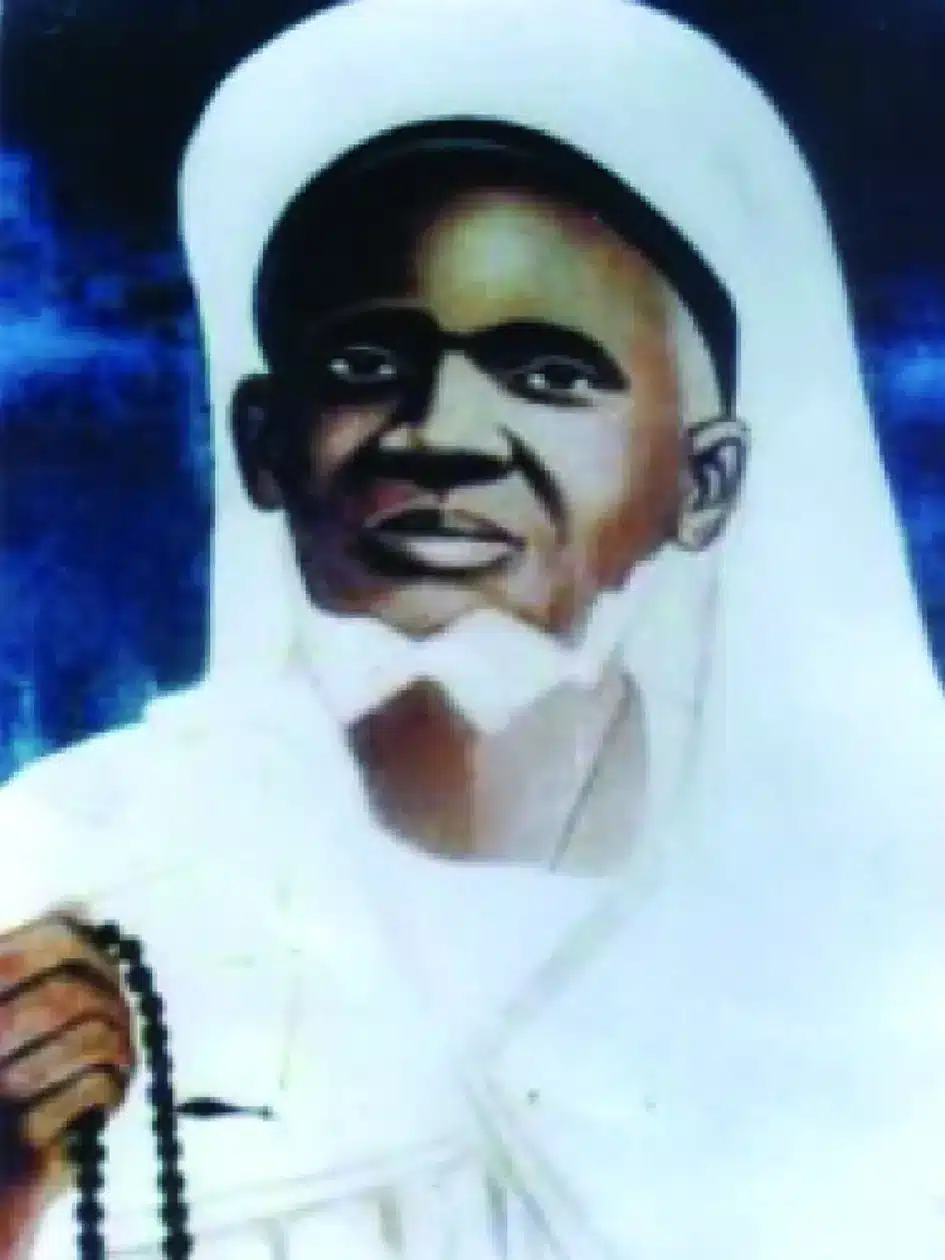
Two voices, one dawn: the birth of the Prophet at Al-Busîrî and Cheikh El Hadji Malick Sy
During the 4th night of the Burdah recital in Tivaouane, as instituted by Cheikh El Hadji Malick Sy, it is the chapter entitled “On his Nativity” which is sung and meditated on. Seven centuries and two continents separate the Mamluk Egypt of Al-Busîrî (7th/13th century) from the Senegal of Cheikh El Hadji Malick Sy (19th-20th century). However, the two men, two great mystical poets, find themselves on the same ground: that of the madîh nabawî, the poetic praise of the Prophet Muhammad, and more precisely that of the irhâsât.
These are the warning signs and wonders which, according to tradition, accompanied the birth of the Chosen One. By comparing the passage from Al-Busîrî’s Burda devoted to this night and the chapter that Cheikh Malick Sy devotes to it in his Khilâçu Dhahab fî Sîrat Khayr al-‘Arab (“Decanted Gold, on the biography of the best of the Arabs”), we see two ways emerge, related but distinct, of recounting the same founding event.
Al-Busîrî: the night when the Persian empire falters
The passage taken from the chapter of the Burda devoted to the birth and the prophetic mission, builds its wonder around a very specific setting: the Persian court. The palace of Kisrâ (Chosroès) is cracking “like an assembly disperses without ever coming together”; the sacred fire of the Zoroastrians, maintained for centuries, goes out “of sorrow”; the lake of Sâwa withdraws and refuses its waters to those who come to drink there. Busîrî pushes the image to the point of paradox: fire, he says, carries within itself the humidity specific to water as it is overwhelmed with sadness, and water carries the ardor specific to fire.
Added to this scene of desolation are the jinns who scream, the augurs and soothsayers who lose their gift, the idols who collapse, the shooting stars who repel the demons wanting to surprise the revelation. The vanquished fleeing “like the heroes of Abraha”, or like the incandescent stones thrown by birds at the army of the one who wanted to destroy the Ka’bah. There, Busîrî comes closer to Cheikh El Hadji Malick in another of his odes the Nûniyya.
But what Busîrî does here is a precise rhetorical style: he anchors the birth of the Prophet in religious geopolitics. Sassanid Persia, rival of Byzantium and guardian of Zoroastrianism, is the very symbol of pre-Islamic “pagan” power. By making it waver at the very moment of birth, Busîrî transforms an event that seemed isolated – the birth of a child in Mecca – into a turning point in universal history. The tone is almost teasing and ironic: “they became blind and deaf” (v. 8), he says of the Persians, who neither heard the announcement nor saw the flash of warning, even though their own soothsayer had warned them that their twisted religion would not hold.
We first find the same representation as in Busîrî: “What a resplendent night! “, “the throne of every king was returned, without exception. By the Lord of the sacred Kaaba.” But where Busîrî named a specific empire, Cheikh El Hadji Malick Sy universalizes the motif: it is no longer only Kisrâ who falters, it is every king, every idol, (Sarîru kulli malîkin); the entire humanity is gripped by the event.
We mentioned it in Inspirations Malickiennes, “where Seydi El Hadji Malick Sy innovates is in his knowledge of the socio-historical context in which the Prophet lived. He constantly navigates between the life of the Prophet and the evocation of this context with a historical culture that can surprise more than one person. Despite the chronic lack of reference works which characterized his time, the difficulty of acquiring them, not to mention the complexity of the historical environment which saw the birth of the Prophet (PBUH), Maodo showers us with knowledge on Rome, Byzantium, Chosroes, Anou Shirwân and the others. His geographical knowledge coupled with his mastery of history which emerges from numerous writings still remains an enigma and a source of admiration for someone who only left Senegal for the pilgrimage to Mecca. When Seydi El Hadji Malick Sy, in his approach to the life of the Prophet and the cradle of revelation, the Hedjaz, manages to give, with incredible precision, the names of places and landmarks still unknown to the very inhabitants of these regions, we can only still admire his inestimable efforts for the acquisition of knowledge.
Convergences and divergences: two theologies of wonder
The two poets clearly draw from the same reservoir of traditions of the Sîra (Ibn Ishâq, Tabarî, and the subsequent literature of the dalâ’il al-nubuwwa, the “proofs of the prophecy”): fall of idols, overthrow of thrones, agitation of the jinns, signs in the sky. It is also very likely that Cheikh Malick Sy, a late scholar, heir to the Tijaniyya tradition where the Burda has been memorized and recited for centuries, deliberately made his own text resonate with that of Busîrî with which he shares the “m” rhyme, hence the Mîmiyya. The possibility is also great that such a process involves intertextuality which brings the texts into dialogue in various ways, but reflecting the sharing of the same well-established poetic tradition.
But, above all, it is the accent that differs:
● Busîrî constructs a predominantly political and polemical scene: it is the fall of a rival empire, Zoroastrian Persia, which embodies the blindness of the pre-Islamic world. The register is that of the disgrace and humiliation of an identifiable power.
● Cheikh El Hadji Malick Sy constructs a predominantly cosmological and sapiential scene: the entire universe with the animals, the seas, the skies, the holy women of the past, the angels, even the infant himself. Everything contributes to welcoming the Prophet and this founding nativity. In Maodo, the framework is less that of a humiliated empire than that of a universal harmony which is reorganized around the Muhammadan Light, a doctrine that Cheikh El Hadji Malick Sy poses in the first chapter of his work, devoted to the pre-existing origin of this light even before the genealogy of the Prophet, a typically Sufi signature of his approach. This aspect is widely highlighted in the work of Seydi Diamil Niane of IFAN.
On a formal level, the two texts share the classic form of the qasîda with a single rhyme spread over dozens, even hundreds of lines. But their purpose differs: the Burda circulates above all as a devotional and mystical text, recited for baraka and healing (Busîrî would have composed it after a miraculous healing); The Khilâçu Dhahab, by Cheikh El Hadji Malick Sy presents itself as a complete versified sîra, structured in numbered chapters and philologically annotated, a sort of manual intended for learners of all centuries as much as a poem of praise.
The birth of the Prophet continues to be told in two poems separated by several centuries, but each poet projects his own universe there: Busîrî sees the collapse of a rival empire and the victory of truth over falsehood; Cheikh El Hadji Malick Sy sees in it the setting in motion of the entire creation, from the sea depths to the heavens, around the Light which, in him, has always preceded the world. The two texts, far from competing or contradicting each other, interact and respond to each other: they show the vitality of the same tradition of prophetic praise which, from the Nile to the Senegal River, has never ceased to reinvent itself without ever leaving its common base.
Dr. Bakary SAMBE, Center for the Study of Religions, Gaston Berger University of Saint-Louis (Senegal)
