
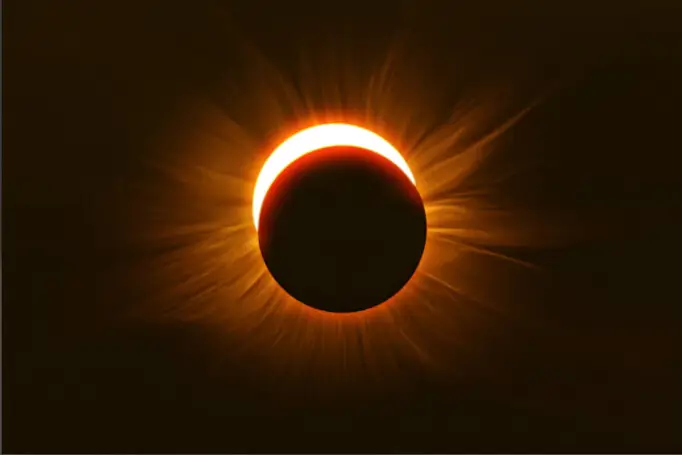
Solar eclipse this Wednesday: The Moon veils the Sun above Senegal
A partial solar eclipse will be visible today, Wednesday August 12, in a large part of Senegal, with a maximum expected around 7:12 p.m. in Dakar. The observation conditions will be decisive, according to experts in the field. `
The Senegalese sky is preparing to offer, this Wednesday, August 12, 2026, an exceptional astronomical spectacle. From the end of the afternoon, the Moon will gradually come between the Earth and the Sun, causing a solar eclipse visible from a large part of the territory. “The Moon will pass between the Earth and the Sun,” explains Maram Kaïré, director general of the Senegalese Space Studies Agency (Aspa). Contacted by “Le Soleil”, he informed that for a little over an hour, observers will be able to see the moon gradually “nibble” away at part of the solar disk. The phenomenon will begin, depending on the locality, around 6:20 p.m. – 6:25 p.m. In Dakar, the first contact is expected around 6:25 p.m. The maximum will occur around 7:10 p.m. – 7:12 p.m., before the phenomenon gradually ends. But, unlike some regions of the world, Senegal will not witness a total eclipse. “In Senegal, the eclipse will not be total, it will be partial,” said the CEO of Aspa. Totality will be particularly observable in Greenland, Iceland and parts of Spain.
The importance of the phenomenon will vary depending on the region. The further we go towards the north of Senegal, the greater the part of the Sun masked by the moon will be.
According to Maram Kaïré, in Dakar, approximately 37% of the solar disk will be obscured at the time of the maximum. In Saint-Louis, this proportion will reach around 41%, while Louga will also be well placed, with almost 40% of the solar disk hidden. “The regions of the north and northwest of Senegal, notably Saint-Louis and Louga, will be particularly interesting for observation,” indicated the boss of Aspa.
A show and a lesson
of science
The phenomenon will, however, be visible in a large part of the country. For Mr. Kaïré, it will not be necessary to travel long distances to benefit from it. “The main challenge will rather be to have a clear horizon and favorable weather conditions,” he stressed. The sun will, in fact, be very low when the eclipse reaches its maximum.
“In Dakar as in Saint-Louis, it will only be around 4 degrees above the horizon at the time of the maximum,” underlined the director of Aspa, estimating that it will be necessary to favor a place offering a perfectly free view to the west. “A building, a tree or a cloud positioned in this part of the sky could obscure the spectacle,” he warned.
The weather is one of the main unknowns. According to Mor Kébé, forecasting engineer at the National Civil Aviation and Meteorology Agency (Anacim), “the evening of Wednesday August 12 should be marked by temporarily cloudy skies over a large part of the territory”.
Conditions are expected to be more unstable in the south and east. “Rainstorm phenomena could develop,” warned the forecaster. These areas could experience less favorable conditions for observation. Conversely, early trends indicate potentially more favorable conditions across much of the central, northern and western regions.
But Anacim remains cautious: “It is still too early to designate with certainty a specific region as the best observation zone. »
Beyond the beauty of the phenomenon, this eclipse constitutes an opportunity to make visible the mechanics of the solar system. “An eclipse is always a fascinating phenomenon because it allows us to see, almost directly, the mechanics of the solar system at work,” explained Maram Kaïré. The Earth revolves around the Sun and the Moon around the Earth. Permanent movements, but which we do not perceive in our daily lives. “We literally see the Moon passing in front of the Sun,” summarized the CEO of Aspa.
The eclipse also serves as a reminder of an astonishing cosmic coincidence: the Sun is approximately 400 times larger than the Moon, but it is also approximately 400 times further from Earth. The two stars thus appear almost the same size in the sky; which makes total eclipses possible.
For Mr. Kaïré, the event must above all be used to transmit scientific knowledge, particularly to young people. “It’s a great opportunity to explain to the public, particularly young people, how the movements of the Earth, the Moon and the Sun work,” he said.
Babacar Gueye Diop
