
The banker who redresses Africa differently August 9, 2026
After thirteen years spent in the heart of Parisian finance, this 37-year-old Senegalese turned her back on a promising career to create “Maket”, a circular fashion platform in Dakar. An entrepreneurial bet coupled with a cultural challenge in a country where reselling your clothes remains far from being a reflex.
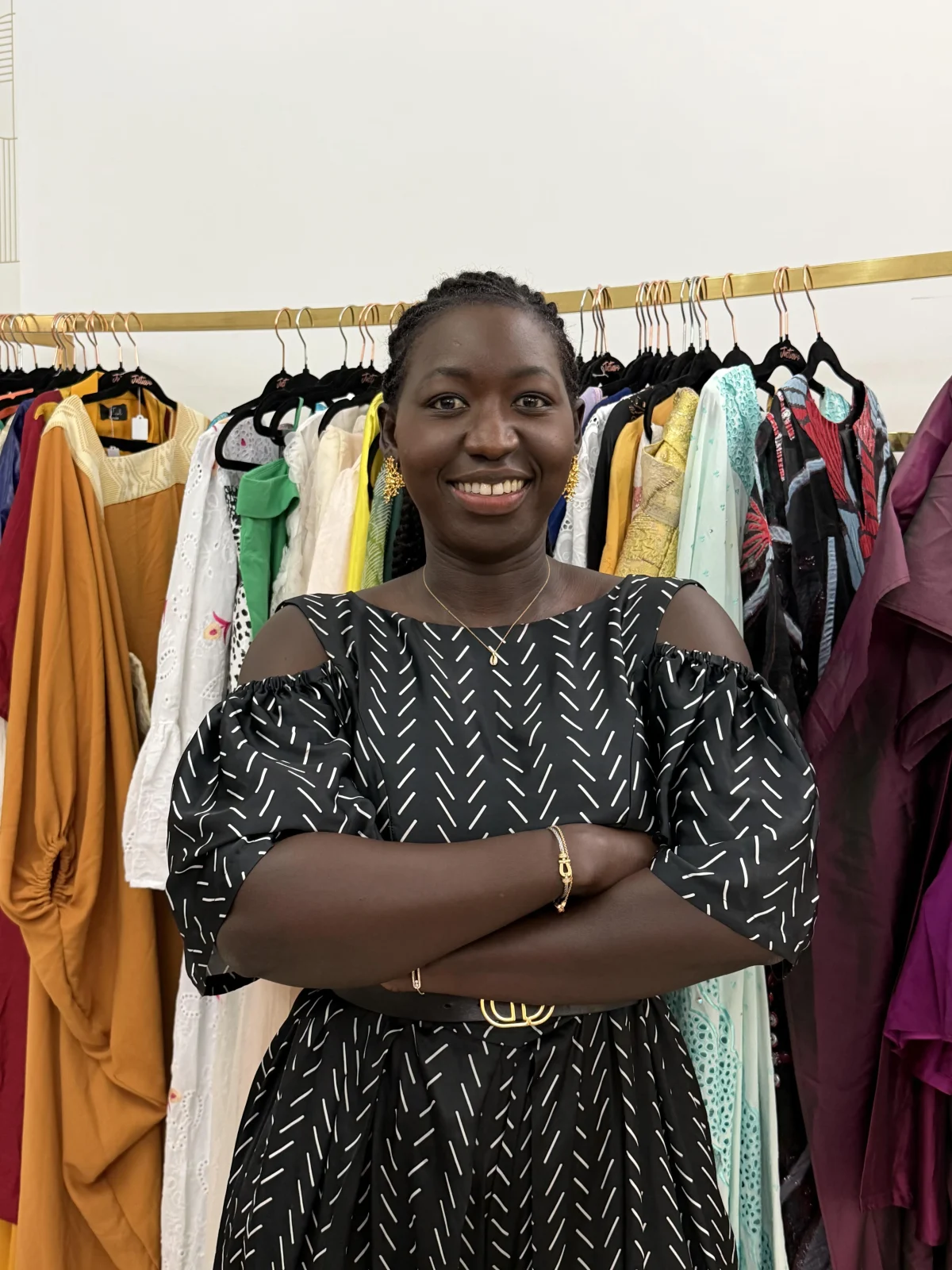
His fingers brush against the fabrics with an almost instinctive attention. She stops at one outfit, then puts back on a white lace dress with delicate work. In its premises, with clean white walls, Ndèye Fatou Dieng gazes with satisfaction at the golden wardrobe where the creations are lined up. She wears a black, off-the-shoulder dress with white patterns on the puffed sleeves. Her hair braided into a ponytail highlights a luminous face, delicately enhanced by golden earrings.
She does not have the voice of those who whisper their ambitions. Laughing easily, speaking loudly, speaking lively and without filter, she strings together sentences without ever searching for words, with the singular fluidity and assurance of those who are used to defending a complex file before a board of directors.
Read also: Fatou Dieng, “personal shopper”: A pioneer serving African designers
At 37, this former international finance executive runs “Maket”, a young company specializing in circular fashion and high-end second-hand goods. A world that seems a thousand miles from the trading rooms where she built most of her career. However, she assures, the common thread is the same: rigor, strategy and a taste for calculated risk.
In an African textile distribution sector dominated by the informal sector, the methodical approach brought by Ndèye Fatou Dieng stands out. His atypical journey offers an original reading grid of the economic dynamics that cross African metropolises today. Dakar, a true crossroads of trends, constitutes in this regard an ideal testing ground to lay the foundations of an innovative economic model.
However, nothing destined her for textile entrepreneurship. The daughter of an engineer and a teacher, she grew up in a family where academic standards were the rule. “At home, we didn’t really have room for error,” she says. A brilliant student, she obtained a scientific baccalaureate at the Jean-Mermoz high school before moving to France thanks to an excellence scholarship from the State of Senegal.
The emergence of an entrepreneurial vocation
In Bordeaux, she obtained a master’s degree in corporate finance before joining the banking sector. For thirteen years, she rose through the ranks within large establishments, notably Société Générale and Bnp Paribas. His ambition is then clearly defined. “My dream was to become a director at the World Bank,” she confides. This family and academic rigor instilled in him an impeccable work ethic very early on. Surrounded by parents convinced of the virtues of effort, the young student quickly understands that merit is the best key to fulfillment. This demanding framework shapes a resilient personality, equipped to face the competitive environments of international finance.
But, far from Senegal, another project is discreetly taking shape. Constantly asked by her loved ones to buy clothes and products that are difficult to find in Dakar, she despite herself becomes their “personal shopper”. The idea gained ground until it became a parallel activity. Days extend after office hours, while evenings and weekends are devoted to ordering. In 2019, she left the bank for the first time to go full-time. The experience is short. “The business was working, but not enough to support a team,” she admits. Forced to return to France in 2020, she resumed her job as a banker without considering this episode as a failure. “It was simply stepping back to jump better.”
Above all, this experience allows him to come back with a more successful project. At the end of 2023, she resigned a second time, this time with a better constructed economic model. She surrounds herself with tech experts and benefits from the support of structures such as Der/Fj, LionsTech and Hec Challenge+. The lessons learned from this first attempt proved valuable. Far from stifling his entrepreneurial ambitions, this experience confirms the relevance of the need while highlighting the adjustments necessary to build a sustainable business capable of changing scale.
Thus was born “Maket”, a platform which aims to develop circular fashion in Africa while promoting the continent’s creators. For its founder, the objective is not only to sell second-hand clothing, but to build an ecosystem where pieces experience several lives and where consumption becomes more responsible. The challenge goes beyond just the entrepreneurial framework. In Senegal, buying second-hand clothes is common, but reselling your own remains not culturally accepted. “Reselling your own clothes is not anchored in our habits,” explains the founder, referring to the many social reluctances surrounding this practice.
Building a responsible fashion ecosystem
To remove these obstacles, Maket relies on high-end positioning, a rigorous selection of parts and an experience designed for local uses. The application allows registration using a simple telephone number, integrates payment by mobile money and guarantees rapid payment to sellers. A physical showroom completes the system in order to reassure customers who are still hesitant. The integration of mobile money payment solutions is quickly becoming a key element of the system. In a context where smartphone use is widespread, ease of use makes the difference. At the same time, the showroom plays the role of a trusted third party essential to establishing a lasting relationship with users.
At the head of a team of eight employees, Ndèye Fatou Dieng also discovers the requirements of management. “Moving from founder to manager is undoubtedly the most difficult. We are not taught to deal with different personalities.” Impulsive in temperament, she was accompanied by a coach in order to learn how to listen better and unite her teams.
A competitor at heart, she finds the same intensity on the padel courts, which she frequents several times a week. An energy that she devotes above all to her business. Her ambitions are commensurate with the challenge she has undertaken: to make “Maket” an African reference in circular fashion, to exceed one billion FCFA in turnover and to permanently place her company among the great Senegalese technological successes. This transition illustrates the challenges many founders face. Accustomed to the structured environments of banking, she learned to deal with the uncertainty specific to young companies. Coaching allowed her to adopt a managerial posture more focused on listening and mobilizing her teams.
Beyond the economic aspects, the initiative supported by “Maket” contributes to the redefinition of urban consumption patterns in West Africa. By demonstrating that eco-responsible fashion can combine elegance, profitability and positive environmental impact, Ndèye Fatou Dieng is paving the way for a new way of consuming fashion on the continent.
Pathe NIANG
