

Crisis at FIFA: AFC, Concacaf and UEFA demand accountability from FIFA
An unprecedented common front is emerging at the top of world football. The AFC, Concacaf and UEFA have decided to speak with one voice to defend what they present as the fundamental principles of football governance: integrity, transparency, accountability and respect for institutions.
In an open letter addressed to the “football family”, the three confederations, represented by their presidents and general secretaries, demonstrate their desire not to leave recent events involving FIFA unaddressed.
A collective response to FIFA’s methods
For the three confederations, football cannot be the property of an individual or a single institution. Its development is based, according to them, on a collective construction bringing together players, supporters, clubs, member associations and confederations.
The AFC, Concacaf and UEFA thus recall that the main developments of the last decade, expansion of competitions, allocation of the 2030 and 2034 World Cups or even distribution of resources, are the result of collective decisions.
They also exclude any financial interpretation of their approach. The three organizations emphasize that they have already advocated for responsible use of FIFA’s significant reserves in order to strengthen investments for the benefit of member associations.
Their fight, they say, is above all about the governance and integrity of football.
A severe disavowal of the process initiated by FIFA
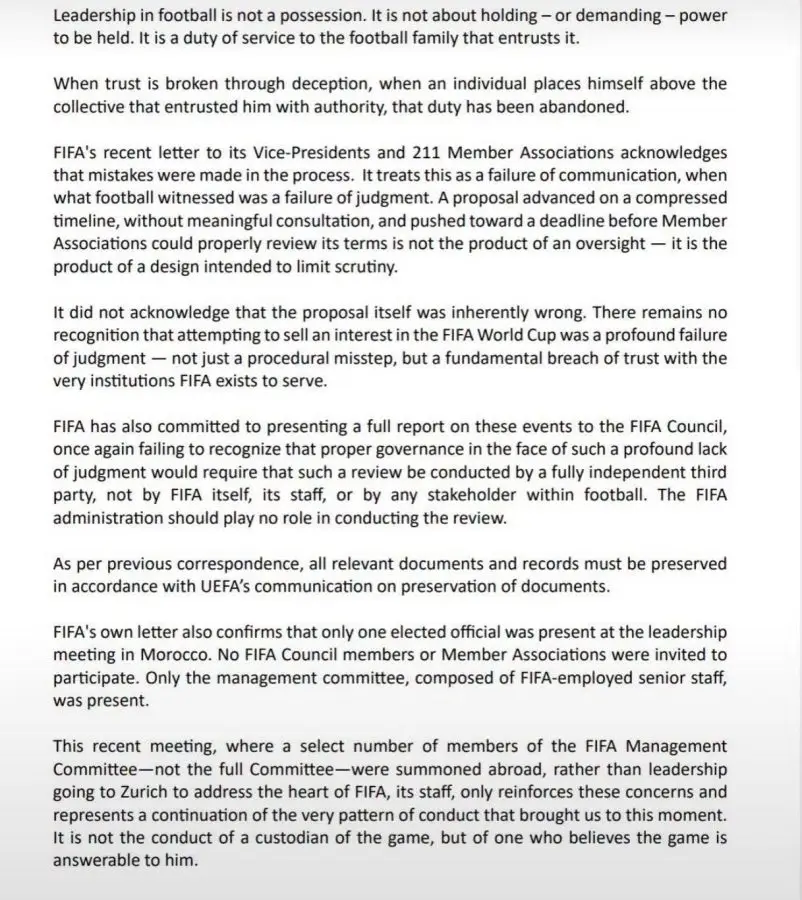
The main criticism concerns the process surrounding a FIFA World Cup proposal. In a recent letter addressed to its vice-presidents and the 211 member associations, FIFA admitted that mistakes had been made. The instance presents them as a communication problem.
For them, it is not simply a lack of communication, but a “failure of judgment”. They denounce in particular a proposal developed in a very short time, without significant consultation, with a deadline which did not allow member associations to properly examine its terms.
Even more severe, the AFC, Concacaf and UEFA believe that this approach cannot be considered as a simple administrative error. They see it as an attack on trust between FIFA and the institutions it is supposed to serve.
Independent investigation required
This is undoubtedly one of the strongest demands made by the three confederations. While FIFA has committed to reporting to the FIFA Council on the events, the AFC, Concacaf and UEFA are calling for the review to be carried out by a completely independent third party.
They therefore refuse to allow FIFA, its employees or any football stakeholder to conduct this procedure themselves.
“The FIFA administration should play no role in conducting this review,” they argue. This requirement reflects their desire to see the facts examined by an external body, in order to guarantee, according to them, the credibility and impartiality of the process.
Another strong decision: the three confederations request the preservation of all relevant documents and files linked to this affair. This request follows on from previous correspondence, in particular the UEFA communication on the preservation of documents.
It aims to ensure that the elements necessary to establish the facts can be available in the context of a possible independent examination.
How FIFA works questioned
The signatories also question the conditions under which a recent management meeting was held in Morocco.
According to the elements reported in their letter, only one elected official was present. No member of the FIFA Council or member association had been invited. The meeting mainly brought together members of the management committee from senior FIFA executives.
For the three confederations, this organization only reinforces the questions already expressed about the governance of the world body.
They particularly regret that FIFA management did not favor a meeting in Zurich, at the organization’s headquarters, with all the stakeholders concerned.
Beyond the current episode, the AFC, Concacaf and UEFA raise the broader question of the conception of power within world football.
Their message is unambiguous: running football does not mean owning it.
For the three confederations, the power entrusted to the leaders constitutes above all a service mission. They consider that a manager who places his interests or his authority above the community breaks the contract of trust which binds him to football institutions.
The letter thus concludes with a call for unity. The three confederations claim to have adopted this position “together” and “out of duty to the football they serve”.
A position which marks a clear desire to rebalance relationships within the governance of world football and to recall that FIFA’s authority cannot be exercised to the detriment of the member associations and confederations which make up the football family.
The main demands of the three confederations
A completely independent review of recent events;
No involvement of the FIFA administration in the conduct of this review;
Preservation of all relevant documents and records;
A questioning of the process surrounding the proposal linked to the World Cup;
Respect for the principle of collective decision-making within world football;
The defense of integrity, transparency and accountability in governance;
A call for management that “serves football” rather than seeking to control it.
CGD
