
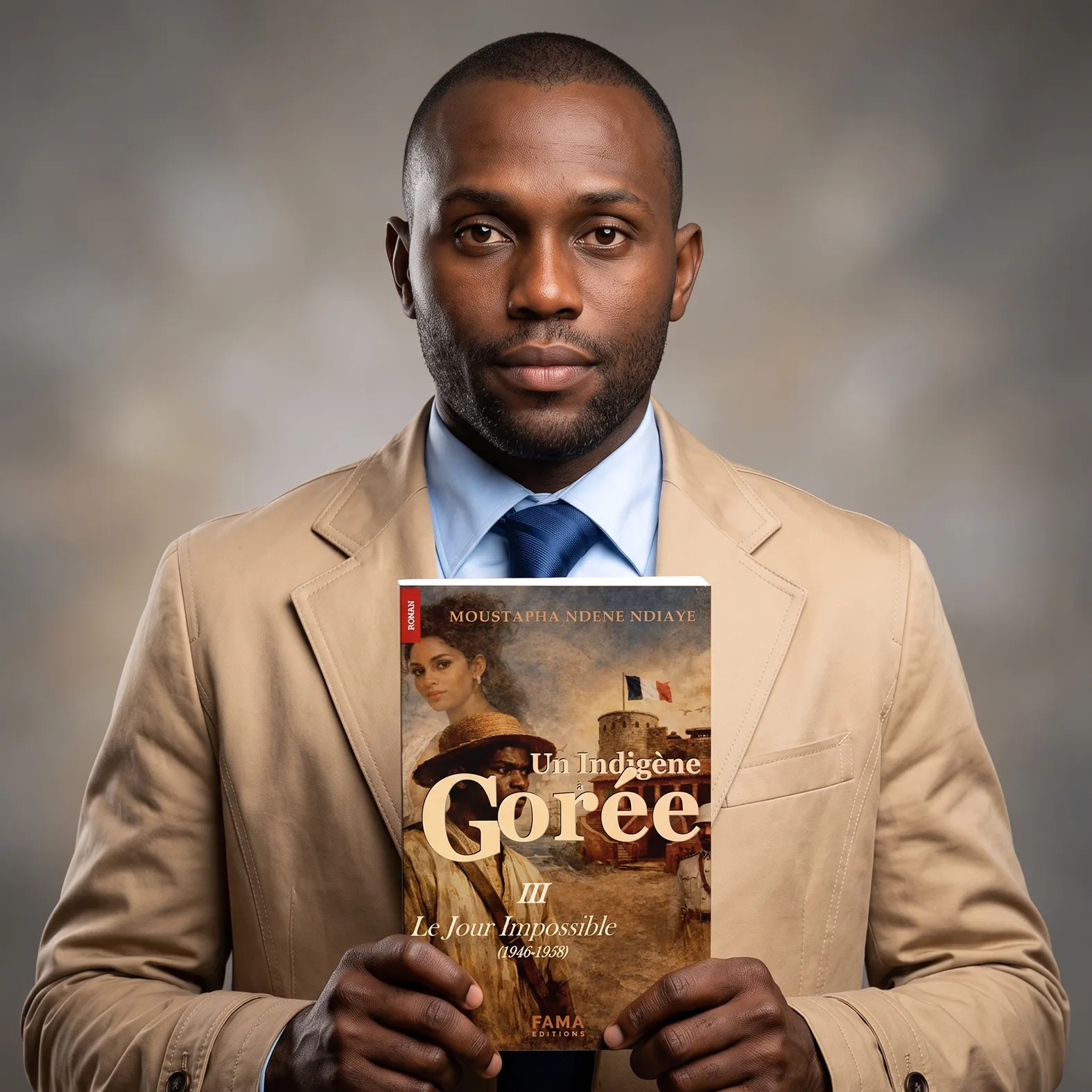
Words against the evils of History July 19, 2026
Winner of the Abdoulaye Racine Senghor Prize for the novel 2026, “Un Indigène à Gorée; The Impossible Day” (1946-1958), Volume 3, by Moustapha Ndéné Ndiaye completes an ambitious novel trilogy devoted to the birth of African consciousness. More than a historical novel, this work questions the very foundations of memory, freedom and sovereignty. With perfect mastery of the linguistic tool, the author accomplishes what only great novelists still know how to do: give the dead their breath so that the living finally understand their own destiny.
There are books that tell the story of an era. Others which explain a civilization. The rarest perform an infinitely more demanding task in making time habitable. They do not describe the past, but reanimate it. They do not line up events like tombstones, but rather give them a human pulse.
The great historical novels belong to this aristocracy of literature where History leaves the field of chronology to become an inner experience. The historian establishes the facts. The novelist restores what the archives cannot preserve, notably the tremor of a voice, the fatigue of a look, the weight of a silence and the invisible fracture of a conscience. Historical records tell us what happened. Literature teaches us what men paid for this to happen.
This is why Tolstoy in “War and Peace” (published in serials between 1865 and 1869 in “The Russian Messenger”), Marguerite Yourcenar in “Memoirs of Hadrian” (1903-1987), published in 1951, or Hilary Mantel in her trilogy devoted to Thomas Cromwell remain writers before being transmitters of History. They understood that historical truth only reaches its fullness when it marries human truth.
It is in this demanding line that it is now appropriate to read Volume 3 of “Un Indigène à Gorée; The Impossible Day” by Moustapha Ndéné Ndiaye.
Gorée as a mineral metaphor
What does this novel, recently distinguished by the Abdoulaye Racine Senghor Novel Prize 2026, say, with the jury saluting “the depth of its historical reflection, the quality of its writing and its constant contribution to contemporary Senegalese literature”?
This novel seems to tell almost nothing, even though it says almost everything about man, history and freedom. Yes, great historical works never only tell the story of their characters. They take a man to enlighten a people and borrow a destiny to probe a civilization.
Philippe is therefore not only Philippe. He is this African consciousness suspended between two worlds, this man that the Republic claims to recognize while continuing to view it as a subject. Former Senegalese rifleman, returned to the island of Gorée after the promises of the Lamine Guèye law, he discovers that legal proclamations sometimes resemble these winter suns which illuminate without warming.
All the power of the novel lies precisely in this contradiction. The author never transforms History into a tribunal. He prefers to make a mirror of it. Each scene reveals the tragic gap between proclaimed ideals and lived realities.
This is why the writer presents Gorée as a mineral metaphor. This island which carries, in each of its stones, the memory of departures without return, of betrayed loyalties and postponed sovereignties. The genius of the publisher and initiator of the Thiès International Book Fair (Silt) consists precisely in making the place breathe.
Under his pen, the streets preserve the echo of vanished footsteps and the walls mark the repositories of a memory that refuses to die. We sometimes think of the way in which Victor Hugo made cathedrals speak or how García Márquez transformed Macondo into a character. Here, it is Gorée which acquires a soul.
The work closes an exceptional novelistic enterprise. Started with “The Fall of the Gods” (1939-1943) nominated for the Grand Prix du Head of State in 2017, continued in “The Dawn of the First Day” (1943-1945), this fresco finds its fulfillment with “The Impossible Day”, covering the years 1946 to 1958.
Around a thousand pages, built on considerable documentation. This articulation between erudition and invention remains one of the major successes of the book. The historical novel often runs aground on one of two reefs. Either it becomes a conference in disguise, or it betrays its time for the benefit of spectacle. Moustapha Ndéné Ndiaye avoids these two shipwrecks. History never weighs on fiction. It discreetly irrigates its depths. The plot does not serve as an ornament to events, but embodies them.
The author himself sums up this ambition admirably when he states that the difficulty consists of “making the characters interact with the settings and contexts in order to avoid the divorce between the plot and the setting”.
But what is even more striking is the writing. A writing that refuses the modern facilities of dry sentences. She prefers broad periods, patient images, comparisons, metaphors, among other figures of speech.
Some sentences reach the density of real aphorisms. “Never mistake injustice for destiny. » Or again: “Philippe can no longer fall, he was born on the ground. »
The Thiaroye massacre, finally, official recognition
These formulas never seek effect. They arise organically from romantic meditation. They have great sentences which will continue to haunt the reader after closing the 267-page book published by Editions Fama.
And then there is love. It would be wrong to reduce “The Impossible Day” to a political reflection. It is first of all a huge romantic novel. The story between Philippe and his concubine Amalia gives the story a universal dimension. Their relationship is an allegory of a world incapable of reconciling its own contradictions.
Impossible love responds to impossible sovereignty. The two impossibilities look at each other like two mirrors in which the entire colonial drama is reflected. The title reaches its full symbolic resonance here.
The impossible day is not only that of a happiness refused. It is also the constantly delayed dawn of true independence. The year 1946 ushered in the promise of equality; the year 1958 heralded that of independence. Between these two dates lies the immense twilight of illusions.
The novel takes on an almost prophetic resonance today. At a time when the Thiaroye 1944 massacre, denounced in the book, finally found official recognition after eight decades of denial, this work reminds us that literature often precedes justice. Writers explore wounds long before states agree to face them.
“Africa, in the light recently shed on the events of Thiaroye, needs its history and we must tell the great lesson-givers that it is the people who are the majority shareholders in this history. It is up to the writer or intellectual to return it to the people who will do with it what they want,” says the author.
This trilogy must be read not only as a novel, but as a major contribution to African historical consciousness. In a continent where archives sometimes remain incomplete, where memory was often confiscated, the novel rediscovers its primary mission of restoring ownership of its history to the people.
Closing this third volume, the reader has not simply crossed a period of African history. He heard the heart of a continent beating. Like the ending: “Philippe took a long breath. He was leaving for a non-existent country. A country to be born. A country which, perhaps, was already waiting for it. The canoe continued its course towards the darkness. Towards the unknown. Towards the dawn of a new Africa. »
By Adama NDIAYE
