
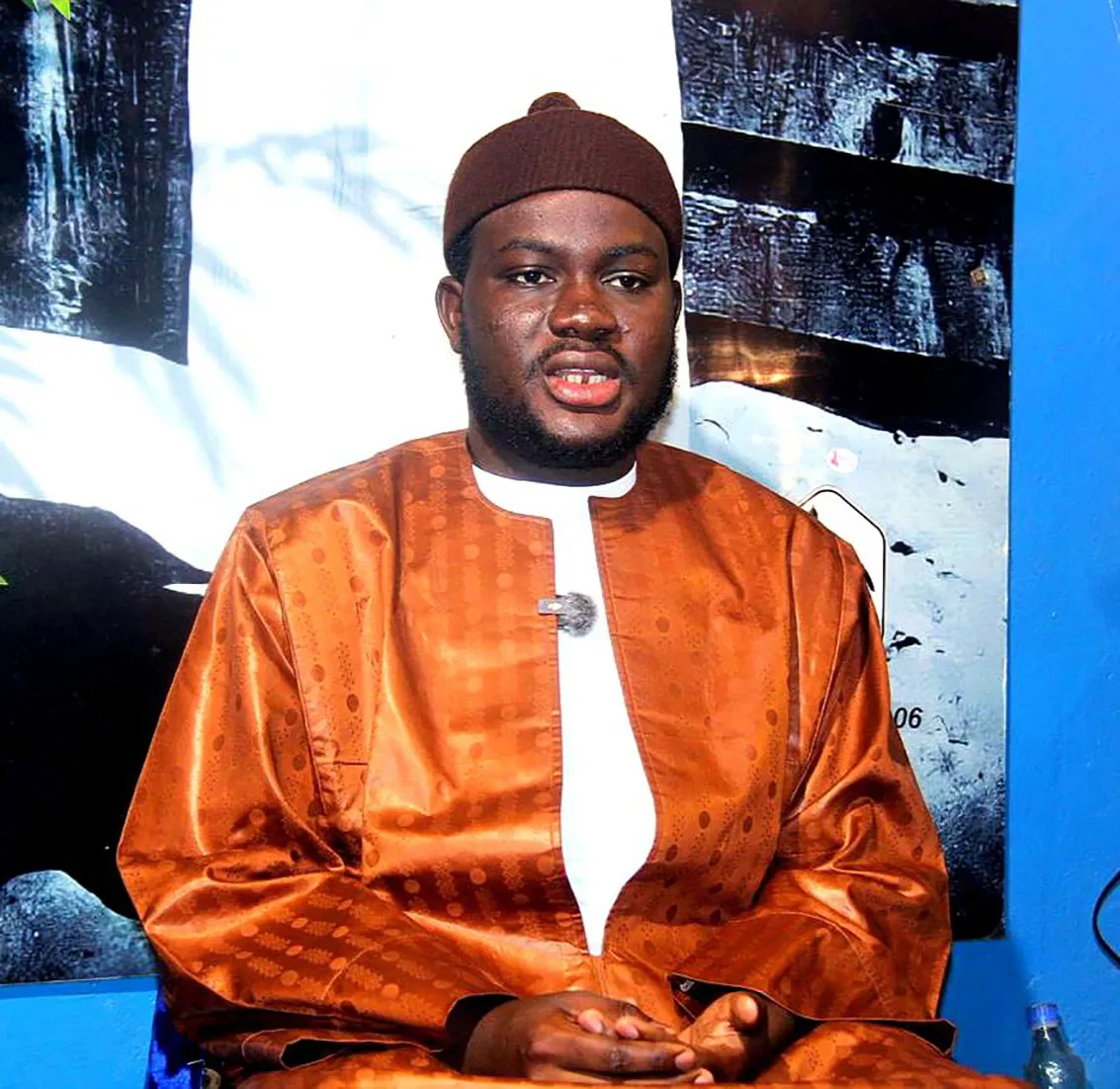
Mame Mor Gaye alias Baay Xalima: The calligrapher of the Xassaids
Initiator of “Xalimagraph”, Mame Mor Gaye, known as Baay Xalima, has established himself as a figure in Xassaid calligraphy in Senegal. Trained in the daara and deeply rooted in the Mouride way, he combines religious discipline, respect for the teachings and artistic demands. Through his works and his presence on social networks, he brings to life a spiritual heritage where writing is at once devotion, transmission and creative work.
In her room, Mame Mor Gaye’s workspace, known as Baay Xalima, is entirely organized around writing. Calligraphed paintings occupy the walls, notably passages from the xassida “Matlabul Muqarabil Asnaa”, produced with great precision. On the table, handwritten notebooks, religious books, draft sheets and work tools are carefully arranged. Ink pots and feathers of different sizes complete this environment entirely dedicated to calligraphy.
Sitting at his desk, he adopts a calm attitude. His way of expressing himself remains measured, with sentences constructed without haste. He listens carefully before responding, then develops his ideas clearly. His movements are discreet, often limited to the right hand, which accompanies his explanations. His gaze remains focused, imbued with a form of serenity and respect in the exchange. “The profession requires passion and patience. It can also be learned,” he says.
His journey is deeply linked to the daara. There he received an education based on discipline, memorization and writing of the Koran. Very early on, he is trained in the rigor of the gesture, the precision of the hand and respect for the knowledge transmitted. “After mastering the Quran, you had to write the entire Quran without looking at it. You have to have a clean hand, that is to say, be a calligrapher. It was this training, alongside my elders at the daara, that shaped me,” he explains.
This training structures not only his writing, but also his behavior. He maintains a respectful attitude, marked by restraint in words and consideration towards elders. In his way of speaking, we find a form of humility and recognition towards those who trained him. In his daily life, he embodies the values often associated with the Mouride way: discipline, work, respect for masters and attachment to knowledge. He speaks little to impose himself, but more to convey. He avoids excesses in speech and prefers to let his works express his commitment.
The turning point in his journey comes during the Covid-19 period. Back home after his time at the daara, he intensified his writing work and began to share his creations on social networks. “When I came home after the daara, during Covid-19, I started to get down to business and share my work on social networks,” he says.
During this period, he noticed the lack of visibility of the calligraphy of the Senegalese xassaides on digital platforms. He then decides to contribute to its development. “We only saw Arabs doing it and publishing their works on social networks. That’s where it all started, with the writing of the Xassaids.”
His work is gradually part of a transmission approach. It is not limited to producing works, but also seeks to make known a religious and cultural heritage. The creative process remains rigorous. It begins with structuring the page, with lines serving as guides. This method allows him to maintain a balance in his writing. “The process involves first drawing straight lines on the paper. They serve as guides for writing. At some point, we are so used to it that we no longer need it.”
With experience, he develops great technical mastery, even if certain combinations of letters still require special attention. “In my case, “laam alif” is often complicated to write,” he explains.
“By writing them, the Xassaides end up becoming part of us”
Over the years, Mame Mor Gaye, known as Baay Xalima, has calligraphed numerous xassaides of Cheikh Ahmadou Bamba. Among them are “Jaalibatul Maraaqib”, “Mafatihul Bichri”, “Matlabul Fawzayni”, “Mawahibou Nafih”, “Massalikoul Jinaan” and many other texts known in the Mouride world. By repeatedly copying them, he developed a special relationship with these works. “When you write a xassida several times, you end up knowing it. Certain passages remain in the memory without us realizing it,” he confides.
For him, calligraphy is also a way of experiencing texts. The long hours spent on a page allow him to become familiar with the verses and their meaning. “Often, when I’m working on a xassida, I don’t just focus on the beauty of the writing. I also pay attention to words and their meaning.”
He explains that certain works require several days of work. Between preparation, writing and corrections, the process can be long. “There are texts that take a lot of time. We write them line by line. At the end, you have the impression of having spent several days in the company of the xassida,” he explains, before adding: “Certain works remain in my heart. When I finish a piece of work, I always have a special feeling, because I spent a lot of time on it.”
Among the texts that he particularly enjoys calligraphing are “Jaalibatul Maraaqib” and “Mafatihul Bichri”, even if he specifies that he does not really have a preference. “All the Xassaids have their importance. Each xassida has its teaching, its message and its beauty.”
Digital technology now supports its activity, without replacing manual work. He uses tools to organize and prepare certain compositions, but the hand remains at the center of his practice. In the room, several paintings illustrate his artistic universe. One of them presents verses from “Wakaana Haqann”, executed in a regular and harmonious writing.
“The mysteries of the xalima”
Other works bear witness to the different stages of its evolution. He devotes long hours to this activity, with a regularity that structures his daily life. “Often, I find myself devoting myself to writing from morning to evening,” he says. This constancy reflects a strong personal discipline, inherited from his time at the daara and reinforced by his religious conviction. He considers calligraphy as a mission linked to the transmission of knowledge. “I devote most of my time to it. I am passionate. I don’t regret anything. Even when I’m somewhere, the urge to write urges me. It’s a priesthood.”
His relationship with the Mouride way is also reflected in his way of approaching work: patience, constancy, respect for effort and valorization of knowledge. He does not only seek recognition, but also works for the continuity of a spiritual heritage. Social networks have made it possible to give greater visibility to his work. There he shares works related to the Xassaides and contributes to making known a writing aesthetic rooted in Senegalese tradition. “There is a way of writing specific to Senegal. I didn’t see anyone highlighting it. That’s why I started publishing.”
Despite this exposure, he maintains a posture of restraint. He places more emphasis on transmission than on notoriety. “Often, the works I write stay in my heart. But the joy of sharing them with people fills me. It’s not the money that counts,” he assures. He sometimes reproduces certain works in order to make them accessible to a greater number of people, with a view to sharing. “We can’t write for everyone. So, sometimes, I write and multiply the copies so that everyone can have their share,” explains the calligrapher.
In his view of the future, he insists on the continuity of knowledge and the capacity of future generations to perpetuate this art. “If everything we wrote disappeared, there would be people capable of rewriting it, because they carry it in their soul.”
Finally, he points to his main tool with respect: the pen, the xalima, which he considers as an extension of himself. “The most important material is the xalima, the feather, my namesake.”
Through her behavior, her discipline and her commitment, Mame Mor Gaye, known as Baay Xalima, embodies a figure for whom artistic practice is part of a spiritual approach, marked by rigor, modesty and transmission.
By Amadou KÉBÉ
