
“The factory of the present” or utopia in action June 11, 2026
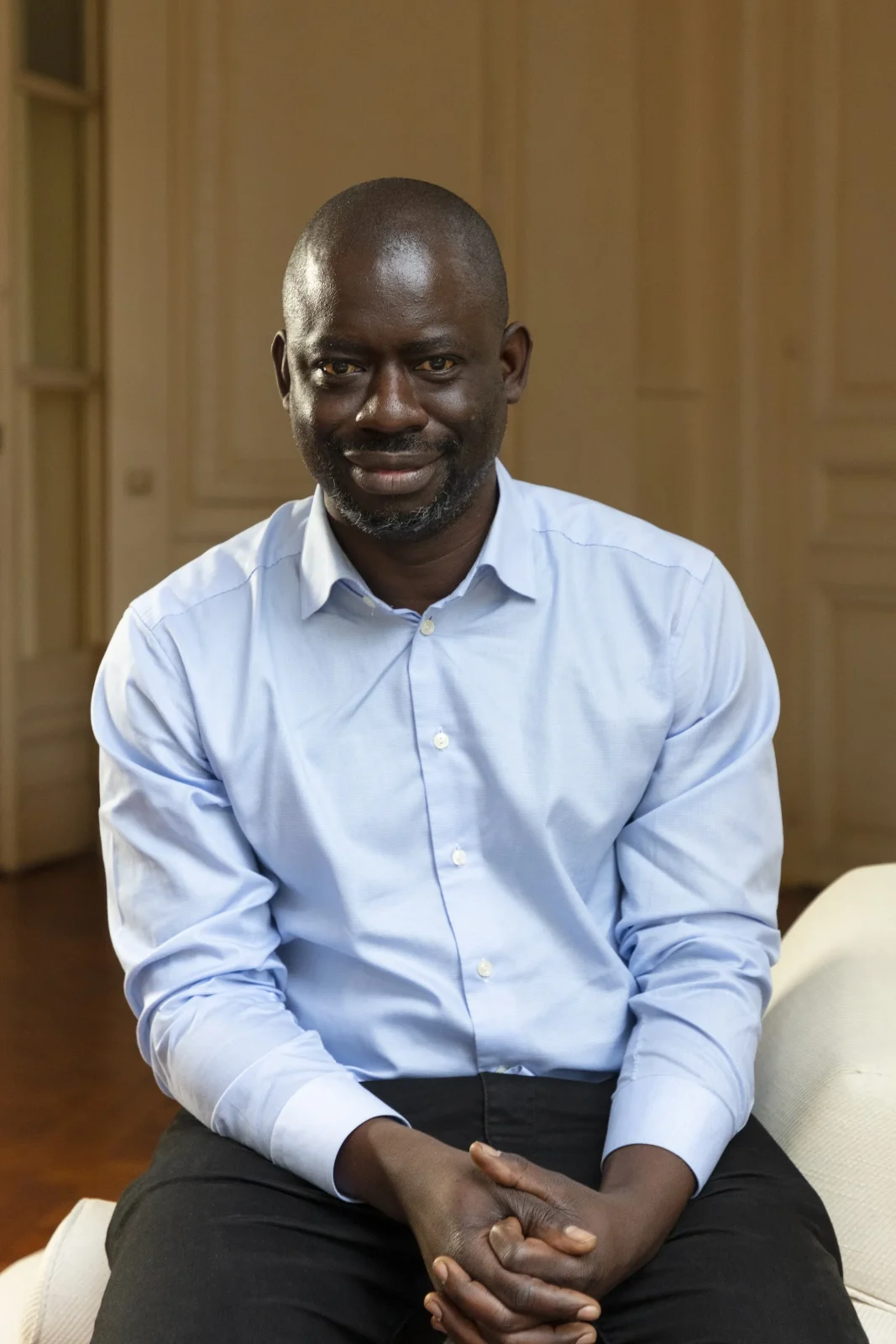
How to move from a desirable imagination to its materialization? This question is at the heart of Felwine Sarr’s latest work, “The Factory of the Present”, published by Éditions Philippe Rey/Jimsaan. The author presented the work to his Senegalese audience during a ceremony organized on Saturday June 6 at the 4 Vents bookstore in Dakar.
Felwine Sarr presented to his Senegalese audience his latest work “The Factory of the Present”, published last April by Philippe Rey and Jimsaan. After a conversation with the Senegalese academic Ibrahima Wane, on Saturday June 6, in Dakar, during which he commented on the different chapters of the book, the author answered questions from the public and held a signing session.
For him, this work is the continuation of a reflection begun in “Afrotopia” published in 2016. The maturation process lasted ten years, but the writing only took him a year.
“Afrotopia was not a recipe project, it aimed to broaden the imagination of African societies. This new work aims to materialize this utopia through reflection on presents and futures that live up to expectations,” explains Felwine Sarr. In other words, it is a question of moving from a utopian process into a mechanism of social transformation, of no longer stopping at the formulation of utopias, but of thinking about their creation in the present.
If the question of imagination is important, that of political economy is preponderant. In contrast to capitalism which presents itself as the political economy of prosperity and socialism (political economy of equality), the African challenge, he says, is to build a political economy of dignity.
In concrete terms, he writes, it is about creating the economic, political, ecological and social conditions so that all individuals have access to the means of a decent life (social capital, social protection, income, assets); guarantee them access to health, security and education, preserve their rights and freedoms.
This political economy of dignity must be linked to an economy of life. It is a carbon-neutral economy, whose production rate matches the rates of regeneration of the biotope and whose action is negentropic (which is opposed to entropy).
Synthesis of knowledge
The question is obviously how to move from theory to practice? In this regard, Felwine Sarr thinks that we must demonstrate economic ingenuity.
Does this mean that the path leads to an exit from capitalism as the philosopher Bado Ndoye suggests? If this disconnection seems difficult to imagine in current conditions because of the imaginary power of capitalism, the author notes that thinking towards a symbiotic economy – an economy whose metabolism does not negatively affect social, environmental and relational orders – has evolved significantly in recent years.
The question of endogenous knowledge has largely come up in the debates. But the way of their integration into a new epistemological order is a much more complex question, recognizes the author. However, he considers it imperative to reinvest this African knowledge for epistemological plurality.
For Felwine Sarr, the question is: what do we want to become? Which, he says, must lead us to move away from the obsession with identity and invest in new paradigms through a synthesis of knowledge by engaging in dialogue, as Edgar Morin suggests, from the heart of each discipline.
It also invites us to draw on African heritage to reinvent the forms of politics and democracy in Africa. However, Felwine Sarr expresses his disagreement with the path taken by certain military regimes in West Africa which, in the name of a revolutionary ideal, permeate freedoms.
“The path to liberation goes through dignity,” insists Mr. Sarr, recalling that the bodies of African populations have been so vulnerable throughout history that it is inconceivable to add more.
“Is Felwine Sarr ready to move from theory to practice by getting involved in politics? », teases a speaker.
“Politics transcends politics,” replies the author, recalling that writing is an eminently political act. The fact remains that many intellectuals (Senghor, Césaire, etc.) have succumbed to this temptation with varying success.
The reality, recognizes Felwine Sarr, is that the best thinkers do not necessarily make good politicians, because political action is much more complicated than theory.
Acting in the making of the present also means thinking about the limits of action. Felwine Sarr admits that a chapter on the subject that acts is missing. He promises to continue the reflection to add new chapters to the book in the form of podcasts. The factory continues.
Seydou KA
