
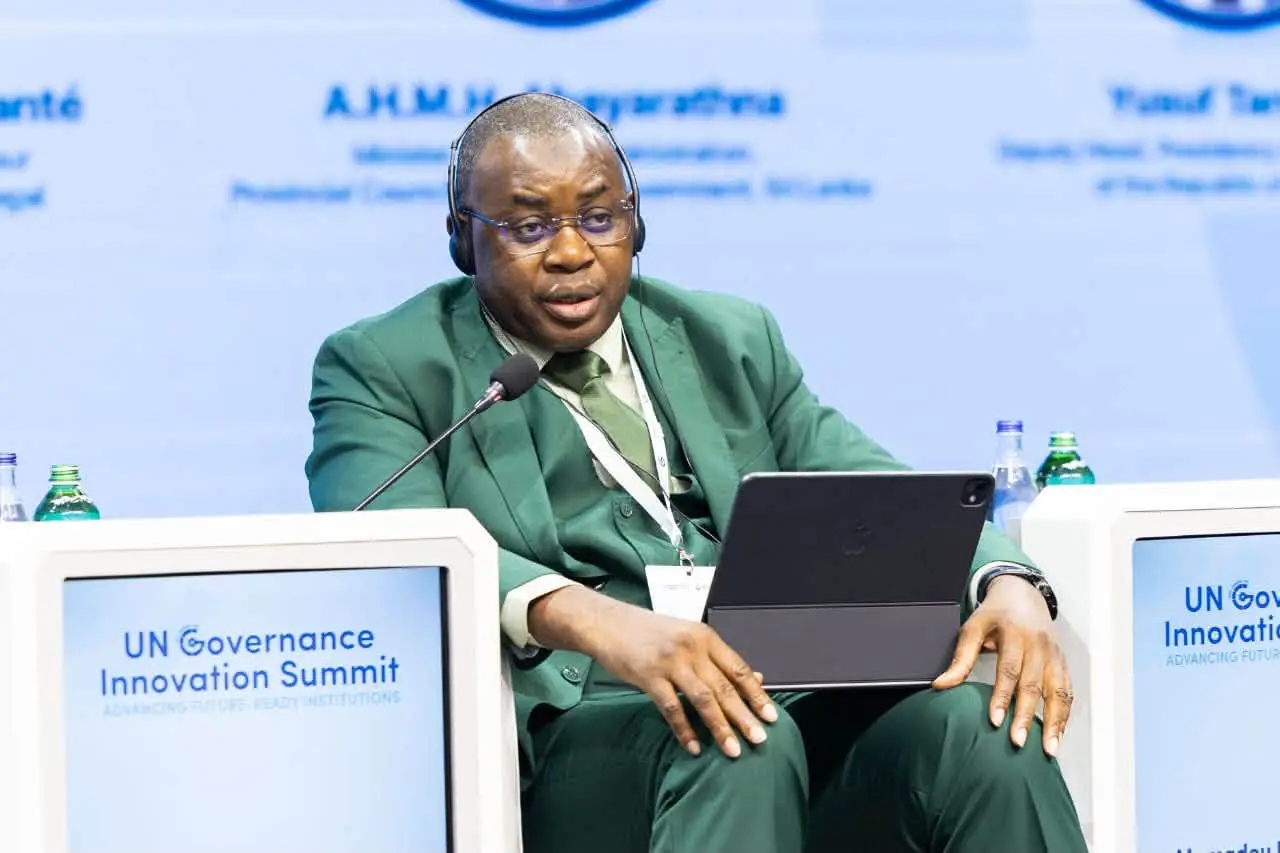
UN Baku Summit 2026: Senegal reaffirms its ambition for a citizen-centered public service
Senegal has renewed its desire to transform its Public Service, relying in particular on the sharing of experiences and the strengthening of partnerships. This was indicated by the Minister of Civil Service, Labor and Public Service Reform, Mamadou Lamine Dianté, during his participation in the United Nations Baku 2026 summit which is being held on November 5 and 6, 2026.
The Gulustan Palace in Baku, Republic of Azerbaijan hosted the ministerial round table dedicated to “The future of governance: vision, mission and transformation”, during the United Nations summit taking place on November 5-6, 2026.
Through its participation, Senegal has reaffirmed, according to the Ministry of Civil Service, Labor and Public Service Reform, its desire to transform its Public Service, relying in particular on the sharing of experiences and the strengthening of partnerships.
Representing Senegal at this meeting, the responsible minister, Mamadou Lamine Dianté, shared Senegal’s experience on the transformation of the Public Service, with particular emphasis on the compartmentalization of administrations and the complexity of procedures.
Also read: “We want a modern, efficient and user-centered public service”
The minister underlined the need to develop administrative practices, notably through the simplification of procedures and the strengthening of coordination between the different structures of the Administration.
“A strong conviction guided his intervention: it is not up to the citizen to adapt to the constraints of the Administration, but up to the Administration to organize itself to better respond to the needs of the citizen”; we read in the ministry’s text.
In this regard, he presented the National Public Service Transformation Agenda (ANTSP), a variation of Vision Senegal 2050 in the field of modernization of the Senegalese public administration, as the unifying framework for this transformation, based on collaboration between administrations, the culture of results and the continuous improvement of the quality of services provided to the populations.
Mariama DIEME
