
Space: NASA launches Roman, a new telescope to unravel the mysteries of the universe
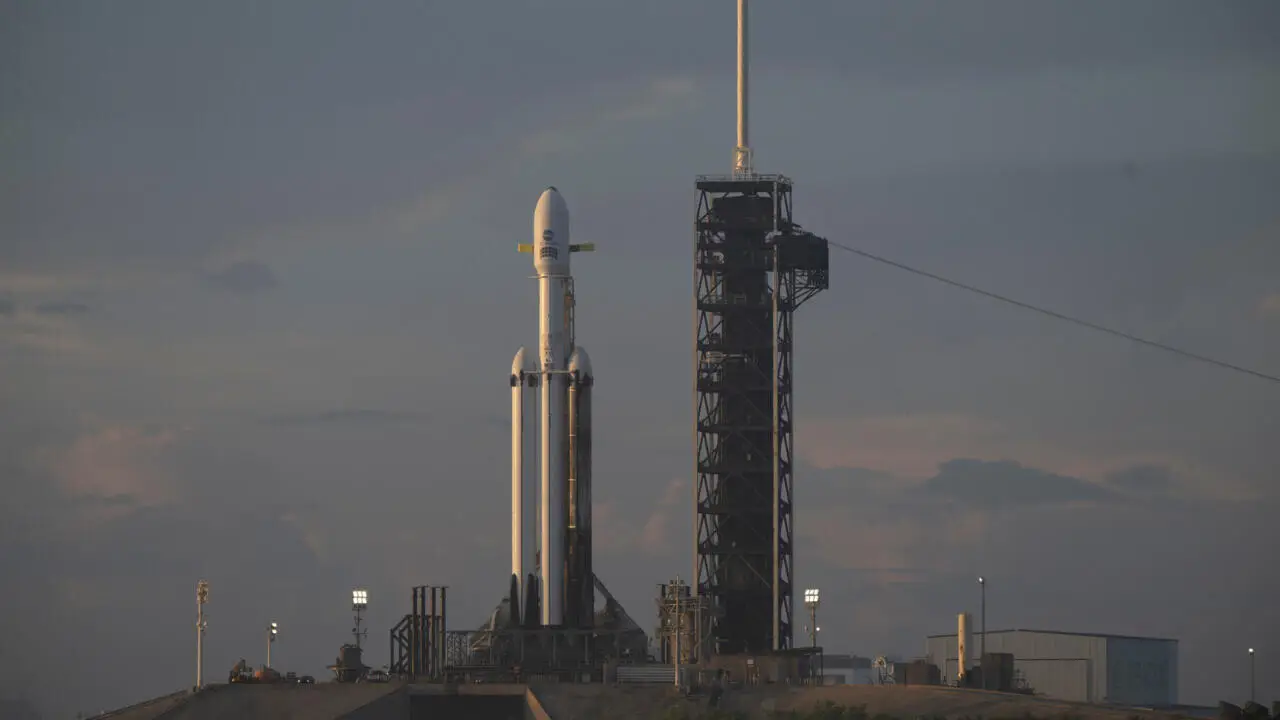
NASA took a major new step in space exploration on Sunday August 30 with the launch of the Nancy Grace Roman space telescope. The machine, designed to study the great mysteries of the Universe, took off aboard a SpaceX Falcon Heavy rocket from the Kennedy Space Center in Florida.
The launch took place at 7:26 a.m. local time (11:26 GMT) from Launch Complex 39A. Minutes after liftoff, ground teams began receiving the first telemetry data from the telescope. The separation between Roman and the rocket’s second stage occurred approximately 31 minutes after liftoff. The observatory’s solar panels were then successfully deployed.
A new window on the Universe
Named in honor of Nancy Grace Roman, NASA’s first chief astronomer and a major figure in the American space program, the new telescope is presented as one of the great astrophysical observatories of the next decade.
Roman combines particularly precise infrared vision with a field of view at least 100 times wider than that of the Hubble Space Telescope. This capacity should allow it to observe vast portions of the sky and map billions of galaxies.
One of the main objectives of the mission will be to better understand dark matter and dark energy, two still largely mysterious components of the Universe. Dark energy is believed to be at the origin of the accelerated expansion of the Universe, while dark matter, directly invisible, plays a major role in the formation and organization of galaxies.
Roman will also devote a significant part of his mission to the study of exoplanets, those planets that orbit stars other than the Sun. Thanks to its large-scale observations, the telescope should make it possible to establish a statistical census of numerous planetary systems and potentially identify hundreds of thousands of new exoplanets. It will also be able to study the environments in which planets form.
The observatory also has a coronagraph, an instrument designed to mask the light of a star in order to allow direct observation of planets surrounding it. This technology should notably contribute to the development of future instruments capable of searching for worlds comparable to Earth.
Three months of travel before the first scientific observations
After its launch, Roman begins a journey of approximately three months towards its final orbit, located around the second Sun-Earth Lagrange point, approximately one million miles from Earth, or nearly 1.5 million kilometers.
This period will be devoted to the deployment of several pieces of equipment, the calibration of instruments and a series of tests intended to verify the proper functioning of the observatory before the start of its scientific mission. NASA plans to release the first images of Roman in early 2027.
The new telescope is also expected to change the scale of astronomical data collection. According to NASA, Roman will be able to transmit up to 1.4 terabytes of data per day, the highest data rate ever planned for an astrophysics mission of the American agency.
To exploit this mass of information, scientists will be able to rely on artificial intelligence, machine learning and the participation of citizen scientists to identify observations of particular interest. With a primary scientific mission planned for five years, Roman must offer astronomers a panoramic and deep view of the cosmos.
