
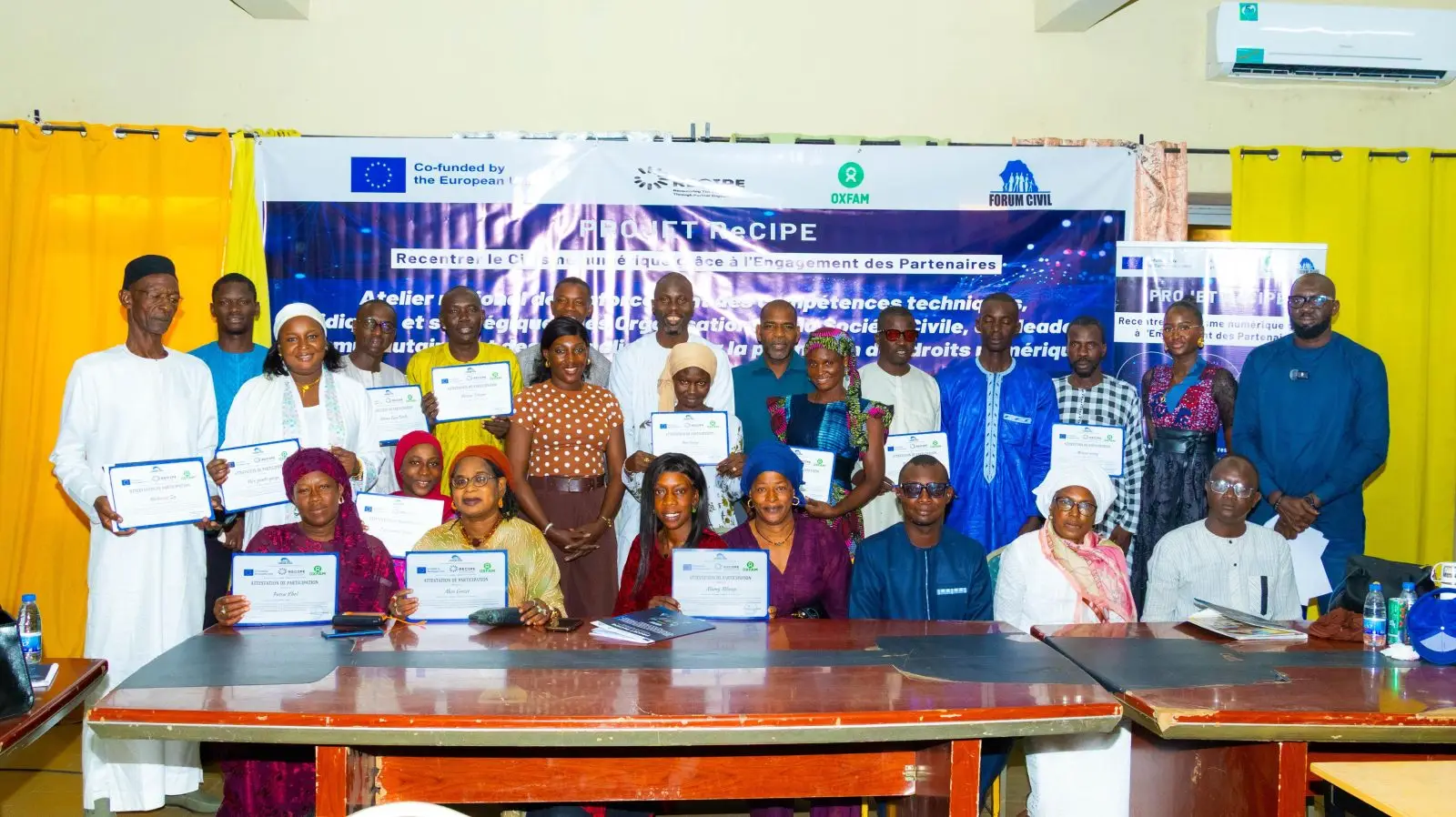
Saint-Louis: The Civil Forum mobilizes stakeholders around digital rights
The Civil Forum organized this weekend in Saint-Louis a regional capacity-building workshop for young people, civil society organizations, community leaders and journalists on digital rights. An initiative aimed at better preventing online violence, protecting personal data and facilitating victim care. Faced with the risks linked to the use of digital platforms, the Civil Forum intends to strengthen the capacities of local actors.
In Saint-Louis, this meeting is part of the ReCIPE project, “Refocusing digital citizenship through partner engagement”, funded by the European Union through Oxfam Ireland. According to Ibrahima Ndaw, project manager at Forum Civil and coordinator of ReCIPE, this initiative supports the popularization of the New Technological Deal and the Senegal 2050 vision, particularly on issues of data governance and dematerialization of public services.
“The objective of this workshop is to share with young people, civil society organizations, community leaders and journalists the challenges of the Technological New Deal,” he explained. The program also addresses fact-checking, disinformation, the protection of journalistic sources and mechanisms for preventing digital violence.
For Mohamed Lamine Tall, regional coordinator of the Civil Forum in Saint-Louis, the challenge is to reposition civil society organizations as accessible interlocutors for victims. “What emerged from our surveys is that young people and civil society organizations do not tend to turn to these structures when they experience digital violence,” he underlined.
For equitable access to the Internet
Capacity building focuses on digital security, digital rights and the legal skills needed to support victims. A mapping of support structures was also carried out in the municipalities of Saint-Louis and Gandiol.
It makes it possible to identify the competent organizations, their managers and the available remedies. AEMO is among the structures cited by Mohamed Lamine Tall.
The project also promoted dialogue between the State, civil society and the private sector on digital governance and Internet access. A study on digital regional planning was commissioned to assess accessibility and connection infrastructure, particularly in border areas.
“In the same way as citizens who have access to the Internet in Dakar, those of Fongolémi, Matam or Agnam must also have access to the Internet,” insisted Ibrahima Ndaw. After Kaolack and Saint-Louis, the Civil Forum plans to continue its activities in Dakar and Bignona, with the ambition of promoting a safer and more inclusive digital space.
